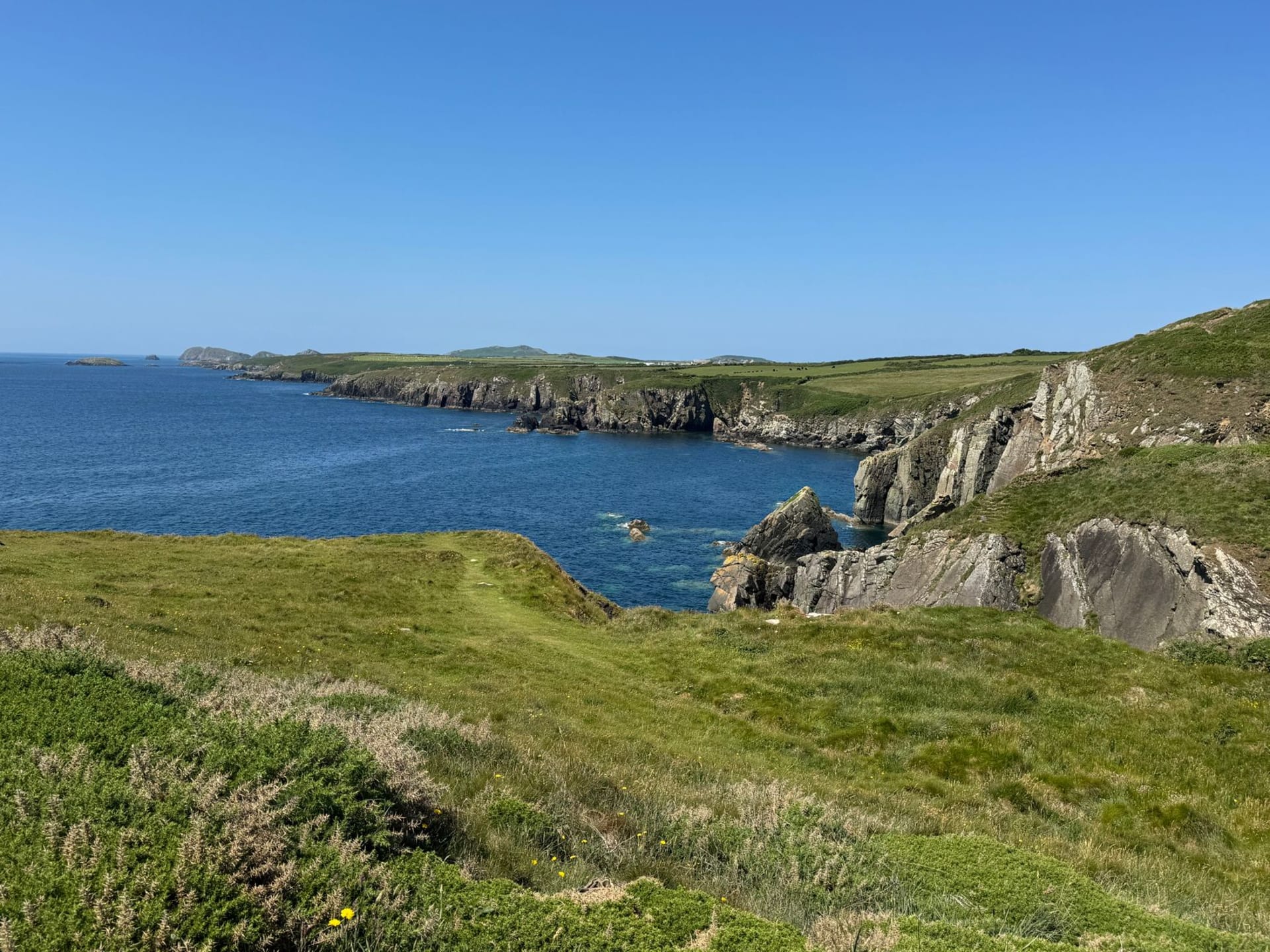
Pembrokeshire Coast
"Pembrokeshire is the coast that Wales keeps for when the rest of the world feels too loud."
Wales' only coastal national park serves 186 miles of clifftop paths, hidden coves, and an Atlantic light that turns the sea fifty shades of blue.
I came to Pembrokeshire expecting grey. That is what the Atlantic tends to offer in October — a uniform ceiling of cloud and a sea the colour of old pewter. What I found instead was light that moved like something alive, shifting the water from slate to jade to a deep, unsettling cobalt within the span of a single hour. I stood on the cliffs above St Govan’s Chapel and watched it happen, and I understood immediately why painters have been coming here for centuries and still running out of colours.
The Path and What It Takes From You
The Pembrokeshire Coast Path runs for 186 miles between St Dogmaels in the north and Amroth in the south, and the section between Marloes and Dale reduced my legs to something unreliable by mid-afternoon. The path dips and climbs without apology — down into every cove, up every headland — and the cumulative effort is a kind of meditation you don’t request. Lia, who has a better relationship with uphills than I do, pulled ahead somewhere near the stacks at St Bride’s Haven and waited on a boulder, eating the last of a Caerphilly wedge we’d bought that morning from a woman in Haverfordwest market who had wrapped it in brown paper as though it was something precious. It was.
Caves, Chapels, and Small Astonishments
St Govan’s Chapel sits at the bottom of a limestone cleft, wedged between the cliff face and the sea as though someone needed somewhere to pray urgently and worked with what was available. The steps down to it are uneven and worn, and the chapel itself is barely larger than a generous wardrobe. What surprised me entirely was the sound — or the absence of it. The Atlantic hammered the rocks fifty metres away and yet inside the chapel the air was still and close and smelled of stone that had been damp for a very long time. I had not expected to feel anything in particular. I sat down and stayed longer than I planned.
The blowholes at Huntsman’s Leap, a little further along the same stretch of coast, offered the opposite sensation: the ground beneath your feet shuddering with every wave, a fissure dropping sheer to churned white water, the whole landscape insisting that it is indifferent to you in the most exhilarating possible way.
What to Eat, Where to Sit Still
In St Davids — the smallest city in Britain, barely a village in scale — the Old Cross Hotel on Cross Square serves a cawl that arrives in a clay pot with bread that has clearly been made the same morning. Lamb, leeks, root vegetables, a broth that tastes like someone’s grandmother made a decision decades ago and has not deviated since. We ate it after a wet morning on the headland and it was exactly what the body had been asking for without knowing the word.
When to go: May and June offer the best balance — the coast path is dry enough to be enjoyable, the Atlantic is still cold and dramatic, and the puffin colonies on Skomer Island are at their most active. September works almost as well, with fewer walkers and a golden quality to the late light that the summer crowds never quite get to see.