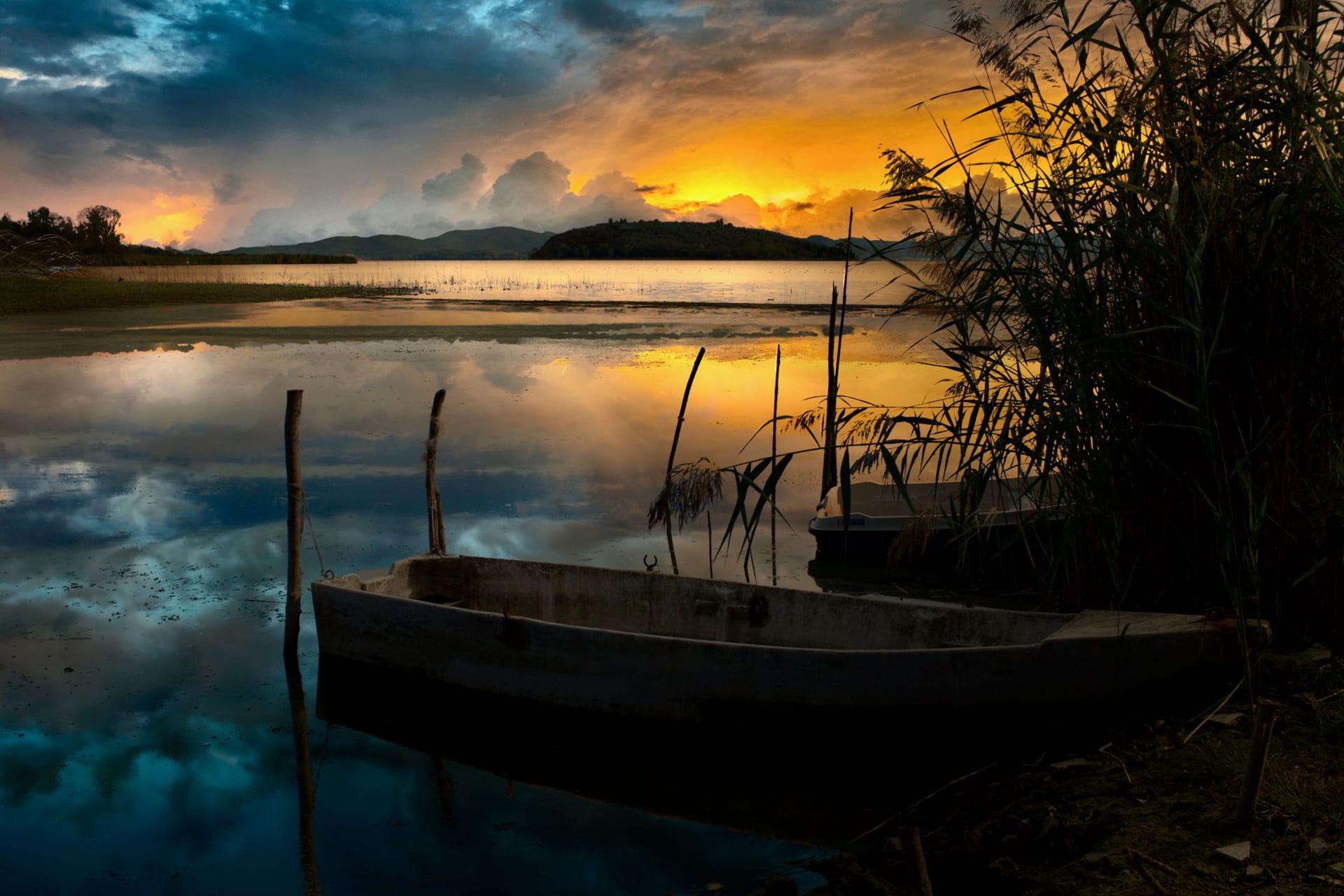
Lago Trasimeno surprised me by being exactly what I needed and nothing more than that. It’s not dramatic — shallow at most six meters deep, ringed by low hills rather than mountains, the water a grey-green that changes with the sky in ways that can be subtle to the point of frustrating. But it has the unhurried quality of places that never made the first tier of the tourist circuit and have consequently remained themselves. I rented a bicycle in Castiglione del Lago on a Thursday and rode around the western shore for most of the day with nothing particular scheduled.
The Battle That Haunts the Shore
In 217 BC, Hannibal ambushed a Roman army of 30,000 men on these northern shores, killing most of them in one morning. The geography explains how: the lake on one side, hills on the other, morning mist filling the valley. The Museo di Annibale in Tuoro sul Trasimeno documents this with archaeological fastidiousness — weapons, armor fragments, the sheer logistical audacity of the engagement. The towns around the lake still carry names that echo it: Sanguineto, Blood Field; Ossaia, place of bones. History with that kind of specificity makes a landscape feel inhabited differently.
The Three Islands
Three islands dot the lake — Maggiore, Minore, and Polvese — reachable by ferry from Castiglione and Passignano. Maggiore is the only inhabited one, with a small village and the Castello dei Marchesi Guglielmi whose towers you can see from the ferry. Polvese is an uninhabited nature reserve with an abandoned monastery and walking paths through Mediterranean scrub; the ferry drops visitors for the day and collects them in the afternoon. I spent three hours on Polvese in October — a picnic, a walk to the ruined monastery on the far end, the silence of an island that no one has found a use for. The lake was completely calm. A heron stood in the shallows without moving for twenty minutes.
Castiglione del Lago and the Local Fish
The western promontory town of Castiglione has the best preserved Rocca and the most functional waterfront. The lake’s traditional fishing culture — carp, tench, perch, the extraordinary regina in porchetta (carp baked with fennel and herbs, ancient recipe, genuinely delicious) — survives in the restaurants along the shore. I was skeptical about inland lake fish and then ate the carp and revised my position. The Colli del Trasimeno DOC produces wine from both banks that drinks young and pairs predictably with the lake-centric menu.
Passignano and the Evening Light
On the northeastern shore, Passignano sul Trasimeno has a medieval tower and a waterfront promenade where the evening passeggiata happens with the lake turning pink behind it. I arrived by the afternoon ferry from the island and walked along the shore until the light changed, which took longer than expected. Lia had found a bar with an actual view of the water — this turns out to be rarer than you’d imagine, given that the lake is right there — and we stayed until dark, watching the fishing boats come in and the families walk the lungofiume in the last of the light.
When to go: May through September for lake swimming and ferry service to the islands. June and early July are ideal — warm enough to swim, not yet August-crowded. The lake’s colors are best in October when the surrounding olives go grey-silver and the water picks up the autumn sky. Avoid August weekends when Perugia and Florence send everyone this direction.