Sharjah is the Emirates’ answer to the question of what happens when oil wealth funds culture instead of spectacle, and the answer turns out to be one of the more interesting experiments in the Middle East. Named UNESCO’s Cultural Capital of the Arab World, the emirate has invested in museums with the same fervor Dubai invests in towers. The results are quieter but, I would argue, more durable.
The Sharjah Museum of Islamic Civilization houses one of the finest collections of Islamic art, science, and calligraphy in the Gulf. The galleries explaining the mathematical genius behind arabesque patterns changed how I see geometry entirely — the idea that these patterns are not decorative but mathematical, that they represent infinity made visible, stayed with me for weeks. The astronomical instruments alone are worth the visit: astrolabes and celestial globes from centuries when the Islamic world was the center of scientific inquiry.
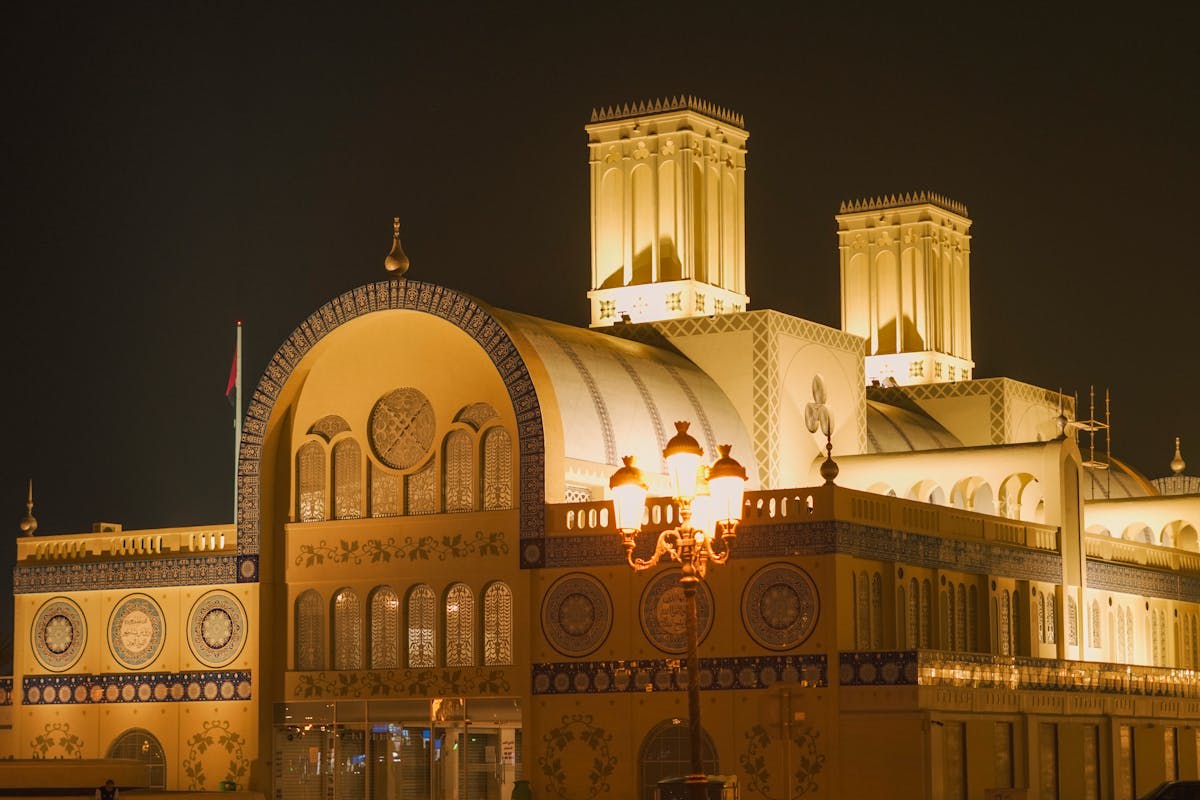
The Heart of Sharjah restoration project is the city’s most ambitious cultural gesture — transforming the old city center into a pedestrian heritage district of coral-stone buildings, traditional souks, and art spaces. Walking through it in the evening, when the light is low and the restored buildings glow against the darkening sky, you get a sense of what Gulf cities felt like before the oil boom: compact, mercantile, built for shade and conversation.
The Sharjah Art Foundation hosts a biennial that draws international attention, its exhibitions spread across restored courtyards and purpose-built galleries. I wandered into an installation by a Bahraini artist that used sound and salt to evoke the Gulf’s pearl-diving history, and it was the kind of art that only makes sense in the place where it was made. The Blue Souk — formally the Central Market — is an architectural landmark selling carpets, jewelry, and perfumes. The carpet dealers here have the encyclopedic knowledge of people who have spent decades handling textiles, and a conversation about a Baluch kilim can last an hour if you let it.
Sharjah is dry — no alcohol is served anywhere in the emirate — which keeps the atmosphere family-oriented and the evenings tranquil in a way that feels refreshing after Dubai’s relentless nightlife marketing. The literary festival, held annually, draws Arabic and international authors, and the bookshops here stock titles you will not find in the rest of the UAE.
When to go: November to March for cool evenings perfect for exploring heritage districts on foot. The Sharjah Light Festival in February illuminates historic buildings with spectacular projections. Friday mornings are best for the traditional markets.