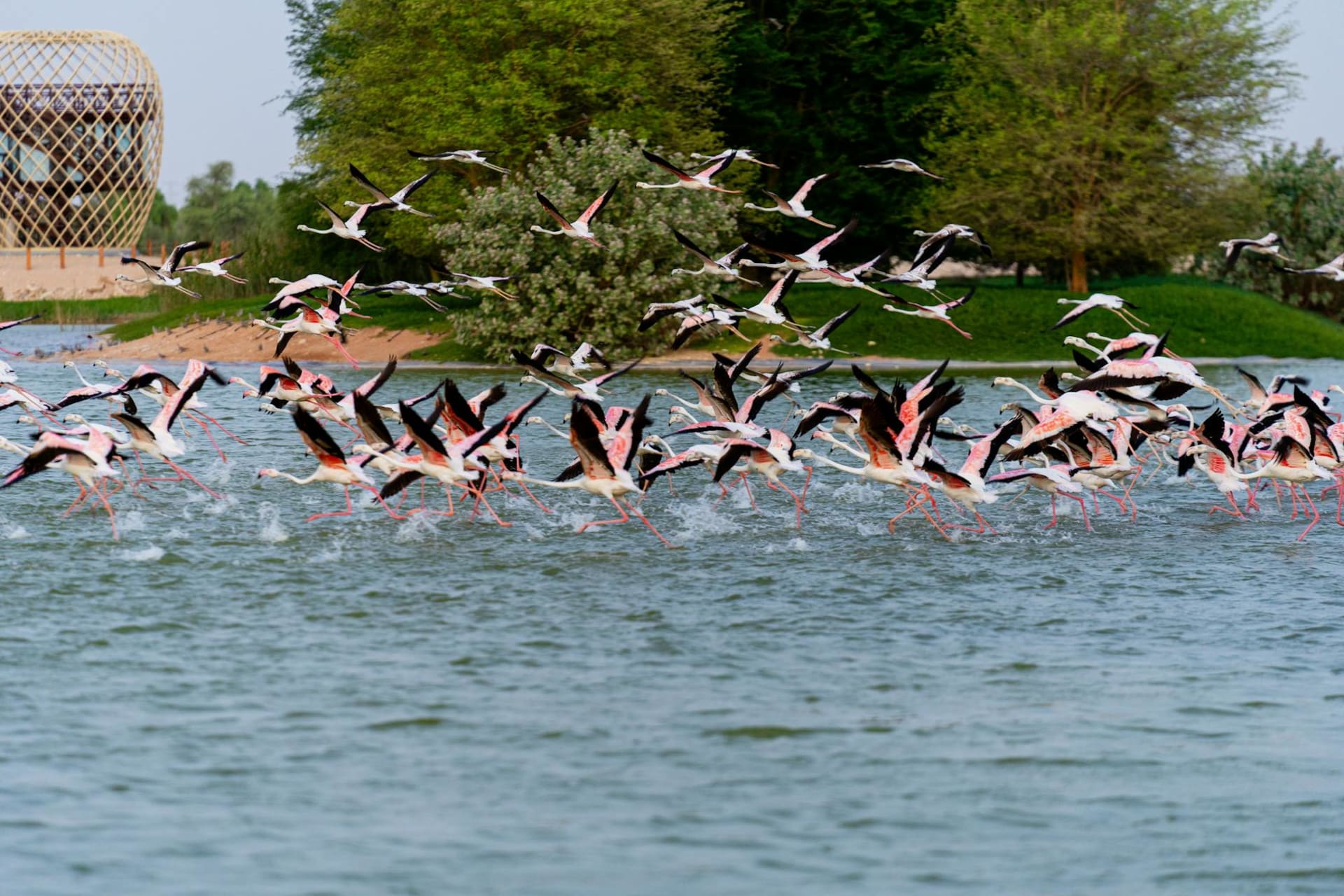
A surprising flamingo sanctuary in the Abu Dhabi desert, pink flocks wading in brackish shallows.
Nobody told me Abu Dhabi had flamingos. I had come expecting marble lobbies and the particular exhaustion of places that have decided to become spectacular at any cost. What I found, thirty kilometres east of the Corniche along the Al Ain Road, was a salt flat trembling with pink.
The Reserve at Dawn
We arrived before seven, when the light still carries that thin, almost apologetic quality — not yet the blade it becomes by midmorning. The Al Wathba Wetland Reserve sits in a shallow depression of the desert, its brackish lagoons fed by treated wastewater from surrounding developments, a fact that sounds ugly until you are standing at the edge of a boardwalk watching six hundred greater flamingos (Phoenicopterus roseus) pivot in slow unison like a single pink thought. The smell is mineral and faintly saline, a low-tide smell with no tide.
The boardwalk stretches roughly two kilometres around the main lagoon, and the flamingos do not flee. They tolerate observation with the serene indifference of creatures that have decided humans are simply part of the landscape. I watched one stand on a single leg for so long I began to feel personally challenged.
What Stopped Me Cold
Lia spotted them first — a cluster of lesser flamingos near the northern shore, darker and more saturated than the greater birds, almost the colour of a wine stain. I had not known two species could share the same shallows so completely, each filtering the water at a slightly different depth, each bent to a different frequency of what the place offers. The reserve also shelters herons, cormorants, and a population of Arabian spiny-tailed lizards that sun themselves on the flat rocks near the entrance with complete shamelessness.
But the flamingos are the revelation. There is something genuinely disorienting about finding biological abundance in a landscape the city treats as pure margin — the desert as afterthought, the wetland as accident. It reminded me that ecosystems are not impressed by real estate valuations.
Getting There and Moving Through It
Entry is free, and the reserve opens daily from 8 a.m. (7 a.m. on weekends). The car park off Al Wathba South Road is small but rarely full on weekday mornings. There is no café, no gift shop — just the birds and the flat light and the distant silhouette of Abu Dhabi’s towers shimmering in the haze like a mirage of themselves. I brought water and was glad I did.
When to go: November through March is the main flamingo season, when migrating birds swell the resident population and temperatures stay manageable. Arrive at opening time to catch the birds active and the light soft before the desert asserts itself.