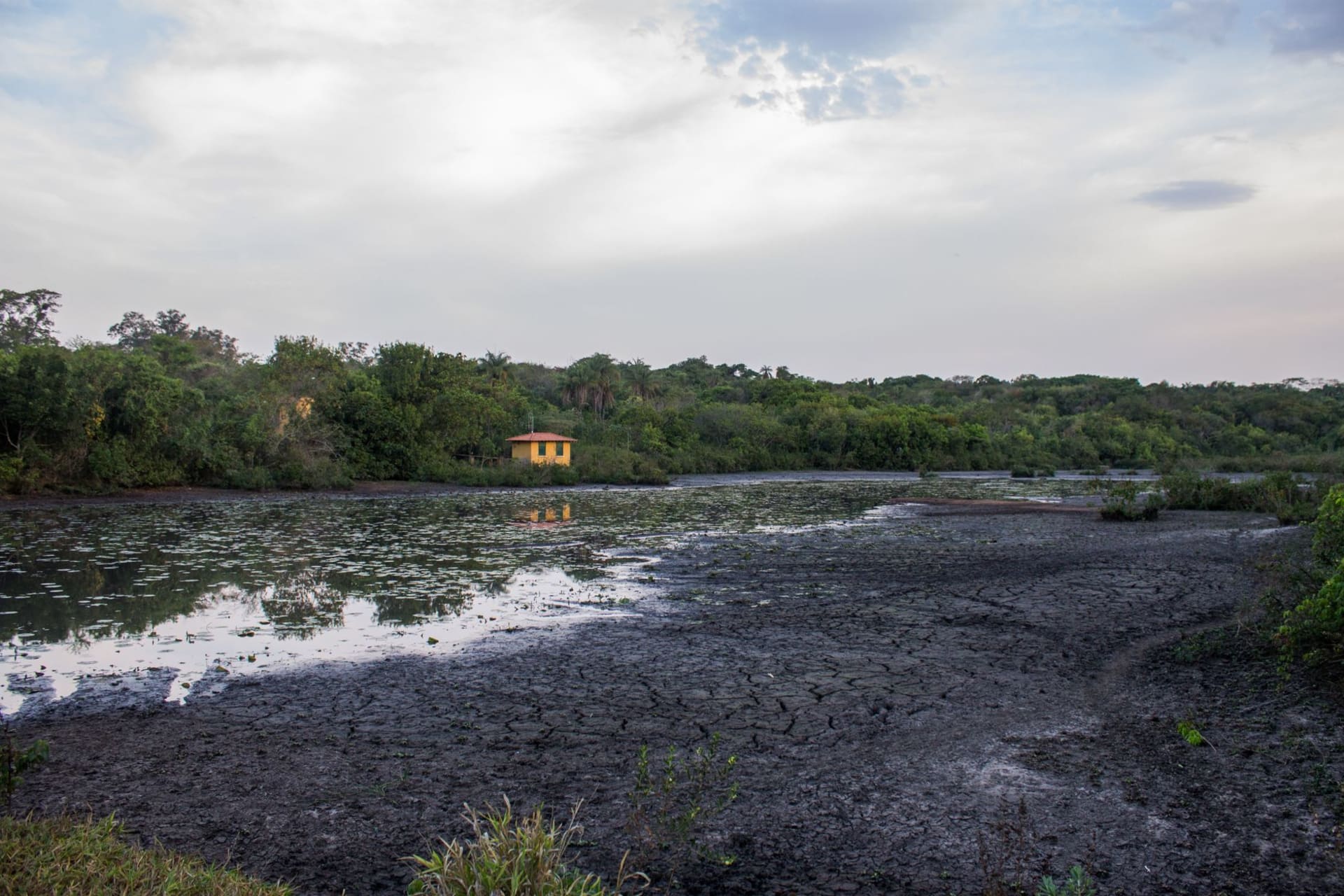
Pitch Lake
"I expected industrial wasteland. I got something stranger and more beautiful."
Pitch Lake is a hard sell on paper. “Come look at the world’s largest natural deposit of asphalt” is not a sentence that typically generates excitement. I almost skipped it. I am glad I did not, because La Brea’s tar lake is one of the genuinely uncanny places I’ve stood on this planet, and strange in ways that photographs don’t capture.
What It Actually Is
The lake covers about 40 hectares and contains an estimated 10 million tonnes of bitumen, continuously replenished from deep geological fissures where oil seeps up and loses its lighter fractions as it interacts with the surface environment. The surface is mostly firm enough to walk on — but with variation. Some sections feel like thick rubber underfoot, giving slightly with each step. Others are paper-thin crusted surfaces over soft material that will take your foot if you choose wrong. The guide I hired, a man who’d been walking it for fifteen years, seemed to know by some sense I don’t possess exactly where to step.
The Surface World
What looks from a distance like a featureless dark expanse turns out, up close, to be a landscape of considerable complexity. There are pools of warm sulfurous water caught in depressions, ringed by crystals of sulfur that have precipitated out. There are cracks where vegetation has pushed through — grasses, even small trees rooted in the few centimeters of soil that accumulate in surface depressions. There are slicks of iridescent oil on the standing water. There are places where the pitch has convected into strange shapes, almost like the surface of cooling lava.
I found an ancient tree trunk half-buried in the center section — it had been incorporated into the lake over decades, and my guide said this happened regularly, that the surface moved slowly but constantly, carrying whatever happened to be on it. Prehistoric animals have been found preserved in the depths: mastodons, giant ground sloths, glyptodonts. This felt relevant to where I was standing.
The Workers
Asphalt is still actively extracted from Pitch Lake for road construction throughout the Caribbean, and on workdays you’ll see workers moving across the surface with tools that look unchanged from the nineteenth century. Walter Raleigh stopped here in 1595 to caulk his ships with the stuff; the pitch has been useful to humans for a very long time. Watching someone hoe up a load of fresh warm bitumen from an active area of the lake — it comes up glossy and pliant, like very dark taffy — is a strange collision of industrial process and geological spectacle.
The Sulfur Springs
Around the edges of the main lake, there are pools of warm water where sulfur compounds have created a particular chemistry — low pH, high mineral content, warm from geothermal activity. Locals have bathed in these for generations, citing skin benefits with the confidence of people who have their own empirical data. I didn’t wade in, but I leaned over one pool long enough to smell the distinct rotten-egg signature of hydrogen sulfide and watch small organisms moving in what should not, by any right, be a hospitable environment.
Getting There
La Brea is in southwestern Trinidad, about an hour and a half from Port of Spain. Most visitors combine it with the Moruga coast or make a day trip. The visitor center at the lake entrance runs guided tours; do not attempt to explore the interior sections without a guide — the thin-crust zones are genuinely hazardous to anyone who doesn’t know the lake’s current state.
When to go: Pitch Lake is accessible year-round and doesn’t change dramatically with season. Go in the morning before the heat builds — the dark surface absorbs and radiates considerable warmth by midday. Dry season (January–May) means better road conditions for the drive.