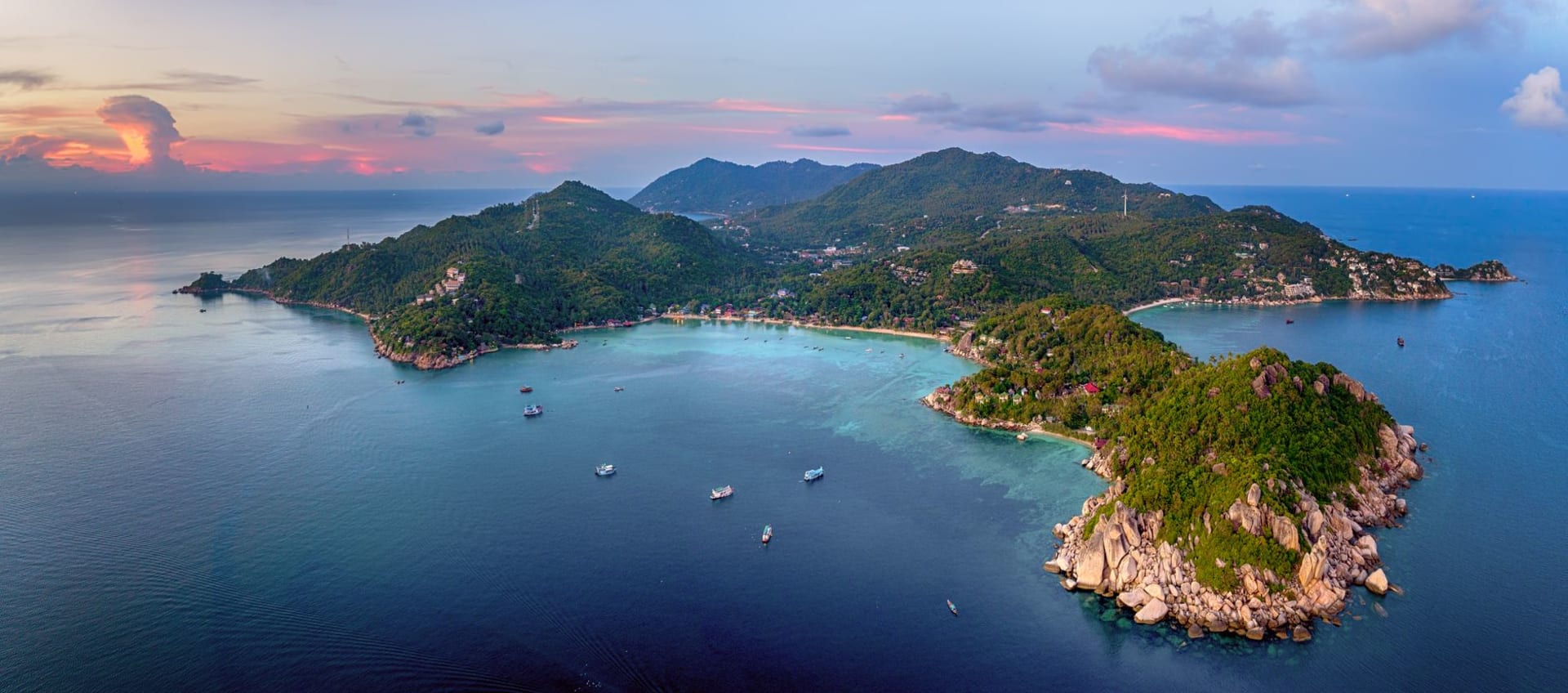
Koh Tao
"Koh Tao turns complete beginners into underwater converts in a single morning below the surface."
The world's most-dived island, where beginners earn their PADI cert in warm, clear Gulf waters.
I had zero interest in diving. Lia had been trying to talk me into a PADI course for two years, and I had spent two years producing reasonable excuses — ears, pressure, the general unpleasantness of breathing through a tube. Then we arrived at Sairee Beach on a Tuesday evening and I had run out of excuses by Wednesday noon.
First Descent at Shark Bay
The school we chose, Crystal Dive on the main strip, starts beginners in the confined water of their pool before anything else. I appreciated that — the ritual of it, the slow escalation. By the second morning we were on a longtail headed south to Shark Bay, which sounds terrifying and is actually a shallow, sheltered cove where blacktip reef sharks idle in the sandy shallows like they are waiting for a bus. My instructor held two fingers in front of my mask: two metres, that’s all. I nodded inside my mask and went under.
What no one had warned me about was the silence. Not absence-of-sound silence, but a deep, pressurized quiet that sits against the ears like cupped hands. The coral below Shark Bay is not the most dramatic on the island — Chumphon Pinnacle holds that title, a granite seamount crawling with giant grouper and the occasional whaleshark — but for a first descent it was exactly sufficient. A school of yellowtail barracuda turned as a single silver sheet. I watched them and forgot entirely that I was breathing through a tube.
The Unexpected Detail: Mae Haad Pier at Low Tide
The part I had not expected was the island above the water. Koh Tao’s interior is steeper and more overgrown than the dive-school reputation suggests. One afternoon, after a morning dive, Lia and I walked the dirt path behind Mae Haad village past a small temple where orange-robed monks were folding laundry in the shade of a frangipani. The smell of incense mixed with the salt smell still in my hair. At low tide, the sandspit between Mae Haad and the tiny islet of Koh Nang Yuan is just barely walkable, and we crossed it in ankle-deep water while the longtails revved in the distance.
Eating on Sairee
At night, Sairee Beach Road becomes a long corridor of grilled fish smoke and competing speaker systems. We ate pad krapao moo — minced pork with holy basil and a fried egg — at a plastic-table place near the 7-Eleven every single night except one, when we splurged on a whole grilled barramundi at a beach restaurant called Farango. The fish arrived with lime and fish sauce and a chili-mango salad so sharp it made Lia’s eyes water. She asked for a second portion anyway.
When to go: The Gulf of Thailand coast has two seasons — the dry season runs roughly December through April, when visibility underwater can reach thirty metres and the sea is glassy calm. Avoid October and November, when short but heavy squalls can ground the dive boats for days at a time.