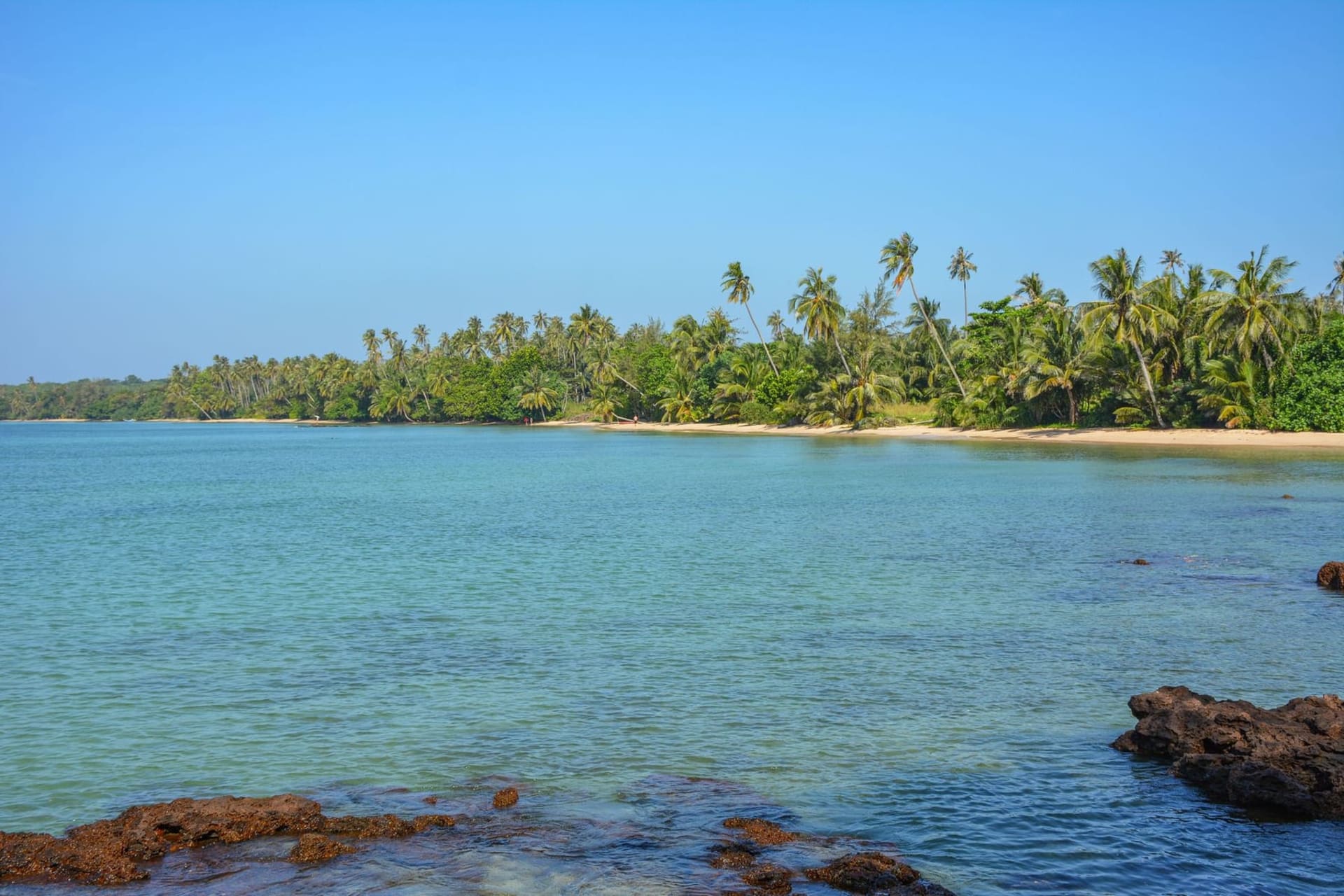
Thailand's fourth-largest island in the Gulf, with waterfalls, fishing villages and turquoise water almost untouched by resorts.
We came to Koh Kood because Lia had read something vague about it being the island that didn’t make the brochures. That turned out to be exactly right. The ferry from Laem Sok dropped us at a concrete pier with no tuk-tuks waiting, no hawkers with laminated menus, no one at all except a teenage boy on a motorbike who drove our bags to the guesthouse on the back of a wooden trailer without a word.
The Water Off Ao Phrao Beach
The color of the sea on the western shore is not something I can adequately describe in French or in English. At Ao Phrao, the water shifts from pale jade to deep teal within fifty meters of the shore, so clear that I could see individual grains of sand moving under the current at three meters’ depth. There was no beach bar. There was a plastic chair someone had forgotten and a coconut palm leaning low enough over the water that you could sit on the trunk like a bench. I sat there for an hour doing nothing, which is harder than it sounds.
The island sits near the Cambodian maritime border and the Gulf currents bring a different quality of water than the Andaman — warmer, glassier, with almost no wave. On calm mornings the surface looks poured.
Nam Tok Klong Chao and the Fishing Villages
The interior of the island surprised me more than the coast. A dirt road from Ban Khlong Mat — one of the island’s handful of fishing settlements, built on stilts above tidal mudflats — leads inland through rubber plantations to Nam Tok Klong Chao, the largest waterfall. I expected a tourist attraction. What I found was a wide cascade over grey granite slabs, a freshwater pool the temperature of bathwater, and exactly four other people. A monk was meditating on a rock at the edge of the falls. I felt like an intruder and waded in anyway.
Ban Ao Salad on the north shore is where the fishing boats go out each morning before five. Walking through it in the early dark, I smelled charcoal and shrimp paste and diesel, and watched men load plastic crates of ice with the efficient silence of people who have done the same thing every morning for decades. Nobody sells anything here. Nobody smiles for tourists. It felt honest in a way that the curated fishing villages on the bigger islands no longer do.
What Koh Kood Still Refuses to Become
There are no 7-Elevens on Koh Kood. No franchise anything. The electricity runs on a single generator that covers the main road corridor; beyond it, guesthouses run on solar and the nights are genuinely dark. The restaurants are mostly single-family operations — a grandmother’s kitchen extended onto a wooden terrace over the sea, with the menu written on a chalkboard that changes depending on what came off the boats. I ate pla kapong neung manao — whole sea bass steamed with lime and chilli — three times in five days because every version was different and every version was remarkable.
The island will not stay like this forever. The speedboats from Trat are getting faster, the boutique resorts are arriving. But right now, in the long afternoons when the generator hum fades and the jungle sounds take over, it is possible to feel that you have arrived somewhere before it became a destination.
When to go: November through April, when the Gulf of Thailand is calm and the skies are clear. Avoid the May to October monsoon season — access is frequently cut off and the sea turns brown.