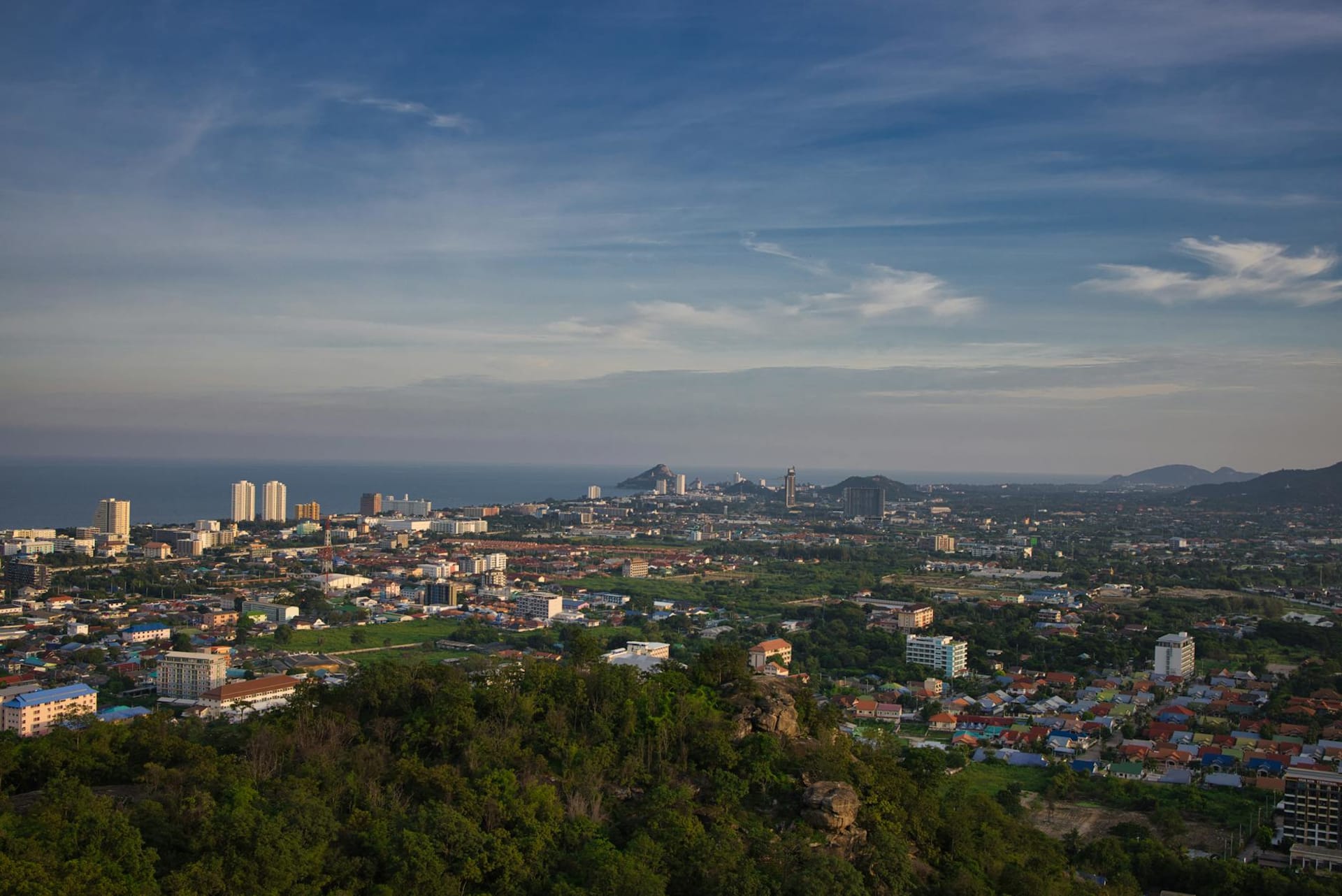
Hua Hin
"Hua Hin perfected the beach town long before the backpackers arrived, and it still does it better."
Thailand's oldest beach resort, beloved by royals, with night markets stretching to the sea.
There is something quietly convincing about a town that has been doing the same thing for a hundred years and never felt the need to explain itself. Hua Hin is like that. The royal family built their summer palace, Klai Kangwon, here in 1926 — the name means “far from worries” — and the rest of Thailand eventually followed. Not the backpackers chasing full-moon chaos, not the resort developers paving over every strip of coast. Just the Thais themselves, arriving by train from Bangkok for the weekend, eating grilled squid at the night market, riding horses along the tide line in the early morning light.
The Night Market on Dechanuchit Road
We arrived on the evening train, which deposits you at what might be the most charming station in Southeast Asia — a low red-roofed building with royal waiting rooms painted yellow and green, built in 1967 and seemingly untouched since. From there, fifteen minutes on foot takes you to Dechanuchit Road, where the night market assembles itself every evening with the unhurried confidence of something that has no competition. Lia found the mango sticky rice first, the vendor pressing each portion into a banana leaf with a small flat paddle. I stood at a charcoal grill watching a man in a paper apron rotate skewers of pork neck over coals that glowed orange in the sea breeze. The smell — charred fat, lemongrass smoke, the faint brine coming off the Gulf — is one I keep returning to in memory.
What the Daylight Hours Hold
The beach itself runs long and gentle, the sand pale and fine enough to squeak underfoot. In the mornings it belongs to the horses — actual horses, led by local handlers along the surf — and to elderly Thai couples doing tai chi near the pier. By ten the parasols are out and the vendors are moving through with fresh-cut watermelon in plastic bags. I spent one afternoon at Cicada Market, an open-air design fair near the Mrigadayavan Palace road, where I did not expect to find anything worth stopping for and instead ended up in a long conversation with a ceramicist from Chiang Mai about the particular shade of celadon glaze her grandmother used.
The Unexpected Discovery
What genuinely surprised me was the food at Chat Chai Market, the covered wet market near the clock tower on Phetkasem Road. I had gone looking for coffee and found instead a row of women making kanom krok — coconut rice pancakes — in cast-iron molds over small fires, each one barely larger than a bottle cap, sweet on the outside and custardy within. I ate eight of them standing up, in the humid morning light filtering through the corrugated roof.
When to go: November through February brings dry, breezy weather and temperatures that make long evenings on the beach genuinely comfortable. Avoid the shoulder months of September and October when the Gulf side turns wet and the market vendors thin out.