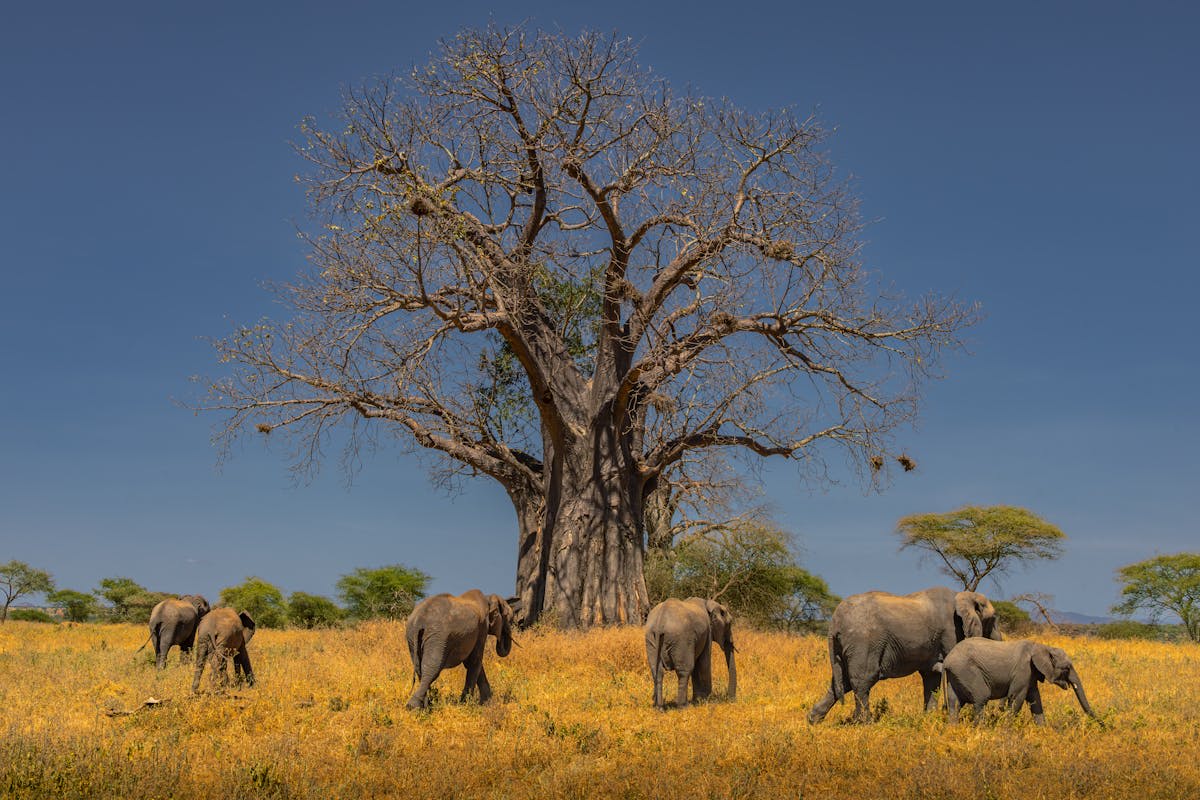
There is a stillness in Tarangire that the more famous parks of northern Tanzania cannot replicate. It settles over the landscape like heat shimmer, broken only by the low rumble of an elephant matriarch calling her family to water. This is a park that rewards the patient traveler, the one willing to linger beneath a baobab whose trunk has been swelling since before the Portuguese arrived on the Swahili coast, and simply watch the theatre of the dry season unfold.
The baobab trees are the first thing you notice, and the last thing you forget. They dominate the skyline with a persistence that borders on the mythic — trunks six meters across, bark smooth and silver as old pewter, branches twisted upward like roots clawing at the sky. The Maasai say the gods planted them upside down in a fit of anger. Standing beneath one at dusk, watching its silhouette blacken against a copper horizon, you are inclined to believe it. Some of these trees are over a thousand years old. They have watched civilizations rise and crumble. They will be here long after the last Land Cruiser has rusted to dust.
But it is the elephants that make Tarangire extraordinary. The park holds the largest concentration of elephants in Tanzania — an estimated 3,000 during the dry months — and when the Tarangire River shrinks to a ribbon of brown water threading through sand, they come in herds of two hundred, three hundred, sometimes more. The riverbanks become a parliament of grey bodies, trunks dipping and spraying, calves stumbling between the legs of their mothers. There is no fence, no boundary, no artifice. Just water and need and the ancient covenant between a river and the creatures it sustains.
The drama extends beyond elephants. Tarangire’s tree-climbing lions have developed the rare habit of draping themselves across the horizontal boughs of sausage trees and large acacias, a behavior shared with only a handful of populations across Africa. Theories vary — escaping tsetse flies, cooling off, gaining a better vantage — but the sight of a full-maned male sprawled along a branch ten meters above the ground defies easy explanation. It simply looks like a lion who has decided that the rules do not apply to him.
The park’s pythons, coiled in the hollows of baobabs, are another quiet spectacle. African rock pythons of four meters and more make their homes in the ancient trunks, emerging to hunt hyraxes and young impala. And the birdlife is staggering — over 550 species recorded, from the endemic ashy starling to lilac-breasted rollers that ignite from fence posts in bursts of turquoise and violet. Yellow-collared lovebirds chatter in the acacias. Kori bustards stalk the grasslands with the dignified gait of Victorian gentlemen. For birders, Tarangire is not a sideshow to the Serengeti. It is the main event.
What elevates all of this is the solitude. Tarangire receives a fraction of the visitors that pour into the Serengeti and Ngorongoro, and on a morning game drive you may find yourself the only vehicle at a waterhole where fifty elephants are drinking. The silence is not empty — it is full of birdsong, of the crack of branches, of the distant whoop of a hyena — but it is yours. In a country where the most famous parks can feel like rush hour, Tarangire offers the increasingly rare gift of wilderness experienced without an audience.
When to go: June to October for peak dry season, when the river contracts and elephant concentrations are at their greatest. November to May brings lush green landscapes and exceptional birding, though wildlife disperses across a wider range.