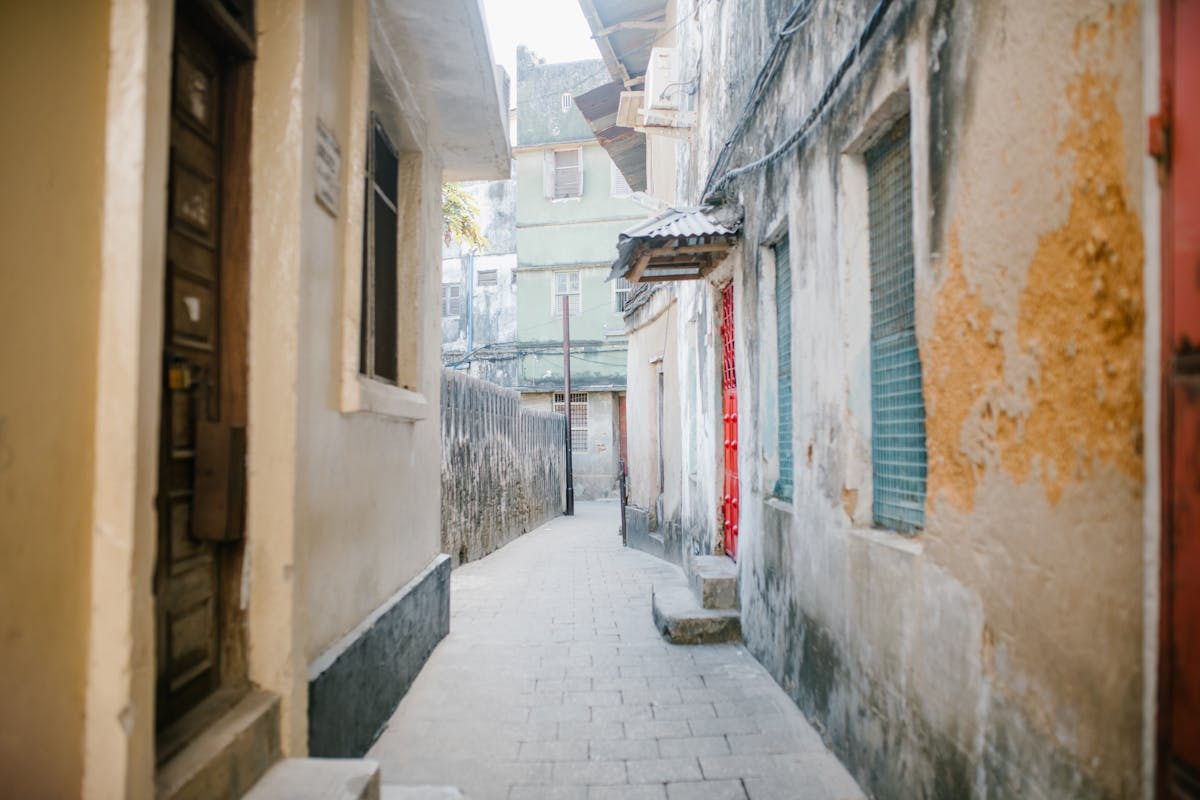
The alleys are too narrow for cars. This is the first thing you notice and the reason everything else about Stone Town works the way it does. Without vehicles, the streets belong to people — to the man pushing a wooden cart stacked with coconuts, to the children chasing a deflated football around a corner, to the women in black bui-bui robes moving between doorways with the unhurried grace of those who know every turn by heart. The town was built for shade and secrecy, its coral-stone walls pressing close on either side, the sky reduced to a bright ribbon overhead. You will get lost. This is not a warning. It is the point.
The Doors
The carved wooden doors of Stone Town are its most famous architectural feature, and they deserve every word written about them. There are more than five hundred, each one a statement of identity. The Omani-style doors are tall and rectangular, studded with brass spikes originally designed to repel war elephants — a tradition carried from India long after the elephants ceased to be a threat. The Indian-style doors are smaller, arched, and carved with intricate floral and vine patterns that speak of the subcontinent’s merchant communities. The Swahili doors blend both traditions, and the carvings often include date palms, frankincense trees, and chains — symbols of prosperity that carry, in this context, an uncomfortable double meaning.
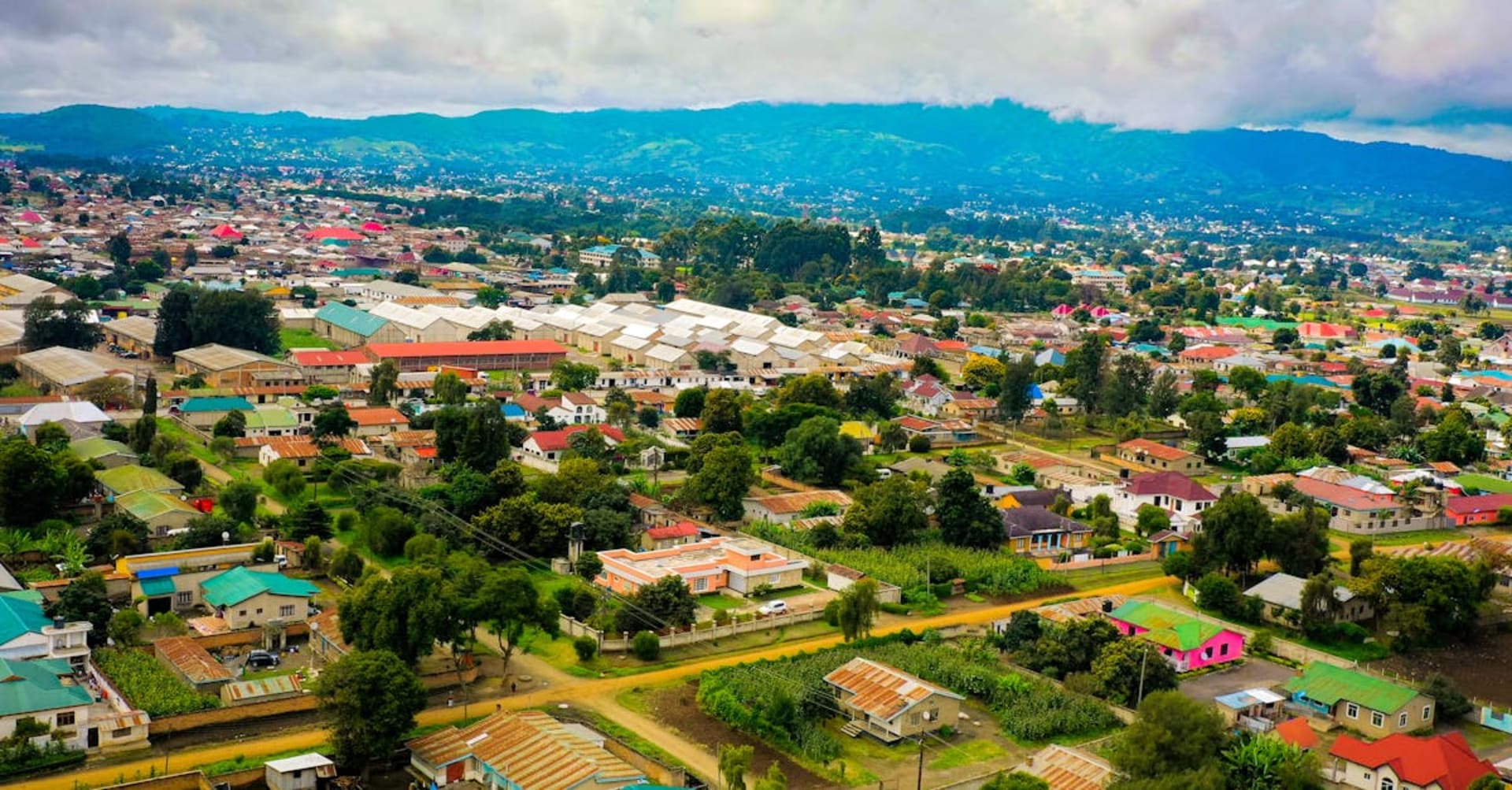
The Waterfront and Its Monuments
The seafront promenade tells the story of power on Zanzibar in architectural shorthand. The House of Wonders — Beit-al-Ajaib — was the first building in East Africa to have electricity and an elevator, built by Sultan Barghash in the 1880s as a ceremonial palace. Its tiers of pillared verandas face the harbor like a grand challenge to anyone arriving by sea. Beside it, the Old Fort, built by Omani Arabs over the ruins of a Portuguese chapel, now hosts cultural events and craft markets within its coral-stone battlements. The Sultan’s Palace Museum — the People’s Palace — offers a quieter encounter with history: personal effects, photographs, and furniture from the last sultans, their domestic lives rendered in fading objects behind glass.
The Slave Trade and Its Memory
Stone Town’s beauty sits atop a brutal history, and the town does not flinch from this. The Anglican Cathedral on Mkunazini Road was deliberately built over the site of the last open slave market in East Africa, its altar placed on the exact spot where the whipping post stood — where enslaved people were beaten to demonstrate their strength to buyers. The underground chambers where men, women, and children were held before auction are still accessible, low-ceilinged and dark, and standing in them is an experience that rewrites the sunlit streets above into something more complex and more honest. The memorial sculpture outside — five figures standing in a pit, chained together — is among the most powerful public artworks on the continent.
The Living Town
But Stone Town is not a museum, however much it resembles one. It is a working town of roughly sixteen thousand people, and its rhythms are domestic and commercial as much as historical. The Darajani Market is its beating heart — a covered labyrinth of stalls selling fresh tuna, octopus, cassava, spices in burlap sacks, and the ornate kangas that serve as Zanzibar’s universal garment and gift. The market smells of fish and turmeric and overripe mango, and the vendors call out prices in Swahili and English and sometimes Arabic, switching languages mid-sentence with the ease of people raised at a crossroads.
In the late afternoon, the town’s energy migrates to the waterfront. The Forodhani Gardens night market begins setting up as the sun drops toward the sea — dozens of portable grills and gas burners arranged in rows, each vendor specializing in a single dish or a small repertoire. Grilled octopus tentacles. Zanzibar pizza — a kind of stuffed crepe that resists classification. Urojo soup, a turmeric-yellow broth layered with bhajias, potato, and chili. Sugarcane juice pressed on the spot. The smoke and the cooking smells and the sound of Arabic pop music from a phone speaker create an atmosphere that is entirely itself — not curated for tourists, though tourists are welcome, but rooted in the daily life of a town that has been feeding itself from the sea for centuries.
Zanzibar Coffee and Quiet Corners
Between the landmarks, Stone Town rewards the wanderer. A Zanzibar coffee — thick, sweet, spiced with cardamom and sometimes ginger — can be found in tiny cafes that occupy former merchant houses, their courtyards open to the sky, bougainvillea climbing the crumbling walls. The rooftop terraces of the old hotels offer views across a skyline of corrugated iron and coral stone, satellite dishes and minarets, the call to prayer mingling with the sound of a television through an open window. It is a town where centuries coexist without apology, where the past is not preserved but simply present, alive in the walls and the doors and the faces of the people who pass through them.
When to go: June to October for dry, breezy weather ideal for walking the alleys in comfort. December to February for heat and proximity to Zanzibar’s beaches. Avoid the long rains of April and May, when the humidity thickens and the stone walls sweat.