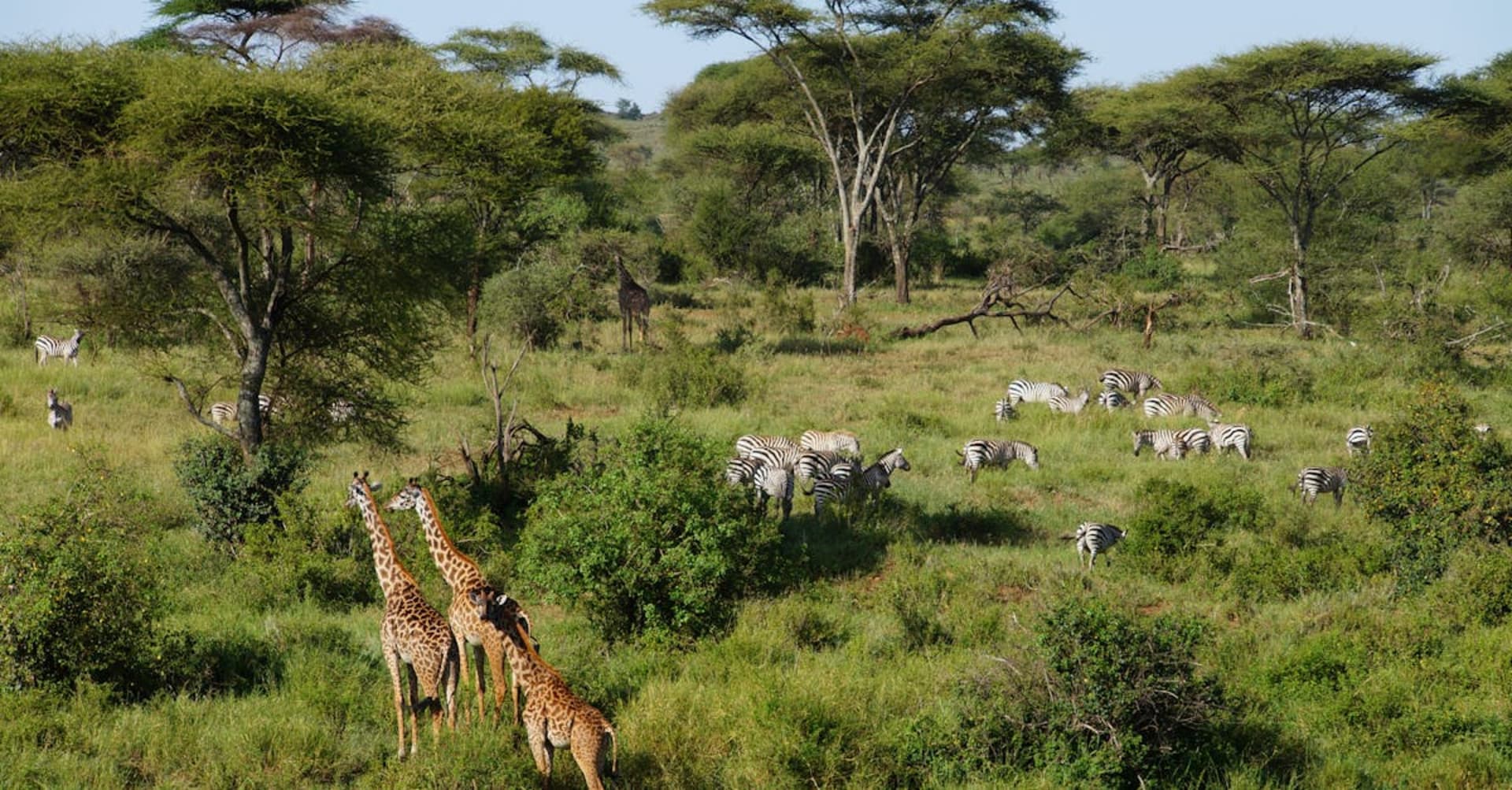
There is a moment, always unexpected, when the Serengeti stops being a place on a map and becomes something closer to a feeling. You are standing in an open-topped vehicle, the engine cut, and the silence arrives — not true silence, but the low hum of wind through waist-high grass, the distant alarm call of a Thomson’s gazelle, the creak of an acacia branch bending under the weight of a roosting vulture. The plains stretch in every direction until the earth curves away from you. No fences. No walls. Just thirty thousand square kilometers of grassland doing what grassland has done here for two million years.
The Great Migration
The Great Migration is the event that made the Serengeti synonymous with the wild. Nearly two million wildebeest, accompanied by several hundred thousand zebras and gazelles, trace a vast clockwise circuit through the ecosystem, following the rains and the fresh green shoots that follow. It is not a single event but a continuous, rolling procession — a river of animals that never truly stops. In the southern plains around Ndutu, the calving season erupts in February. Eight thousand calves are born every day for roughly three weeks, and the predators know it. Hyenas, jackals, lions, and cheetahs converge on the nursery grounds, and the air carries the metallic tang of birth and death mingled together.
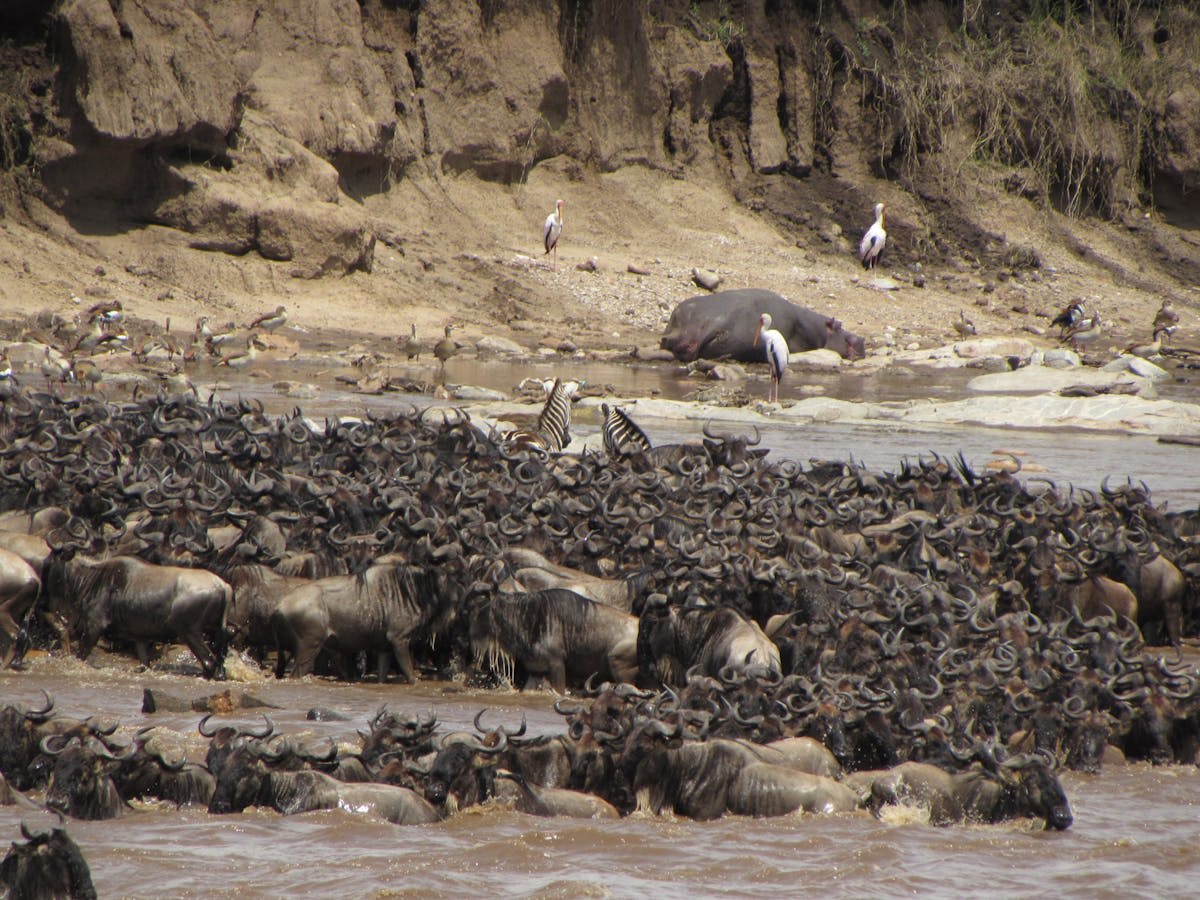
As the dry season tightens its grip, the herds push north and west toward the Mara River. The crossings — typically between July and October — are the migration’s dramatic crescendo. Thousands of wildebeest mass on the riverbanks, jostling, braying, until some invisible consensus breaks and they pour into the current. Crocodiles the length of small boats wait in the brown water. Not every animal makes the far bank. The footage you have seen does not prepare you for the sound: the splashing, the bellowing, the crack of hooves on submerged rock.
Beyond the Migration
But the Serengeti is far more than its most famous spectacle. The Seronera Valley, in the park’s central corridor, holds resident populations of lion, leopard, and cheetah throughout the year. The valley’s riverine woodlands and open glades create a patchwork of habitats where predators concentrate in remarkable density. It is here that you are most likely to witness a leopard draped over a sausage tree branch, tail swaying, utterly indifferent to your presence.
Scattered across the plains like the ruins of some ancient civilization are the kopjes — smooth granite outcrops pushed up through the soil by geological forces far older than any living thing here. Lions claim them as lookout points and denning sites. Agama lizards bask on their sun-warmed surfaces. Each kopje is its own island ecosystem, a pocket of shade and shelter in the endless grass.
Balloon Safaris and the Scale of Things
A hot-air balloon safari at dawn offers the Serengeti’s most humbling perspective. You rise in near-silence above the plains, and the scale reveals itself in ways that ground-level game drives cannot: the herds become dark, winding threads stitched across gold fabric; the rivers become silver seams; the kopjes become pebbles. From the air, the Serengeti looks less like a national park and more like the entire world before humans decided to organize it.
The Serengeti is also home to over five hundred bird species, from the secretary bird stalking through the grass on impossibly long legs to the lilac-breasted roller performing its tumbling courtship display. The Big Five — lion, leopard, elephant, buffalo, and rhinoceros — are all present, though the black rhino remains elusive, confined largely to the park’s northern reaches.
The Emotional Weight
What stays with you is not any single sighting. It is the cumulative effect of days spent in a landscape that has not fundamentally changed since the Pleistocene. The Serengeti asks nothing of you except attention. Give it that, and it will return something you did not know you were missing — a sense of proportion, of belonging to something older and larger than yourself.
When to go: June to October for the migration crossings and dry season game viewing at its finest. January to February for the calving season on the southern plains. The Serengeti rewards visitors year-round — there is no bad time, only different acts of the same extraordinary performance.