There are places in Africa where the wilderness has been loved into a kind of performance — photogenic, accessible, and subtly managed for the comfort of the visitor. The Selous is not one of them. Now partly renamed Nyerere National Park, this is the largest protected area in Africa, a swathe of miombo woodland, floodplain, and river channel covering more than 50,000 square kilometers — an area larger than Switzerland, larger than Denmark, larger than the imagination easily accommodates. And yet it receives fewer visitors in a year than the Serengeti hosts in a week. To come here is to understand what wilderness meant before the word needed defending.
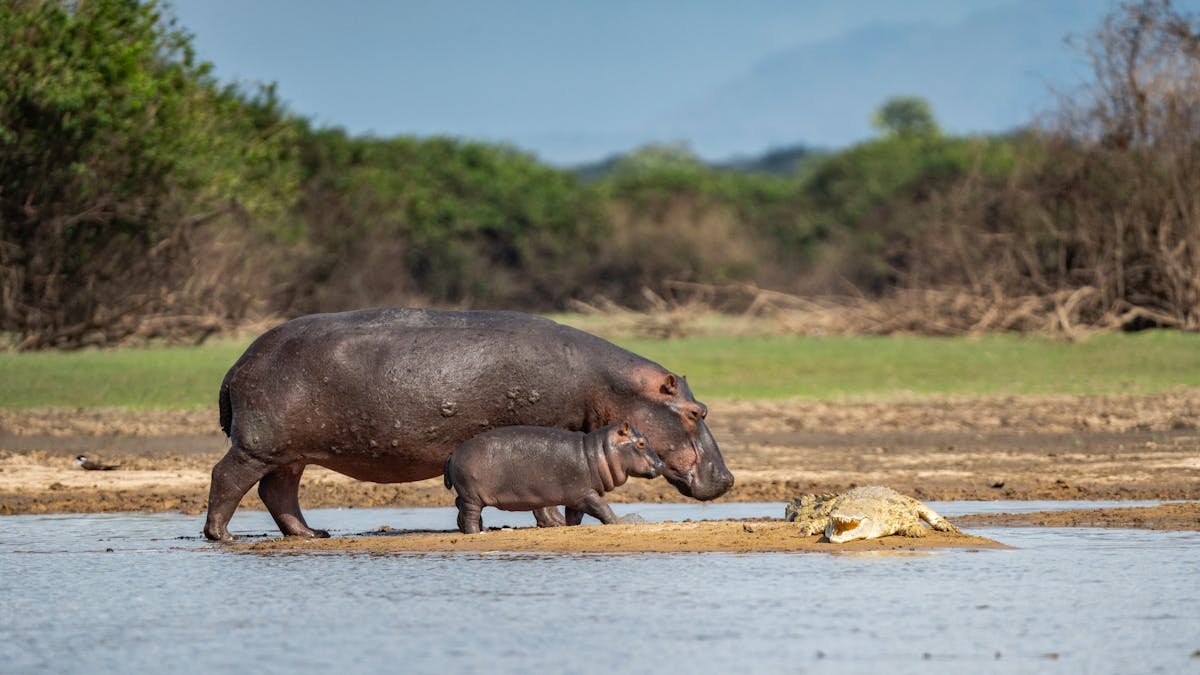
The Rufiji River is the reserve’s central artery, a broad, brown, slow-moving body of water that splits into a labyrinth of channels, lakes, and oxbow lagoons as it approaches the Indian Ocean. It is along these waterways that the Selous reveals its most distinctive experience: the boat safari. The engine cuts to idle. The guide steers the skiff along a channel no wider than a country lane. On the left bank, a pod of hippos tracks your passage with small suspicious eyes, their ears flicking like pink semaphores. On a sandbank ahead, a Nile crocodile lies with its jaws agape, utterly still, utterly patient. A goliath heron stands in the shallows like a grey monument. And then, around a bend, a herd of elephants appears at the water’s edge — drinking, bathing, a young bull spraying mud across his back — and you are among them at eye level, drifting, silent, close enough to hear the rumble of their stomachs.
The game viewing on land is no less compelling. The Selous supports one of Africa’s largest remaining populations of African wild dogs — the continent’s most endangered large predator, a painted, long-legged hunter that moves in coordinated packs with a success rate that shames the lion. Sighting a pack on the hunt — fanning out across the floodplain, communicating in twittering calls, running down an impala in a burst of lethal cooperation — is one of the most electrifying experiences the African bush can offer. The reserve also holds strong populations of lion, leopard, buffalo, and elephant, all moving through a landscape so vast that their encounters with vehicles are infrequent enough to preserve a genuine wariness.
Walking safaris are the Selous’s other specialty, and they change everything. On foot, accompanied by an armed ranger and a specialist guide, you drop from the comfortable altitude of the vehicle into the bush itself. The grass is suddenly at shoulder height. Every sound sharpens. A broken twig becomes a question. Elephant dung, still steaming, becomes a text to be read — how many, how recently, which direction. You learn to move slowly, to watch the guide’s hands for signals, to understand that the bush is not a backdrop but a place with its own rules, and that you are a guest in it. It is not adrenaline, exactly. It is attention — a quality of presence that vehicle-based safaris, for all their rewards, cannot replicate.
The camps in the Selous are small, remote, and deliberately few. Many are accessible only by bush plane — a forty-minute flight from Dar es Salaam that crosses a landscape empty of roads, villages, and any sign of human enterprise. You land on a dirt strip, and a guide meets you with a vehicle, and within minutes the camp appears: eight tents, perhaps ten, set beneath riverine trees with the Rufiji sliding past below. Dinner is served under the stars. The sound of hippos grunting carries across the water. A leopard coughs somewhere in the darkness. The isolation is not a limitation. It is the entire point.
When to go: June to October for the dry season, when the Rufiji shrinks and wildlife concentrates along its banks. This is the prime window for boat safaris, walking safaris, and wild dog sightings. Most camps close during the heavy rains from March to May.