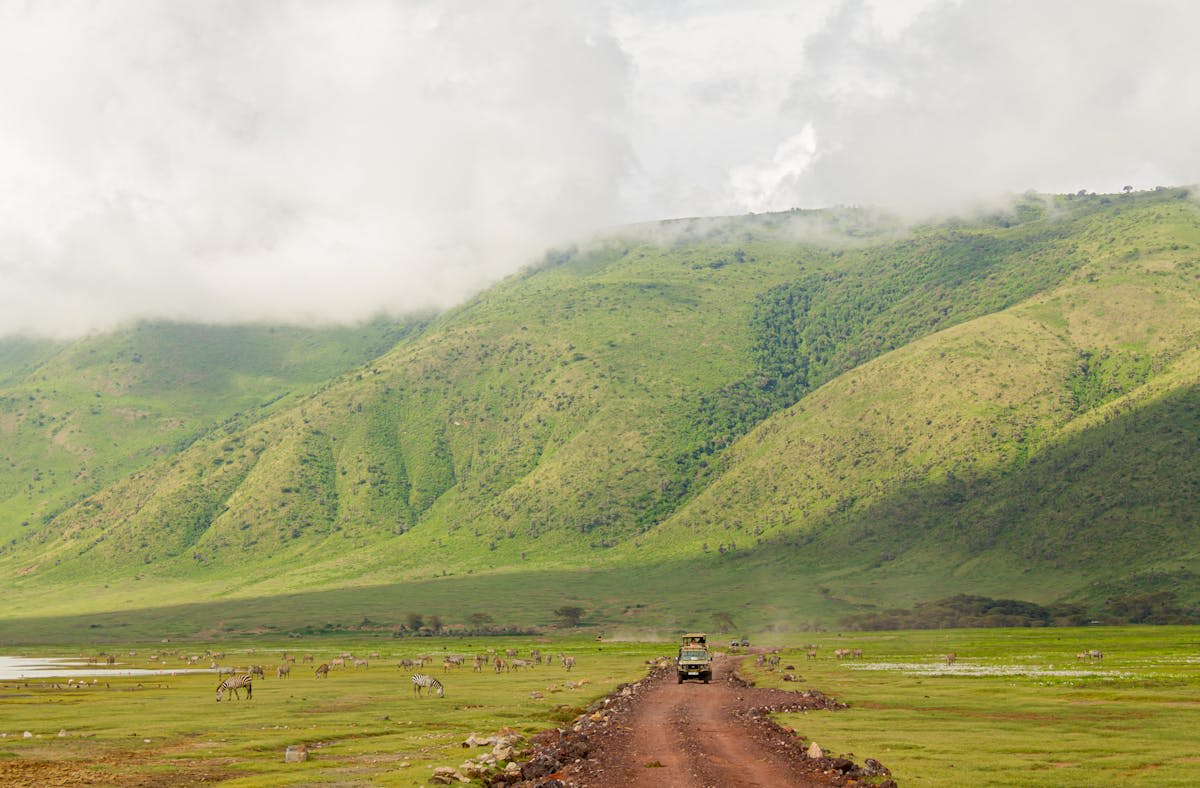
You stand on the rim and look down, and for a long moment the mind refuses the scale. The Ngorongoro Crater is not a crater in the violent, jagged sense — it is a caldera, the collapsed summit of an ancient volcano that may once have rivaled Kilimanjaro in height. What remains is a bowl roughly nineteen kilometers across and six hundred meters deep, its floor a patchwork of grassland, acacia woodland, freshwater springs, and a shallow soda lake that shimmers in the heat. It is, by any honest measure, the most extraordinary natural amphitheatre on earth.
The Crater Floor
The descent from the rim takes about thirty minutes on a winding dirt road that drops through montane forest — thick, cool, dripping with moss — before emerging onto the open floor. The transition is startling. One moment you are in cloud forest; the next, you are on an African savannah enclosed on all sides by walls of green. Approximately 25,000 large animals live permanently within the crater, sustained by the springs and the grazing and the simple fact that the walls, while not impassable, discourage most migration. The result is a concentration of wildlife that is almost absurd in its density.
The Big Five and Beyond
The crater holds one of the densest populations of lions in Africa — the prides here are large, well-fed, and remarkably visible on the open grassland. The critically endangered black rhinoceros, nearly impossible to find elsewhere in Tanzania, maintains a small but closely guarded population on the crater floor. Leopards haunt the fever tree forests near Lerai, though they are shy and require patience. Buffalo herds number in the hundreds, and the old bulls — mud-caked, battle-scarred, magnificently indifferent — stand like monuments in the tall grass. Elephants move along the swamp edges, and the old tuskers here carry some of the largest ivory remaining in East Africa, their survival within the crater’s relative protection a small, fierce victory against the poaching that has devastated herds elsewhere.
The soda lake at the crater’s center — Lake Magadi — draws flamingos in shifting pink congregations that alter the lake’s color from a distance. In the right light, the water appears to blush. The spotted hyena clans of Ngorongoro are among the most studied in the world, their complex social hierarchies and hunting strategies observed by researchers for decades. They are not scavengers here — they are apex predators, and watching a clan bring down a wildebeest on the open plain is a reminder that reputation and reality are not always aligned.
The Maasai and the Crater
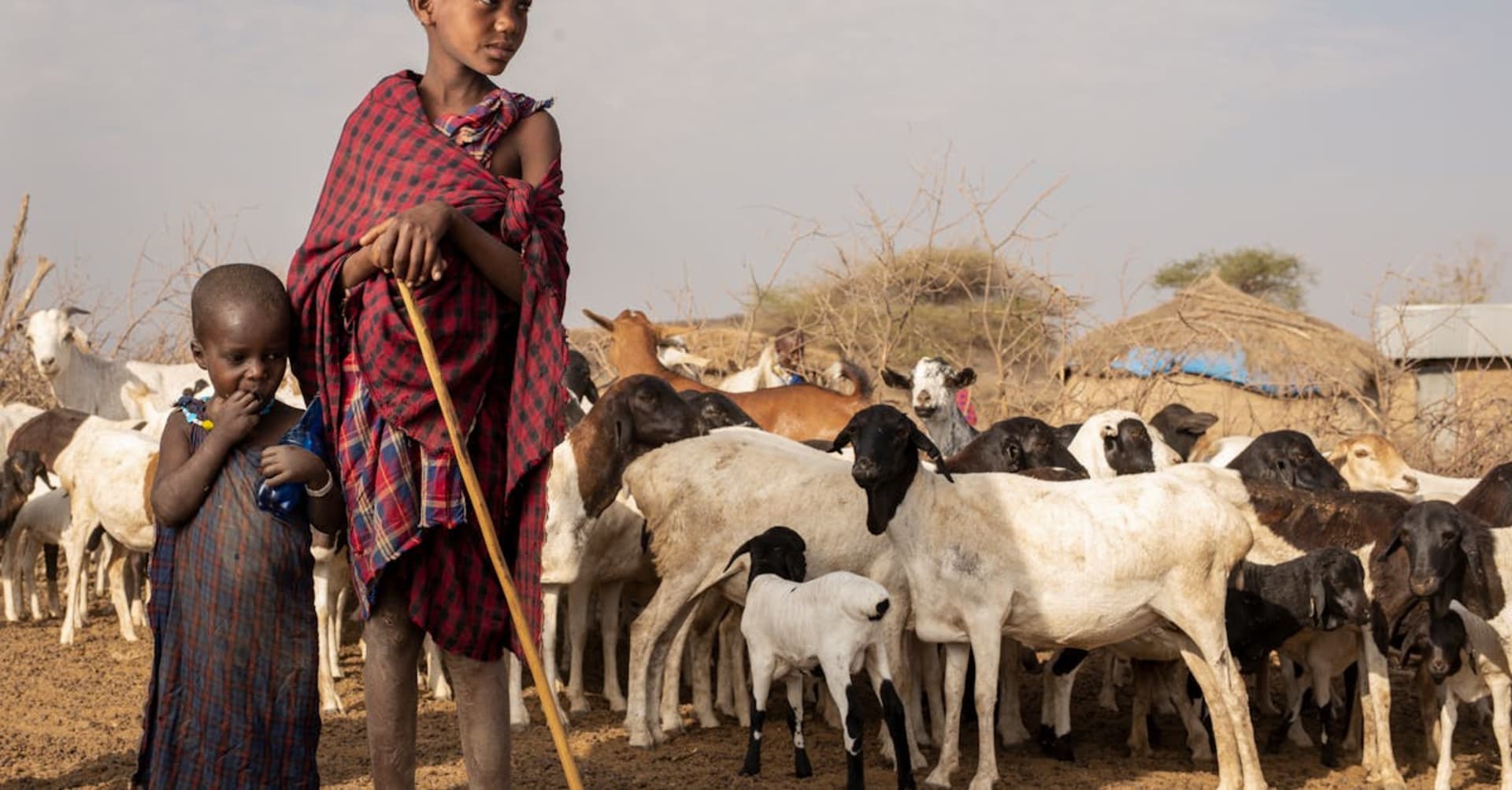
The Ngorongoro Conservation Area is unique in East Africa for its model of human-wildlife coexistence. The Maasai people live and graze their cattle within the conservation area, though not on the crater floor itself. Their red shukas are visible on the rim and on the surrounding highlands, their bomas dotting the landscape. It is an imperfect arrangement — the tensions between conservation and livelihood are real and ongoing — but it represents something rare: an acknowledgment that the land belongs to its people as well as its animals, and that the two are not necessarily in opposition.
The Rim
The crater rim, at roughly 2,300 meters, is often draped in mist and cooled by highland breezes. The lodges perched along its edge offer views that no photograph adequately captures — you look down into the caldera as the morning fog lifts, and the animals below appear as moving specks on a vast green stage, and the silence is broken only by birdsong and the distant contact calls of wildebeest. At dawn and dusk, the light does extraordinary things to the crater walls, painting them in shades of amber and violet that shift by the minute. It is the kind of view that makes you set down your camera and simply look.
The Emotional Weight
Ngorongoro is not the Serengeti. It does not offer the infinite horizon or the drama of migration. What it offers instead is intimacy — a contained, watchable, almost comprehensible ecosystem where the relationships between predator and prey, grass and rain, human and animal play out in a space you can see from edge to edge. It is nature as theatre, with the rim as the balcony and the floor as the stage, and every seat has a clear view.
When to go: Ngorongoro rewards visitors year-round. June to September brings dry season clarity and the best game viewing conditions. December to March offers the green season — lush landscapes, calving on the crater floor, flamingos in greater numbers, and fewer vehicles sharing the experience.