
The first thing Lake Manyara teaches you is that size is a poor measure of wildness. At just 330 square kilometers — two-thirds of which is the lake itself — this narrow ribbon of park wedged between the alkaline water and the sheer face of the Rift Valley escarpment contains more ecological variety per square kilometer than almost anywhere else in Tanzania. It is a place of compressed wonders, where you can pass through five distinct habitats in a single morning’s drive, each one a different world, each one teeming.
You enter through the groundwater forest, and the transition is immediate. The dry scrubland outside the gate gives way to a cathedral of wild fig, mahogany, and sausage trees whose canopy blocks the sun entirely. The air turns cool and green. Olive baboons sit on the road in troops of forty or more, grooming each other with the unselfconscious intimacy of old families. Blue monkeys leap between branches overhead. Vervet monkeys watch from the undergrowth with eyes like polished stones. The forest floor is layered with the debris of centuries — fallen trunks colonized by ferns, roots snaking across the track like exposed tendons — and driving through it feels less like a game drive and more like entering some older, quieter version of the world.
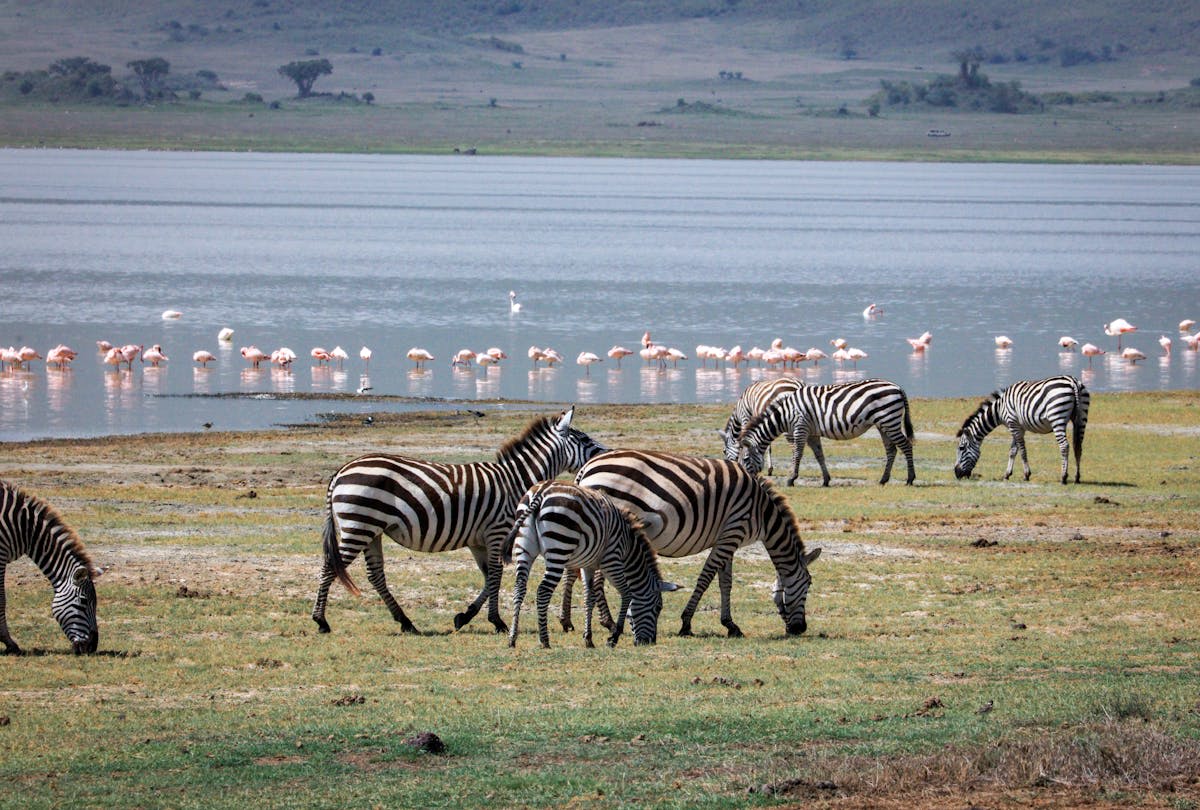
The forest opens without warning onto the lake shore, and the effect is breathtaking. Lake Manyara stretches east toward a horizon that dissolves into haze, its shallow alkaline waters tinted pink by the bodies of flamingos — lesser flamingos, mostly, in flocks that can number in the hundreds of thousands during peak season. They feed with their heads inverted, filtering blue-green algae from the brine, and from a distance the flock looks less like individual birds than a single living stain of color moving slowly across the water. When they take flight — spooked by a fish eagle or simply restless — the sky fills with a blizzard of pink and white wings, and for a moment the world seems to have been redesigned by a painter who could not restrain himself.
The tree-climbing lions are the park’s most famous residents, though they demand patience. Manyara’s lions have developed the unusual habit of resting in the boughs of acacia and mahogany trees, their tawny bodies draped along branches with a bonelessness that seems to defy anatomy. The behavior is rare — documented reliably in only a few populations across Africa — and theories about its cause range from tsetse fly avoidance to thermoregulation. Whatever the reason, spotting a lion in a tree remains one of safari’s most wonderfully surreal experiences, a reminder that the natural world has no obligation to meet your expectations.
The Rift Valley escarpment forms the park’s western wall, rising 600 meters in a near-vertical face of dark rock that catches the afternoon light and turns it amber. Raptors — augur buzzards, crowned eagles, Verreaux’s eagles — nest in the cliff’s crevices and ride the thermals that rise along its face. At the base, hot springs bubble up through the sediment, their mineral-rich waters feeding pools where elephants sometimes wade, steam curling around their legs in the early morning.
Elephant herds move between the forest and the shore with an unhurried confidence, and the hippo pool at the park’s southern end offers remarkably close encounters from a raised viewing platform — the animals grunting and yawning barely fifteen meters below. Manyara is often treated as a brief transit stop between Arusha and the Ngorongoro Crater, and it can serve that purpose well. But those who give it a full day discover a park that stays in the memory long after the grander spectacles of the Serengeti have softened into a single, magnificent blur.
When to go: June to October for dry season game viewing and reliable tree-climbing lion sightings. November to February for the green season and peak flamingo numbers, when the lake fills and the birdlife is at its most abundant.