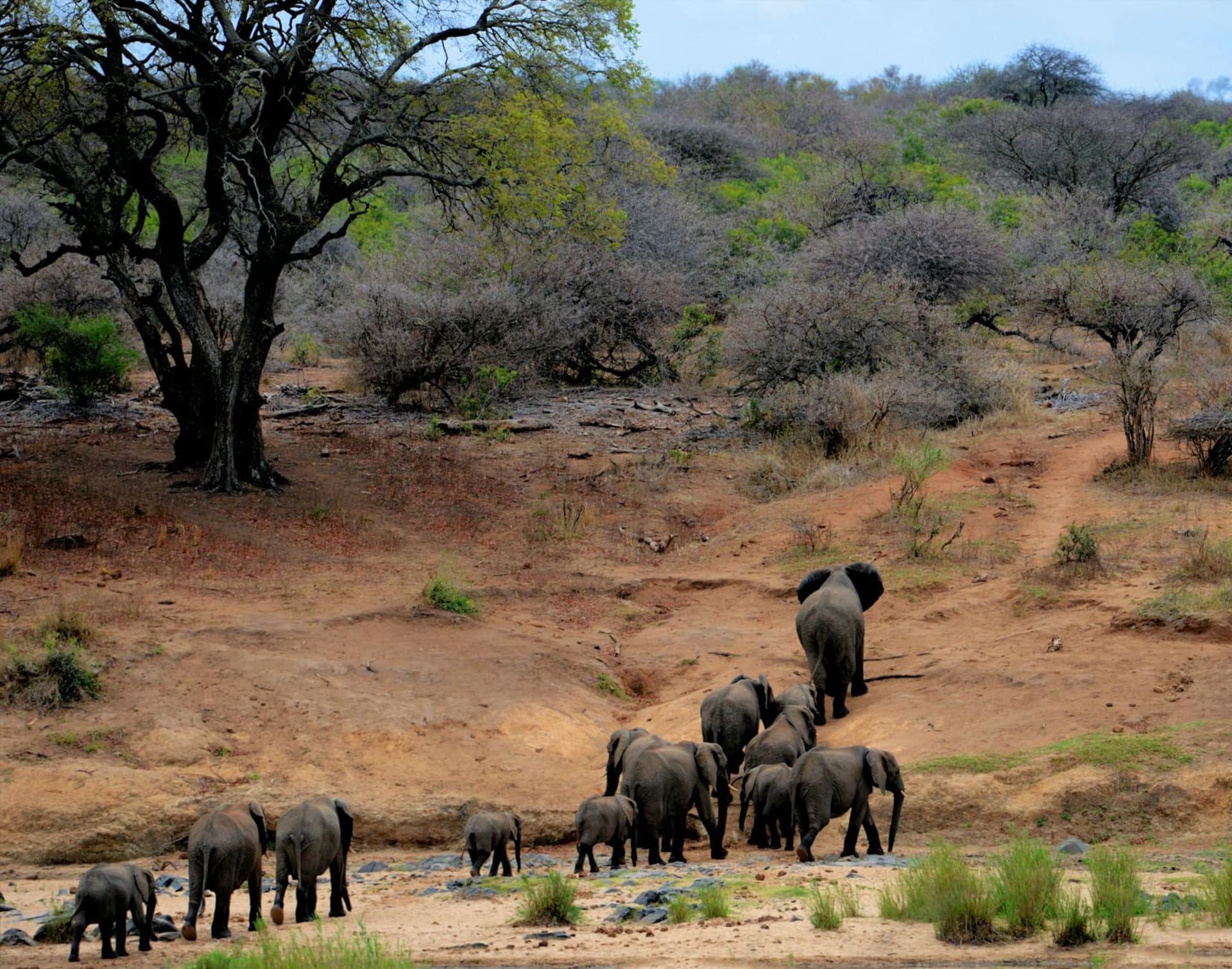
Tanzania's largest park, raw and uncrowded, where elephants gather under ancient baobab trees.
We arrived in Ruaha in the last hour of afternoon light, the dirt track from Msembe airstrip still powdering the dashboard of the Land Cruiser when the driver cut the engine without explanation. Fifty meters ahead, a breeding herd of elephants — twelve, maybe fifteen animals — moved between two ancient baobab trees, the calves pressing against their mothers’ flanks, the matriarch pausing to test the wind. No other vehicle. No other sound except the dry rattle of acacia pods and, somewhere unseen, the alarm bark of a bushbuck. Lia reached for my arm.
This is what Ruaha does. Tanzania’s largest national park spreads across more than twenty thousand square kilometers of the Southern Highlands, a landscape of broken escarpments, sand rivers, and miombo woodland that most safari routes never reach. The crowds that fill the northern circuit — the convoys outside the Serengeti, the jostle for position at Ngorongoro — simply do not exist here. Ruaha is what the continent looked like before the camera tours arrived.
The Great Ruaha River
The Great Ruaha River is the park’s spine. In the dry season, from June onward, it contracts into a series of deep pools connected by damp sand, and every animal within range is drawn to its edges. We spent two mornings parked above a bend near Jongomero Camp, watching the cycle repeat itself with hypnotic regularity: elephants arriving in long files from the miombo, coating their skin with grey mud; crocodiles so still they looked like driftwood until they didn’t; greater kudu stepping delicately down to drink, their spiral horns catching the low eastern light. Hippos groaned from a pool downstream, invisible but constant. The smell was rich and ferrous — sun-heated mud, dung, something sweetly organic that I eventually identified as the blooms of the sausage tree leaning over the bank.
The density of elephants here surprised me. Ruaha holds one of the largest elephant populations left in East Africa — numbers decimated by ivory poaching in the 1970s and 1980s but slowly, stubbornly recovering. You read that fact in a guidebook and it registers as a statistic. Then you see forty elephants moving through a dry riverbed in the amber light of six in the morning, and it becomes something you feel in the chest.
The Baobabs and the Unexpected Leopard
The baobabs of Ruaha are not incidental backdrop. Some of the specimens in the park’s central and eastern sectors are estimated at over a thousand years old, their trunks swollen to four and five meters in diameter, bark the color and texture of weathered concrete. Lia spent an embarrassing amount of time photographing the same tree from different angles — I understood completely.
The unexpected discovery came on our third afternoon, following a dry lugga — a seasonal streambed — east of Msembe toward the Mwagusi area. We had been watching a pair of bat-eared foxes near a termite mound when the guide went still and pointed upward. In the fork of a large fig tree, a leopard lay draped across two branches, watching the foxes with the lazy, assessing patience that leopards seem to have in infinite supply. No radio calls had gone out; no other vehicles materialized. For twenty minutes it was entirely ours — the leopard, the tree, the declining sun turning everything amber. The leopard eventually stood, stretched with theatrical slowness, and disappeared into the fig canopy as if it had simply grown tired of us.
Why Ruaha Stays With You
What Ruaha offers that the famous northern parks struggle to match is a quality of solitude that changes how you experience wildlife. The absence of competing vehicles means your guide can work with the animals on the landscape’s own terms — following a pride of lions through a dry pan rather than circling them on a road. The park receives fewer than twenty thousand visitors a year. The numbers feel unreal until you are out in it, and a morning passes without seeing another vehicle at all.
It is not an easy park to reach — the drive from Iringa on poor roads, or a charter flight into Msembe — and that inaccessibility is precisely what keeps it honest. The wilderness here has not yet learned to perform.
When to go: June through October for the dry season, when game concentrates around the Great Ruaha River and the roads are passable. November and April mark the short and long rains; the park partially closes in April and May, but the green season brings resident birds, newborn impala, and an entirely different, lush face to the landscape.
