The Wall Above the Village
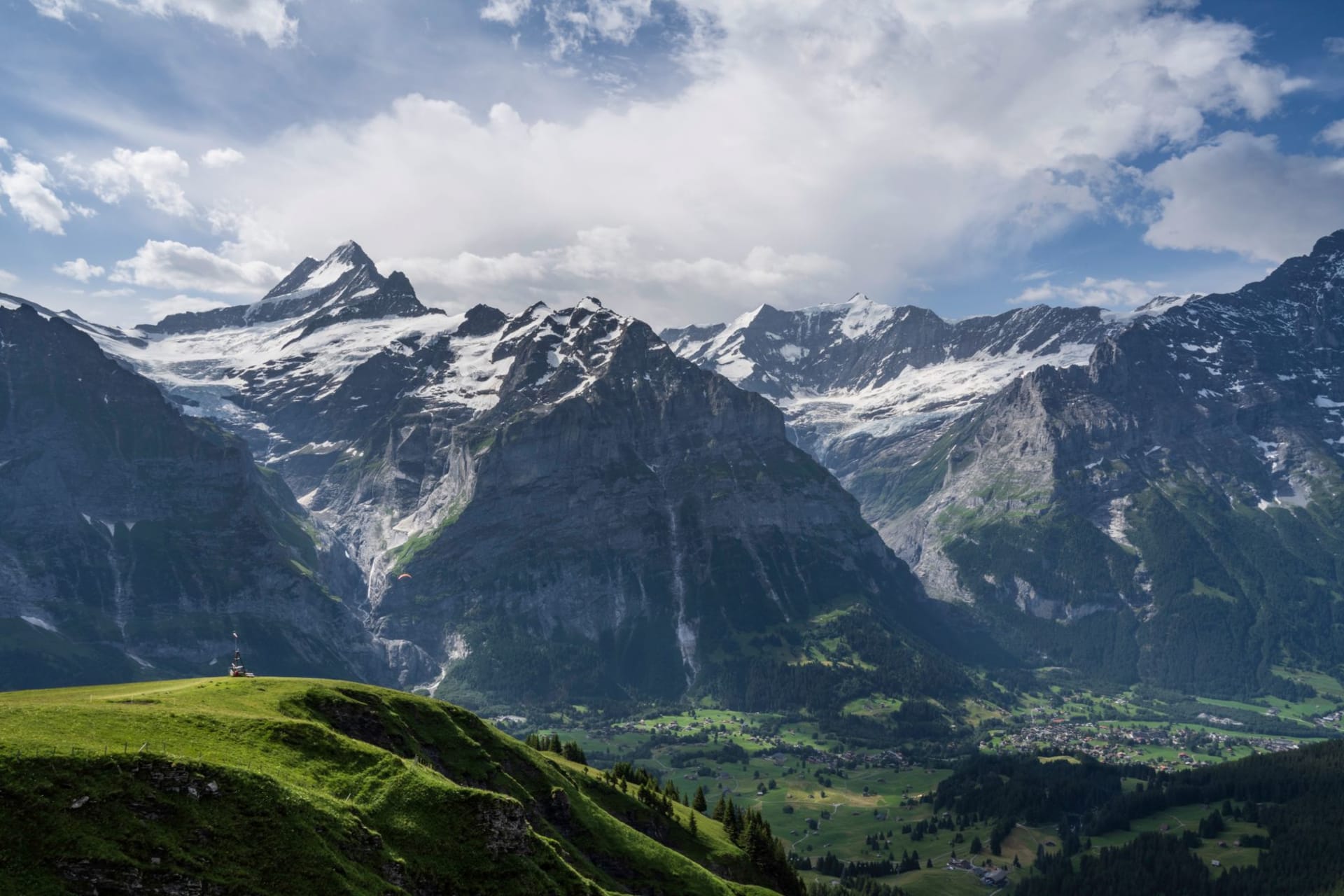
The Eiger’s north face rises 1,800 meters directly above Grindelwald. You can see it from the bakeries, from the parking lots, from the chair of any terrace café. It’s a grey slab of limestone that catches the early morning light and then falls into shadow by mid-afternoon. The wall has killed dozens of climbers. Everyone in the village knows this and nobody really talks about it. There’s something quietly intense about living under something like that.
I arrived by train — the cogwheel railway from Interlaken, which winds through meadows and then suddenly punches into the valley — and my first reaction was to stop on the platform and stare upward for longer than was probably polite. The mountain doesn’t care. It never does.
Jungfraujoch and the Altitude Tax
From Grindelwald you can take the railway up to Jungfraujoch, which at 3,454 meters is the highest railway station in Europe and bills itself breathlessly as “Top of Europe.” The views are genuinely staggering — the Aletsch Glacier rolling away to the south, a white corridor seventeen kilometers long. But the plateau is also crowded with tour groups, and there’s a McDonald’s. I’m telling you this not as criticism exactly — more as preparation. The mountain is spectacular. The infrastructure around it is a theme park.
What I preferred was the Männlichen cable car from the valley, which deposits you on a ridge with views of the Eiger, Mönch, and Jungfrau in a row. The walk from Männlichen down to Wengen along that ridge takes about ninety minutes. It’s one of those paths where you stop every few minutes not because you’re tired but because you need to look again.
The Village Itself
Grindelwald is larger and more lived-in than Zermatt — it has cars, proper supermarkets, a petrol station. That makes it slightly less picturesque and considerably more practical. The guesthouses in the lower village are good value by Swiss standards. The bread at the Bakerei Fuchs on the main street is excellent, particularly the Ruchbrot, a Swiss-German country loaf with a dense dark crumb.
Lia found the place more comfortable than some of the higher-altitude resorts precisely because it feels like a real town. You can buy aspirin. You can do laundry. There are children playing football in the street. The mountains haven’t colonized every inch of ordinary life.
First Tracks and Last Light
In winter, Grindelwald connects with Wengen, Mürren, and First to form the Jungfrau ski region — one of the largest in Switzerland. The First mountain above town has a gondola and a cluster of trails including the Bachalpsee hike, which in summer leads to a pair of mirrored lakes reflecting the Wetterhorn.
The best hour in Grindelwald is the last hour of afternoon light, when the Wetterhorn and the Schreckhorn catch the gold and the valley goes blue-grey below. I sat outside the Hotel Kirchbühl with a Feldschlösschen and watched it happen. It took maybe forty minutes. I didn’t speak. There was nothing useful to say.
When to go: Late June through September for hiking — trails to Bachalpsee and First open fully, wildflowers in July, larches amber in October. December through March for skiing, with reliable snow above 1,500 meters. Avoid Easter weekend and mid-August when Jungfraujoch queues stretch for hours. May and November are the honest off-season: grey, quiet, some trails still closed.