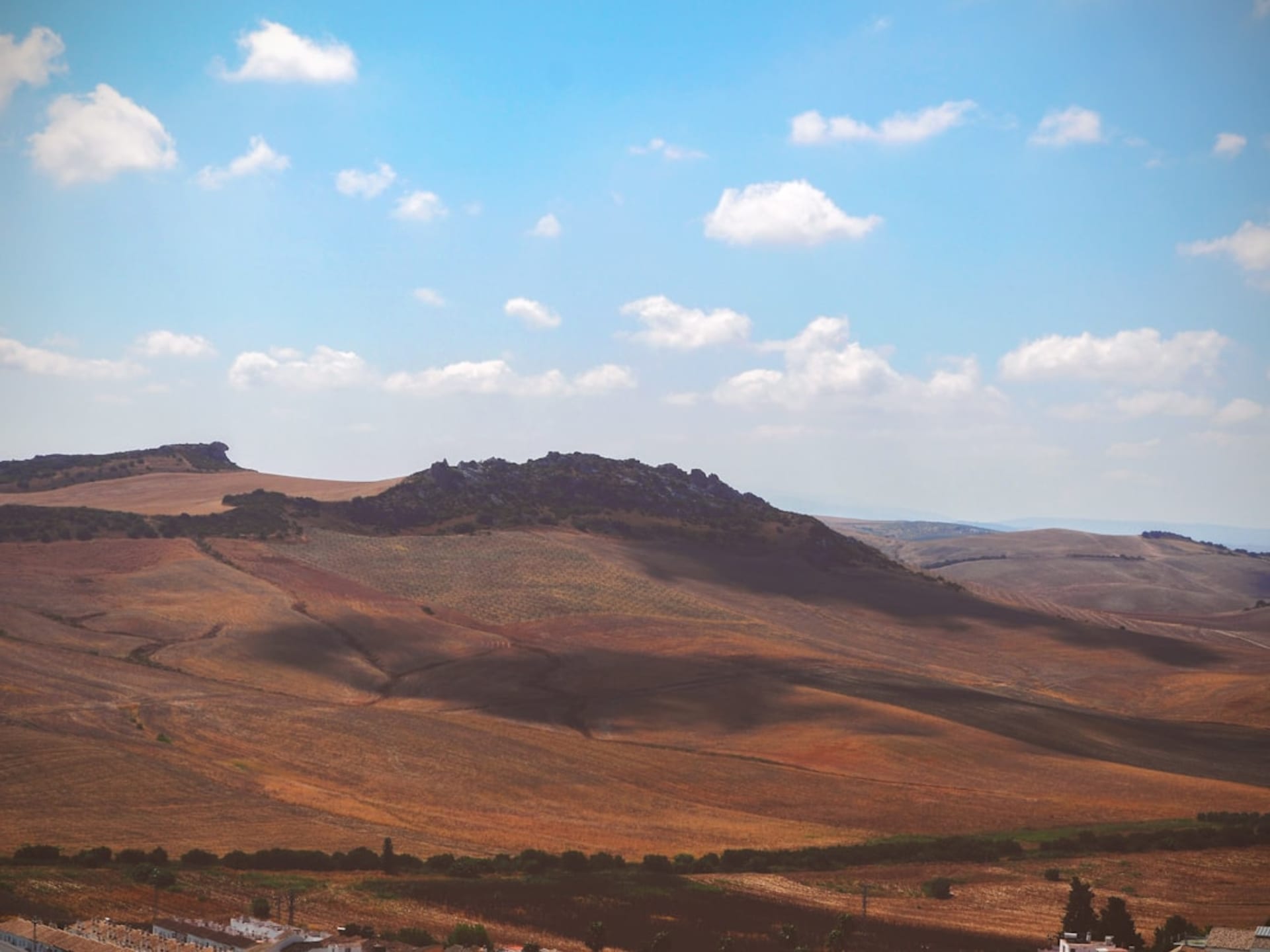
Vejer de la Frontera
"Vejer keeps its face half-turned toward the sea, the way its women once kept theirs half-hidden behind the cobija."
A whitewashed hill town above the Atlantic coast where women once wore full-face veils in the street, and where the wind never really stops.
The wind hits you first in Vejer de la Frontera, before the whitewash, before the views. This part of Cádiz province sits close to the Strait of Gibraltar, where Atlantic and Mediterranean air collide, and the town perched two hundred metres up catches the full force of it. I’d been warned — this coastline is Europe’s kitesurfing capital for a reason — but I still wasn’t ready for how it moved through the narrow streets, funneling and gusting around corners like it was looking for something.
The Town Behind the Veil
Vejer’s most striking historical detail is the cobija, or cobijada, the full-length hooded garment that covered women almost entirely, leaving only one eye visible, worn in the town well into the twentieth century. Nobody agrees precisely on its origin — some trace it to Moorish veiling customs that simply never left after the Reconquista, others to a stricter local Catholic modesty tradition that calcified over generations. What’s certain is that it lasted here longer than almost anywhere else in Spain, and there’s a bronze statue of a cobijada near the Plaza de España as a kind of civic memory of it. Standing in front of it, I found myself thinking about how towns hold onto certain images of themselves long after the practice itself has vanished — Vejer sells postcards of a costume that essentially disappeared by the 1940s, but the fact that it lasted that long here, on a coast this exposed to Africa across the strait, says something real about the town’s particular relationship with the Moorish centuries it lived through.
The old town itself climbs steeply from the Arco de la Segur up through a genuine Moorish quarter — all whitewash, wrought iron, and blind alleys — to a castle of Almohad origin at the summit, later modified by the Christians who took the town in the thirteenth century. From the castle walls the view runs clear down to Los Caños de Meca and the long Atlantic beaches below, with the hazy outline of Africa sometimes visible across the strait on a clear day.

Above the Beach, Not On It
What I liked most about Vejer is its refusal to be a beach town, despite sitting a short drive from some of the best coastline in Cádiz. The town keeps its distance and its altitude, and that separation gives it a different pace than the surf towns down at the water. I ate dinner one night on a rooftop terrace near the Plaza de España as the wind finally dropped with the sun, watching swallows cut low over the rooftops, and the whole town felt like it was exhaling after a day of bracing against the gusts.
The Plaza de España itself, with its Portuguese-tiled fountain and orange trees, is the social heart of the place, and it’s worth just sitting there with a beer for an hour watching the town’s actual daily life happen around you rather than treating Vejer as a checklist stop between beaches.

When to go: Come in September or early October, after the summer wind and crowds ease but while the Atlantic coast below is still warm enough to swim.