Segovia
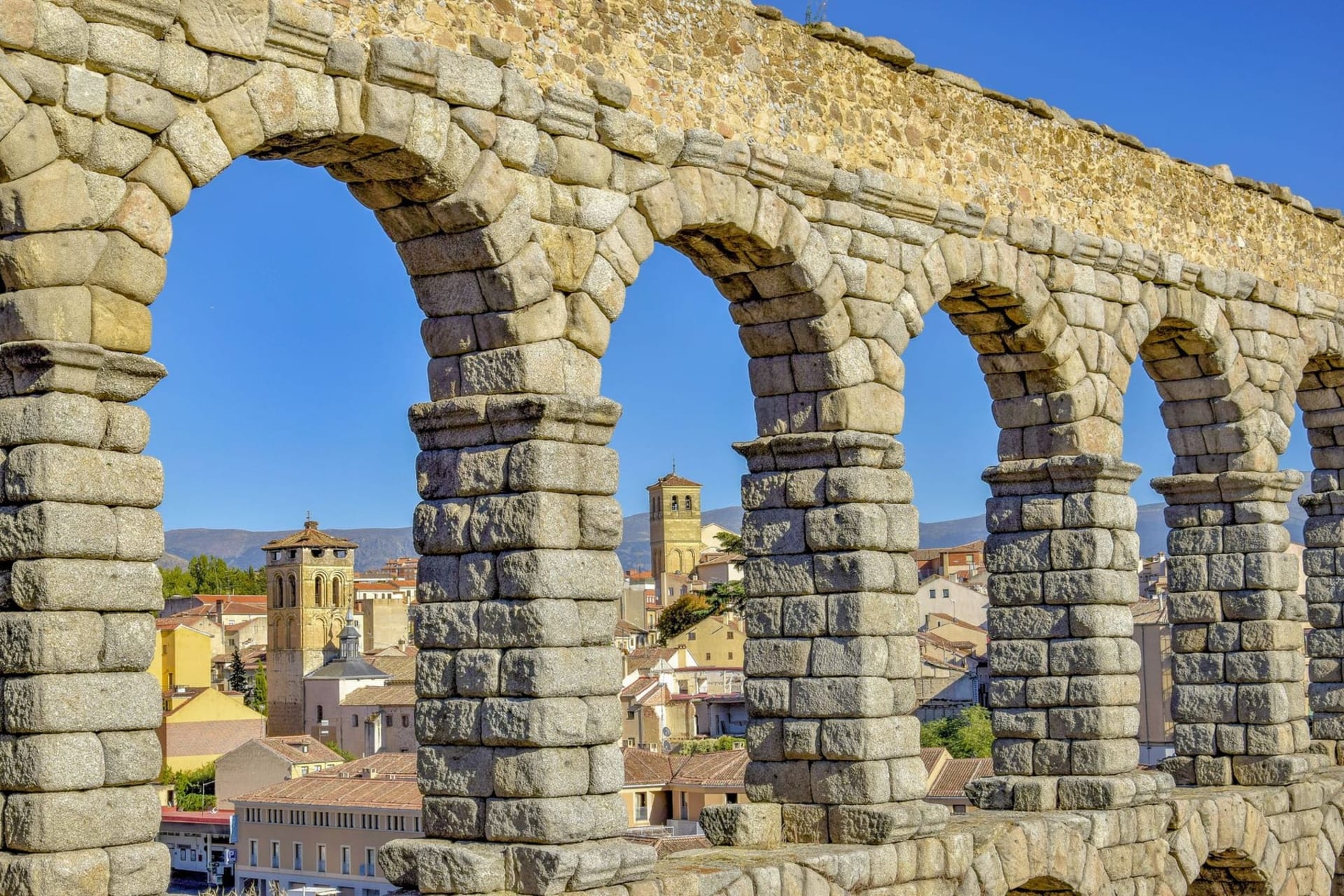
"Segovia's aqueduct has been carrying water for two thousand years without a drop of mortar."
A Roman aqueduct, a Disneyesque Alcázar, and a cathedral converge in a city set on a rocky outcrop above the Castilian plain.
I had done the research. I knew the aqueduct was Roman, first century AD, nearly nine hundred metres long. I knew the numbers. What I didn’t know — what no number prepares you for — is standing beneath it on the Plaza del Azoguejo at seven in the morning, before the tour groups arrive, and feeling the particular silence that enormous, old, useful things produce. Lia put her hand on one of the granite blocks and said nothing for a long time. That said everything.
The Weight of Stone
The aqueduct’s granite was cut from the Sierra de Guadarrama without iron clamps, without mortar, nothing but precise geometry holding one hundred sixty-six arches in the air. In the blue early light it looks almost weightless, a drawing rather than a structure. By noon, when the shadow it casts shrinks to nothing and the stone heats up, it looks inevitable — as though the city grew around it the way a river grows around a boulder.
The old town sits on a narrow rocky spit, two rivers at its flanks, and everything about Segovia feels like that: squeezed, vertical, intense. Walking up Calle de Juan Bravo toward the cathedral, the streets narrow and the stones underfoot change pitch. The smell of roasting cochinillo — suckling pig, the city’s obsession — drifts from somewhere always slightly ahead of you, never quite locatable until you round a corner and find a restaurant with a wood-fired oven visible through the window.
The Alcázar and the Edge of the Plateau
At the western tip of the rock, where the two rivers finally meet far below, the Alcázar juts out like the prow of a ship. From certain angles, approaching along the Paseo del Conde de Sepúlveda, it looks precisely like the castle Walt Disney traced for Cinderella — and in fact he did. That knowledge should make it feel cheap. Instead, standing on the terrace as the Castilian plain stretches flat and brown to the horizon, it makes the whole situation feel surreal in a way I hadn’t expected: this absurdly beautiful thing, completely real, at the edge of a plateau, in a city of eighty thousand people who eat lunch at three and dinner at ten and seem entirely unbothered by their own improbability.
The surprise came inside the cathedral. I had expected grandeur and got it, but in the cloister — carried stone by stone from the old cathedral demolished during the Comunero revolt — there is a small tomb effigy of a child, worn almost smooth, that stopped me completely. No explanation nearby. Just grief made permanent in limestone, five hundred years old.
When to go: April through early June, or September and October — the summer heat on that exposed rock plateau can be punishing, and the aqueduct is more itself in the low horizontal light of shoulder season.