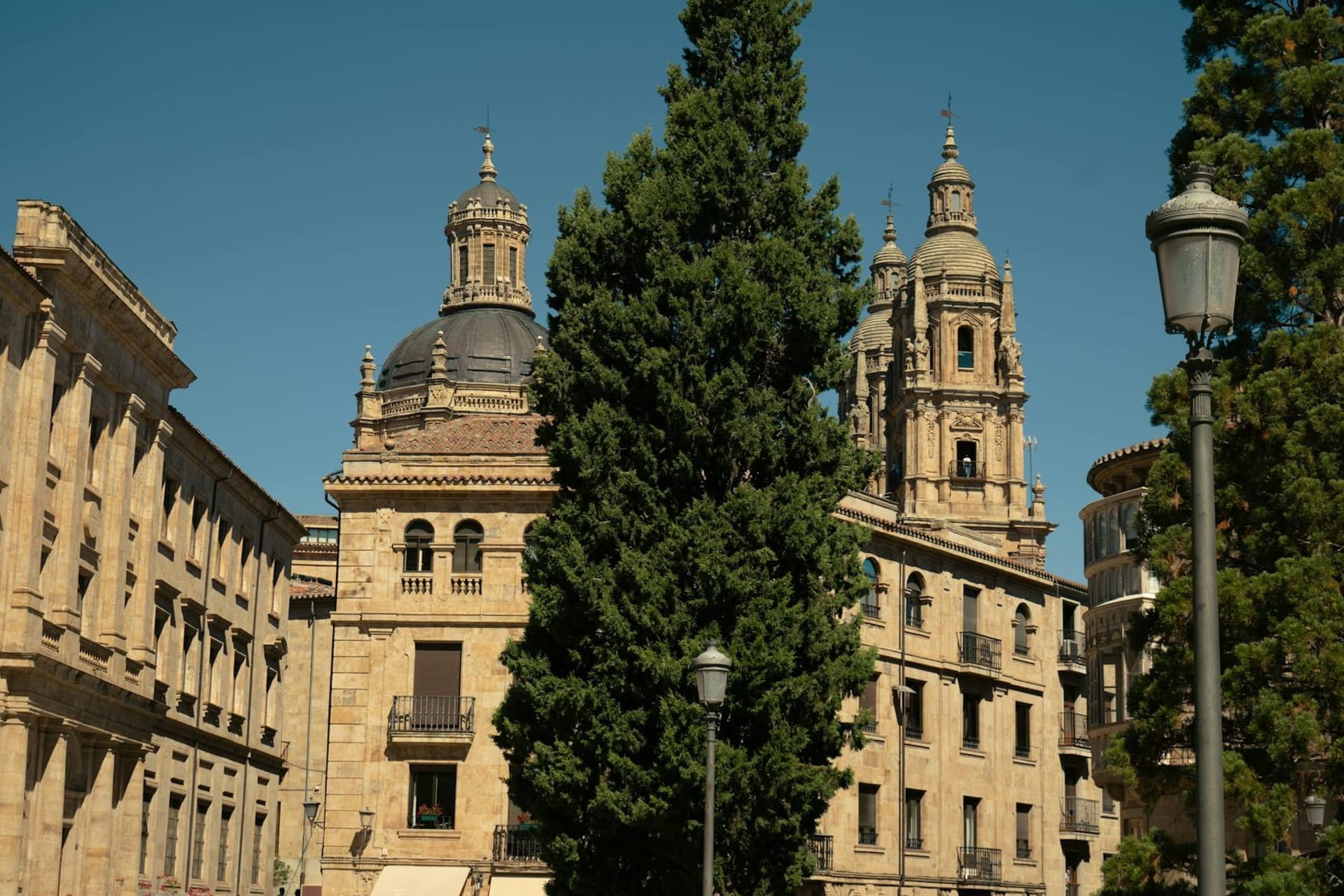
Salamanca
"Salamanca turns gold at dusk, not metaphorically but literally, because of what it's made of."
A UNESCO university city of golden sandstone glowing like amber at sunset — the Plaza Mayor alone ranks among Spain's greatest urban achievements.
The train from Madrid drops you into Salamanca mid-afternoon, which turns out to be exactly the right time. Not because of logistics, but because the light is already beginning its slow conspiracy with the stone — the villamayor sandstone that gives every façade here its characteristic honey-amber glow — and you have just enough hours to walk the city once before it ignites.
What the Stone Does at Sunset
Salamanca turns gold at dusk, not metaphorically but literally, because of what it’s made of. The villamayor limestone — quarried for centuries from the hills around the city — oxidizes slowly in the open air, deepening from pale cream to something closer to saffron, then copper. By six in the evening, walking along Calle Compañía toward the twin cathedral spires, the entire street feels like it’s been backlit from within. I stopped in the middle of the road to photograph a doorway and Lia had to pull me out of the path of a passing Vespa.
The Plaza Mayor is the obvious set piece, and it earns every supercilious word written about it. Churriguera’s arcade — all rhythmic archways and carved medallion portraits — wraps around you on four sides, and the effect is less of a public square than of stepping into a baroque drawing room someone forgot to put a ceiling on. We sat at a café table with two glasses of Arribes wine and stayed for an hour longer than we meant to.
The University Quarter and an Unexpected Detail
The Universidad de Salamanca, founded in 1218, predates most European universities and it carries that age visibly. The Plateresque façade on Calle Libreros is dense with carved detail — shields, medallions, foliage — and somewhere among the ornamentation is a small sculpted frog perched on a skull. Students have been hunting it as a good-luck ritual for generations. I found it on my own, which felt like a small private victory, before discovering that every tourist brochure in the city gives away the location.
What genuinely surprised me was the silence inside the Catedral Vieja. The old cathedral, swallowed half-accidentally by the new one in the sixteenth century, has preserved something the newer building gave up: intimacy. The Capilla de San Martín holds a fresco cycle so worn by time it looks like memory itself — shapes emerging from plaster, half-legible, deeply affecting.
In the evenings, tapas along Rúa Mayor cost almost nothing and the bocadillo de lomo at the stand-up bars near the market is as good as food gets when it is simple and made without pretension.
When to go: Late September through November, when the summer crowds have thinned and the afternoon light falls at that long, low angle that makes the sandstone absolutely incandescent. Spring also works, but autumn is Salamanca at its most itself.