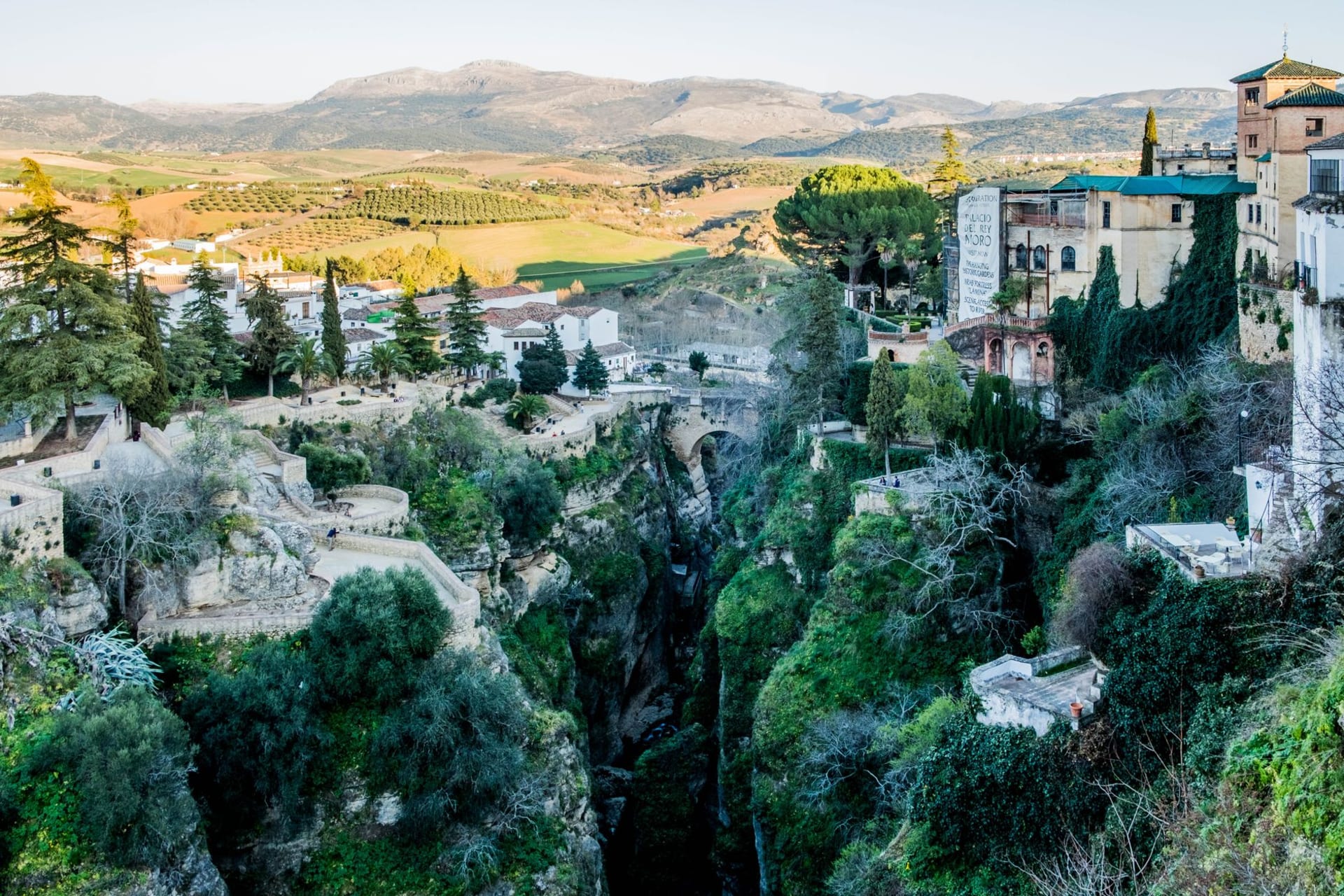
A white town balanced on the edge of a spectacular gorge, its 18th-century bridge spanning 120 meters of sheer Andalusian air.
There is a moment, walking along the Camino de los Molinos on the western rim of El Tajo, when the path bends and the full drop presents itself — 120 meters of sheer limestone, the Guadalevín river a white thread far below, and the Puente Nuevo rising above it all with the casual confidence of something that has no business existing. I stood there for a full minute not moving. Lia took two photographs and then put her camera away. Some things resist framing.
The Bridge and What It Means
The Puente Nuevo — the New Bridge, completed in 1793 after earlier attempts collapsed — is not just a crossing. It is the reason the town exists at scale, the hinge between the old Moorish medina of La Ciudad on one side and the newer Mercadillo quarter on the other. Walking across it, you look down through the parapet gaps and feel the altitude in your stomach. The small chamber inside one of the central arches was used as a prison during the Civil War. The town does not hide this.
From the south side, along the Paseo de Blas Infante in the late afternoon, the light turns the stone the color of amber and the gorge fills with shadow before the bridge does. That sequence of light — amber on limestone, blue in the gorge — lasts about twenty minutes and then it is gone.
La Ciudad and the Tajo Rim
The old Moorish quarter of La Ciudad sits south of the bridge, its streets still following the medieval grid: Calle Armiñán, the Marqués de Salvatierra palace, the Arab baths on the lower slopes where the horseshoe arches have stood since the thirteenth century. I ordered a plate of berenjenas con miel — fried aubergine slicked with cane honey — at a tablecloth-less bar on Calle Ruedo Alameda and ate it standing, watching two men argue cheerfully over a chess board in the corner.
The unexpected thing was the smell. Ronda in October smells of woodsmoke and something floral I could not identify — jasmine, maybe, or the pittosporum hedges along the garden walls. The town sits at 740 meters and the air is genuinely cool even in early autumn, clean in a way that surprises you after the coast.
Corrida, Hemingway, and the Weight of Context
The Plaza de Toros of Ronda is the oldest bullfighting ring in Spain, built in 1785, and it is beautiful in the way colonial architecture is beautiful — proportionate, rational, deeply implicated. Pedro Romero, born in Ronda in 1754 and considered the father of modern bullfighting, fought here. Hemingway came for the September Corrida Goyesca, the period bullfight where the matadors wear eighteenth-century costumes, and wrote about it in the kind of sentences that age badly. The ring is worth entering for the architecture alone. What you make of its purpose is yours to decide.
When to go: Late September through early November, or April into May. Summer fills the mirador with tour groups by nine in the morning and the heat at midday is indifferent. In October the light is perfect, the crowds thin after noon, and the town smells of that smoke I still cannot name.