Jerez de la Frontera
"Everything in Jerez smells faintly of oak and yeast, even the cathedral, even the horses."
Sherry ages in dark bodegas here while flamenco gets born in the same breath — Jerez is the one Andalusian city that never bothered to choose between its two obsessions.
The smell hits you before anything else — a low, sweet must of fermenting grapes and old oak that seems to seep out of the very walls downtown. Jerez de la Frontera gave sherry its name (the English mangled “Jerez” into “sherry” centuries ago and never gave it back), and the wine is still the organizing fact of the city. Bodegas the size of small cathedrals sit right in the historic center — Tío Pepe’s sprawling complex practically leans against the Alcázar — their vaulted, whitewashed halls stacked floor to ceiling with American oak barrels arranged in the solera system, a slow relay of blending old and young wine that can keep a house style consistent across generations.
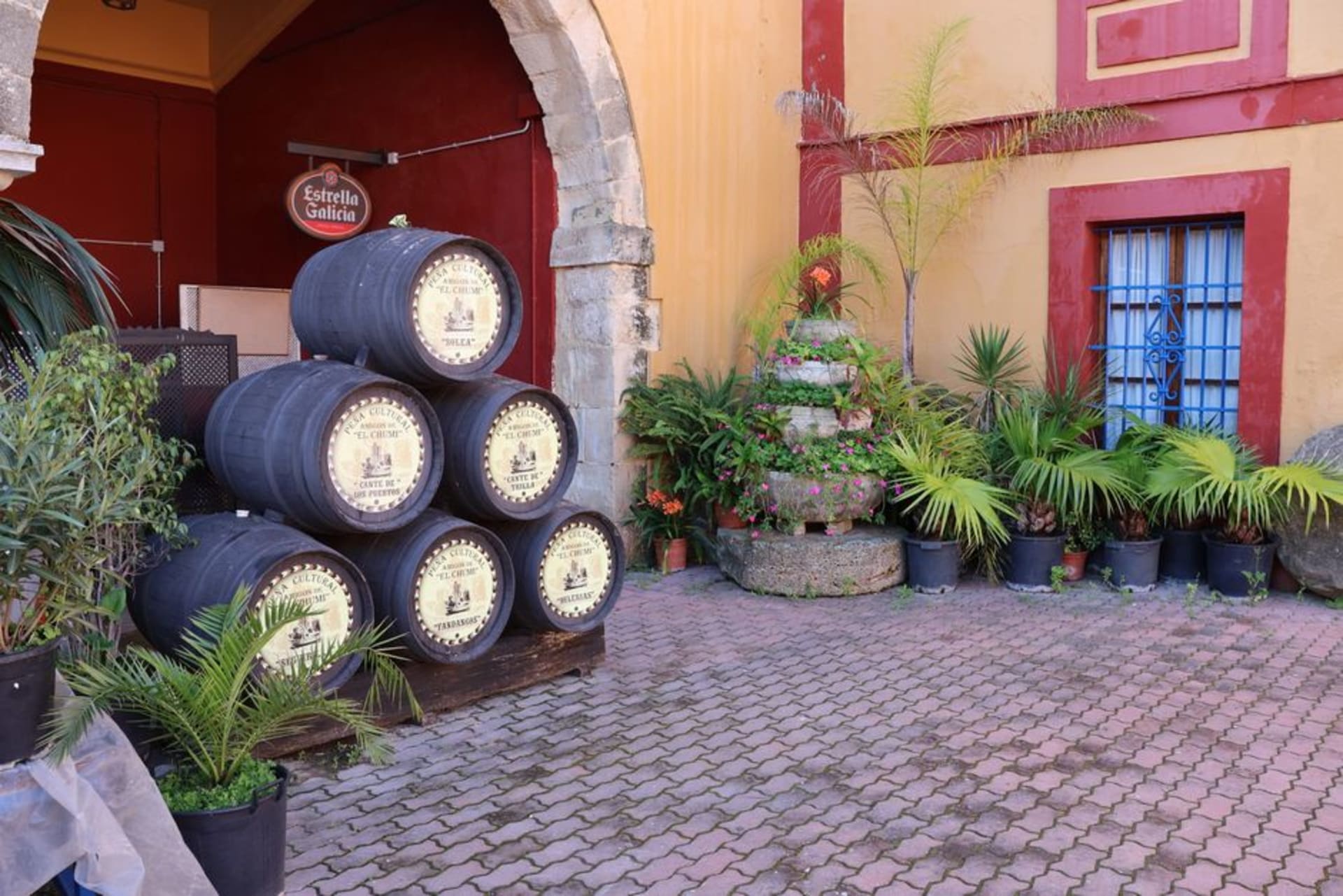
Under the Arches, Barrels Waiting
I did a bodega tour on a whim, more curious than committed, and left converted. A guide walked us between rows of casks signed in chalk by visiting dignitaries going back a century, explaining how the region’s albariza soil — chalky, brilliant white, almost lunar in the midday sun — reflects heat back up into the vines and holds moisture through the punishing Andalusian summer. We tasted a fino, bone dry and faintly saline, apparently a product of flor, a living veil of yeast that forms naturally on the wine’s surface and protects it from oxidation while it ages. Nobody engineered that; the microclimate here just happens to grow it. I’d always thought of sherry as my grandmother’s dusty bottle at Christmas. I don’t think that anymore.

Horses, and the Other Kind of Rhythm
Jerez’s other great institution is the Real Escuela Andaluza del Arte Ecuestre, where Andalusian horses are trained to something between dressage and dance, and the Thursday showcase — pure Spanish horses moving in formation to music under the eighteenth-century palace’s arcades — plays out with a formality that borders on operatic. But the rhythm that actually stayed with me came later, in a bar in the Barrio de Santiago, the old Gitano quarter widely considered one of flamenco’s true birthplaces alongside Triana in Seville. Jerez has its own dialect of the art, called bulerías — faster, more percussive, almost teasing compared to the gravity of flamenco elsewhere — and I watched a trio perform in a room barely bigger than my kitchen, close enough to see the guitarist’s fingers blur and the singer’s face contort around a note that seemed to cost him something.

The cathedral, oddly, is a late addition to all this — an eighteenth-century Baroque build with a Gothic ambition, its silhouette dominated by an octagonal tower that used to double as a minaret watchpost when the site held a mosque. I climbed up as the evening cooled, watched the light go copper over the rooftops and the bodega chimneys, and thought that a city built on fermentation and improvisation has its priorities exactly right.
When to go: September, during the grape harvest (vendimia) and the city’s flamenco and equestrian festivals, is when Jerez feels most fully itself, though spring offers gentler heat for wandering the bodegas.