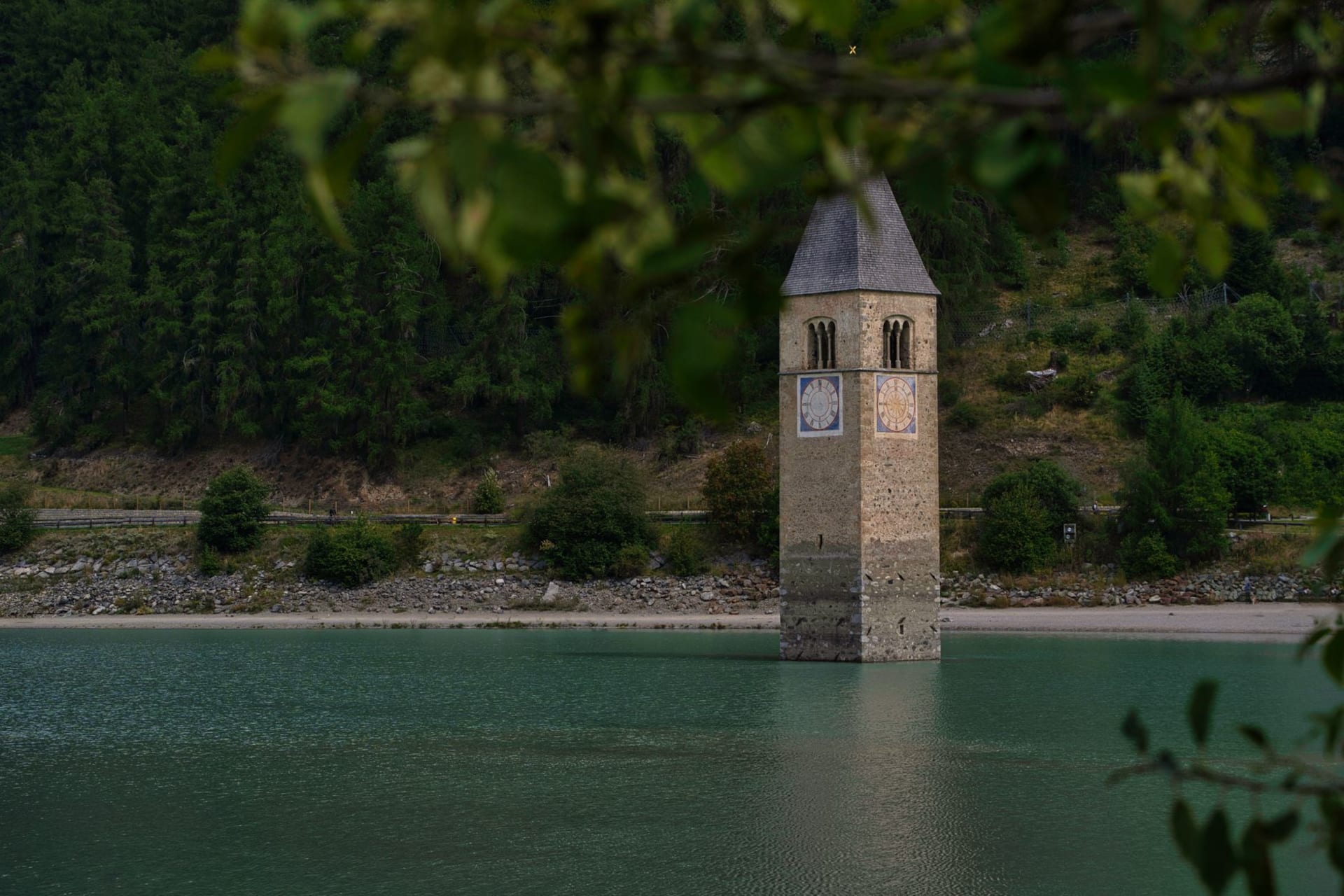
Val Venosta
"Too dry for the Dolomites, too green for the desert, too interesting to explain quickly."
The Driest Valley in the Alps
Val Venosta — Vinschgau in German — receives around 500 millimeters of rain per year, less than half the European alpine average, which is why it looks different from the first kilometer. The valley floor is wide and flat, the Adige river running through irrigated orchards in a landscape more agricultural than alpine. The mountains rise steeply on both sides but the valley itself sits in a rain shadow created by the surrounding massifs, and the light here has a clarity and sharpness you notice without being able to immediately name.
The apple production is enormous. South Tyrol grows about 10% of Europe’s apples, and a substantial portion of that comes from Val Venosta. The orchards in April are startling — white blossom wall to wall across the valley floor, the smell carried on cool air down from the mountains — and the harvest in September brings a sweetness to the whole valley that you taste before you see it.
Castles, Plural
Val Venosta contains more medieval castles per kilometer than almost anywhere I’ve been in Europe. They sit on every rocky spur, every defensible hill above the valley: Churburg at Sluderno, Juval (Reinhold Messner’s private home-museum), the ruins of Lichtenberg above Laces, Castel Coira near Glorenza. Most are open to visitors in summer; several have ticket offices staffed by people who clearly expected you to come.
Churburg is the one to not skip. It’s been in the same aristocratic family — the Trapp-Attimis — since 1293, continuously inhabited, and contains one of the finest private collections of medieval armor in Europe. The halls smell of old stone and lanolin from centuries of metal maintenance. The tour guide speaks slowly and precisely, as if the objects require that.
Glorenza and the Enclosed
Glorenza (Glurns in German) is a town of about 900 people enclosed in complete 16th-century walls that have never been significantly altered. You walk through the original gate under a tower, and the interior — a square with arcaded walkways, a single main street, two cafés and a bakery — is small enough that you can see all of it in fifteen minutes. But the compression of the place, the sense of life continuing inside a military boundary that no longer makes strategic sense, is the point.
I sat in the square for an hour in October. Two elderly men played chess at a table outside the café. A cat moved between their chairs. The clock on the tower struck twice.
The Stelvio Pass
The valley climbs at its upper end toward the Stelvio Pass — 2,757 meters, one of the highest paved Alpine passes, with 48 numbered hairpin turns on the south approach. I drove it in late June when it had been open for three weeks. The pass itself is cold even in summer, the snowbanks still two meters high on the roadside, and the view from the top — south into the Val Venosta, north into the Swiss canton of Graubünden — is the kind that makes you want to describe things and fail.
When to go: April for apple blossom, September for harvest. June to October for the Stelvio Pass (closed in winter). The valley is genuinely four-season accessible — drier winters than the rest of South Tyrol make cross-country skiing reliable without the icy chaos.