
Jeju Coastal Trail
"Jeju's Olle trails prove that walking a volcanic island slowly is the only way to understand what a volcano leaves behind."
The Olle coastal walking trails circle Jeju's basalt coastline past haenyeo divers and tangerine orchards.
I kept expecting the trail to feel like exercise. It never did. The Jeju Olle routes — twenty-six numbered paths that together circle the entire island — move at the pace of someone who is not in a hurry, which is the only pace that makes sense here. The basalt underfoot has been worn smooth by centuries of feet. The wind off the strait carries salt and something green I could never name. Every twenty minutes, the view changes entirely. You round a headland and the sea opens in a new direction, a different shade of the same impossible blue.
We started on Route 7, the section that runs from Wolpyeong Port near Seongsan into the eastern coast, largely because our guesthouse owner pointed at it on a laminated map and said, in the kind of firm Korean English that admits no argument, “This one is best.” He was not wrong.
The Basalt Coast at Low Tide
The trail drops down from the cliff path to the shoreline at several points along Route 7, and at low tide the exposed basalt is extraordinary — hexagonal columns stacked like a collapsed library, the rock so dark it looks wet even when it is dry, the pools between them holding small crabs and sea urchins and water the colour of green glass. Lia spent nearly forty minutes photographing a single tidal pool while I sat on a flat rock and ate a tangerine from a bag we had bought at a roadside stall that morning. The fruit on Jeju has a different quality than tangerines anywhere else — thin-skinned, intensely sweet, with a bitterness underneath that arrives just as the sweetness fades. The island grows them in quantities that feel absurd: orange nets hanging from every available branch, the orchards pressing right up against the trail’s edge, the smell of citrus mixing with salt for entire kilometres at a stretch.
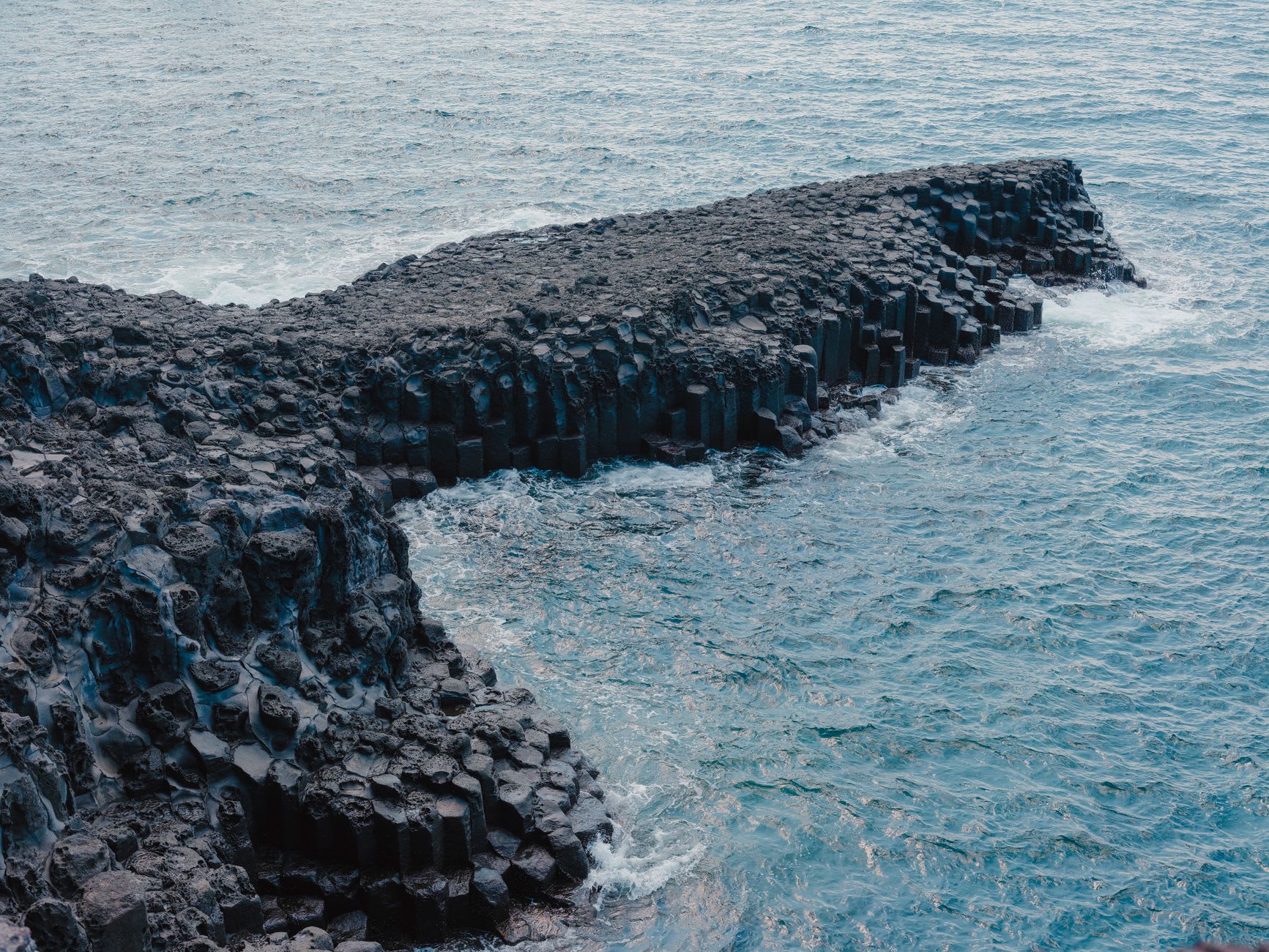
The light on the eastern coast in the morning has a particular quality I was not prepared for. Jeju sits at a latitude where the sun rises at an angle that stretches every shadow long across the stone, and the basalt — black, porous, ancient — catches the light differently from anything I have walked on before. It does not gleam. It absorbs. The cliffs along this stretch look like they are still deciding whether they are finished being volcanic.
The Haenyeo
I had read about the haenyeo — the women divers of Jeju who free-dive for abalone and sea cucumber and turban shells without air tanks — before arriving. The reading did not prepare me for the reality.
We found them at a rocky inlet near Sinyang Beach, about two hours into the walk. A cluster of small figures in black wetsuits standing knee-deep at the water’s edge, adjusting nets, checking equipment with the casualness of people for whom the sea is a workplace and not a spectacle. Then, one by one, they waded in and disappeared beneath the surface. No ceremony. No announcement. They simply went under.
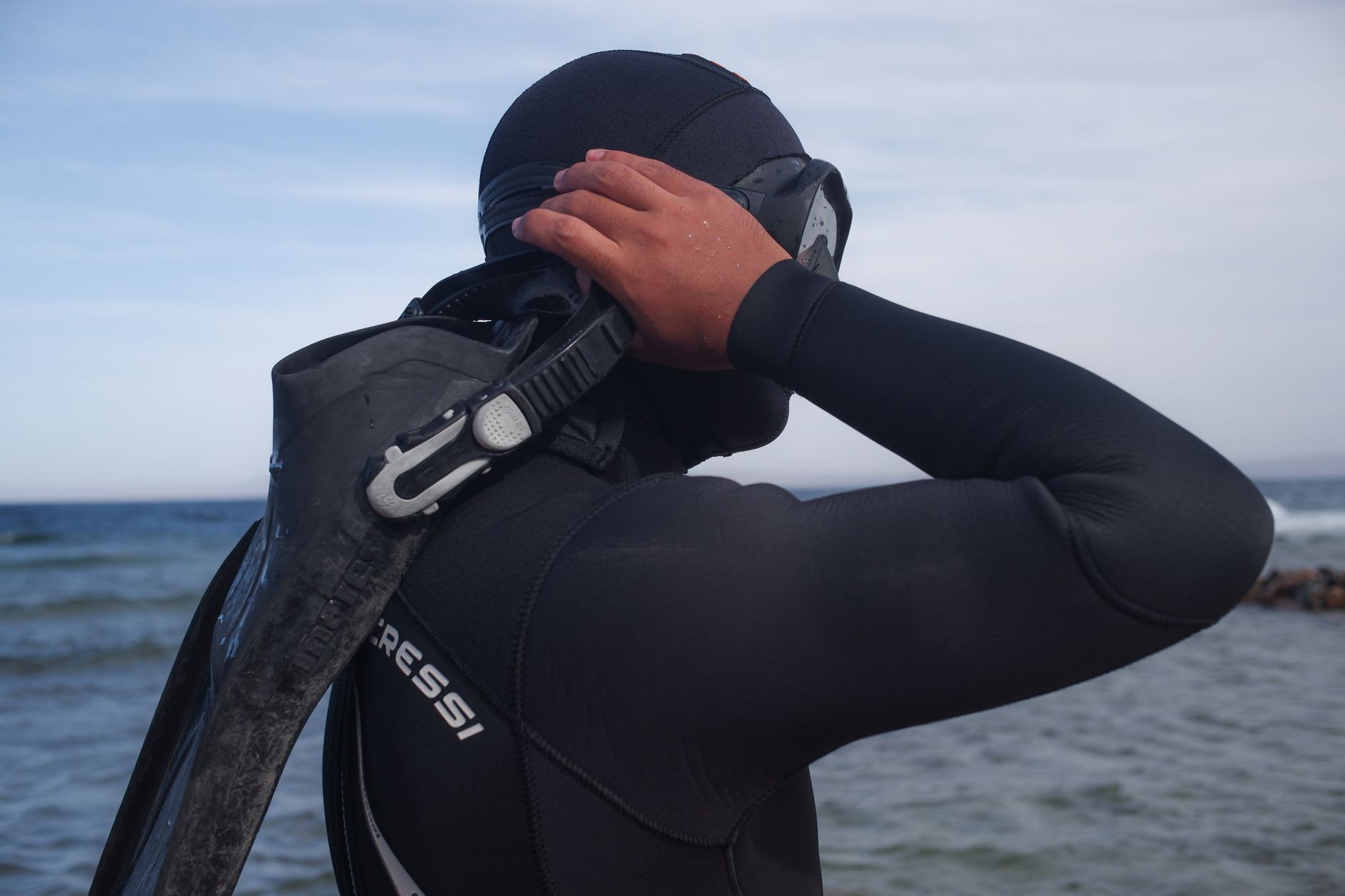
What surprised me — the thing I had not anticipated from anything I had read — was the sound. When a haenyeo surfaces, she exhales in a long, controlled whistle called sumbisori, a breath technique that regulates pressure and signals the dive is complete. Standing on the rocks above the inlet, I heard it before I saw her surface: a high, sustained note that carried over the waves and the wind. Then another. Then three at once, a strange underwater choir rising from the water into the morning air. Lia grabbed my arm without saying anything. We stood there for a long time, not moving, listening to women who have been diving this coastline for centuries surface into a sound that belongs entirely to this place and nowhere else on earth.
Ending at Seongsan Ilchulbong
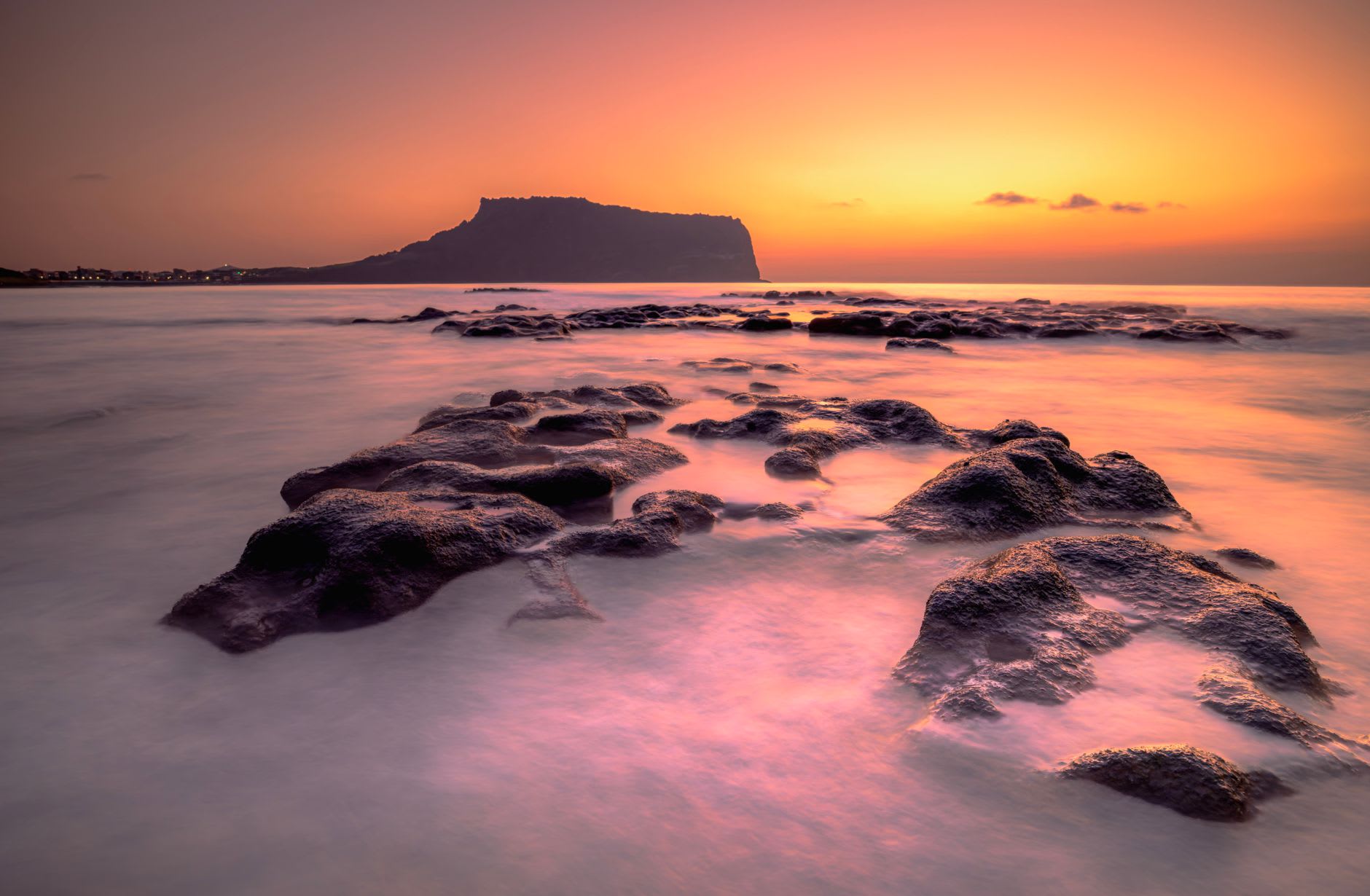
The final kilometres of Route 7 follow the coast toward Seongsan Ilchulbong — the tuff cone that rises from the sea at the island’s eastern tip, its crater rim visible from the trail for a long time before you arrive. I had seen photographs of it. The photographs show a dramatic green hill rising from the water. The reality adds the scale: the thing is enormous, and it appears over the last hour of the walk like a ship approaching, growing slowly until it fills the horizon ahead.
We did not climb it that evening — we had walked nineteen kilometres and my calves had opinions about stairs. But we sat at the base with paper cups of haemul pajeon we had bought from a stall at the trailhead — a seafood and scallion pancake, crisp on the outside and yielding in the middle, eaten standing up with no table and no ceremony — and watched the light change on the crater wall. The green of the grass on the rim turned gold, then amber, then the deep orange of a coal before it goes dark. The sea below it was perfectly still. A fishing boat crossed the frame at exactly the wrong moment and then at exactly the right one.
This is what a volcano leaves behind: not just rock, but everything that grows in it and around it. The tangerine orchards anchored in black soil. The tidal pools carved into basalt columns. The coastline shaped by an eruption that ended millennia ago and is still, walking these paths, entirely legible. The trail is a way of reading it slowly enough to understand.
When to go: September through November offers clear skies, mild temperatures, and the tangerine harvest in full swing — the orchards along the trail are loaded and roadside stalls are everywhere. Spring (March to May) brings yellow canola fields against the dark basalt, one of Jeju’s most distinctive sights. Avoid July and August if possible — the trail is crowded and the humidity is punishing.