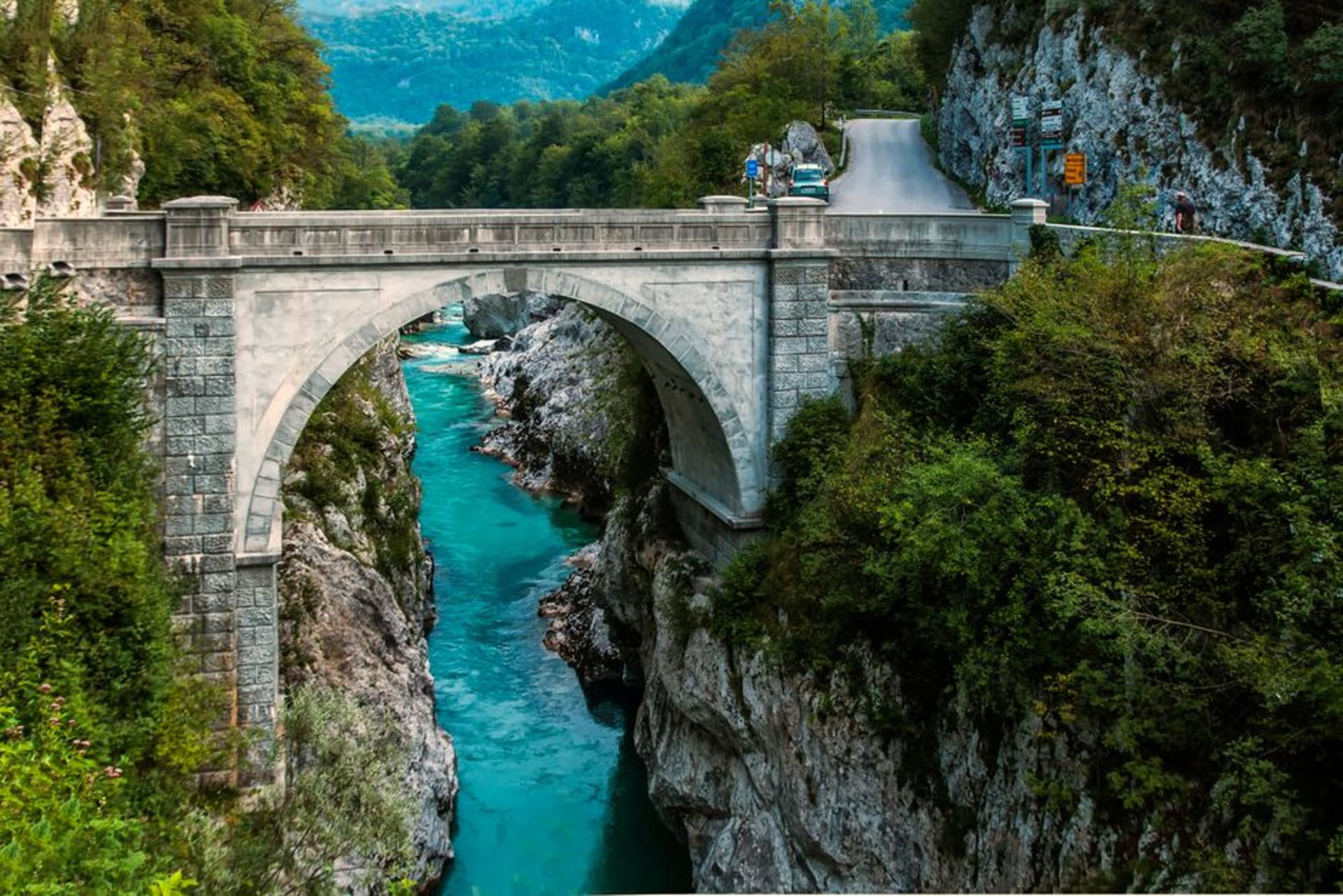
Solkan Bridge
"A century-old railway bridge that makes you stop the car just to stare at how a single stone arch can hold that much weight."
The largest stone railway arch bridge in the world, spanning the Soča near Nova Gorica in a single elegant span that has carried trains across the river since 1906.
We nearly missed Solkan Bridge entirely — it was a five-minute detour on the drive from Nova Gorica toward Kobarid, mentioned in a guidebook footnote as “world’s largest stone railway arch bridge,” a claim specific enough that I assumed it had to be exaggerated. It wasn’t. The bridge spans the Soča in a single stone arch 85 meters wide, still in daily use, still carrying freight and passenger trains exactly as it has since it opened in 1906 as part of the Bohinj Railway connecting the Austro-Hungarian empire’s interior to the port of Trieste.
An Arch That Shouldn’t Work, and Does
Standing on the riverbank looking up at it, the scale is difficult to process — this is not a modern suspension structure with cables doing the load-bearing work, it’s solid cut stone, assembled block by block by masons working over the river more than a century ago, using engineering principles that had been refined but not fundamentally changed since Roman times. We watched a freight train cross while we stood there, the whole structure barely registering the weight, and I found myself doing the mental math on how much stone had to be quarried, shaped, and placed to make this thing possible, and getting nowhere useful with it.
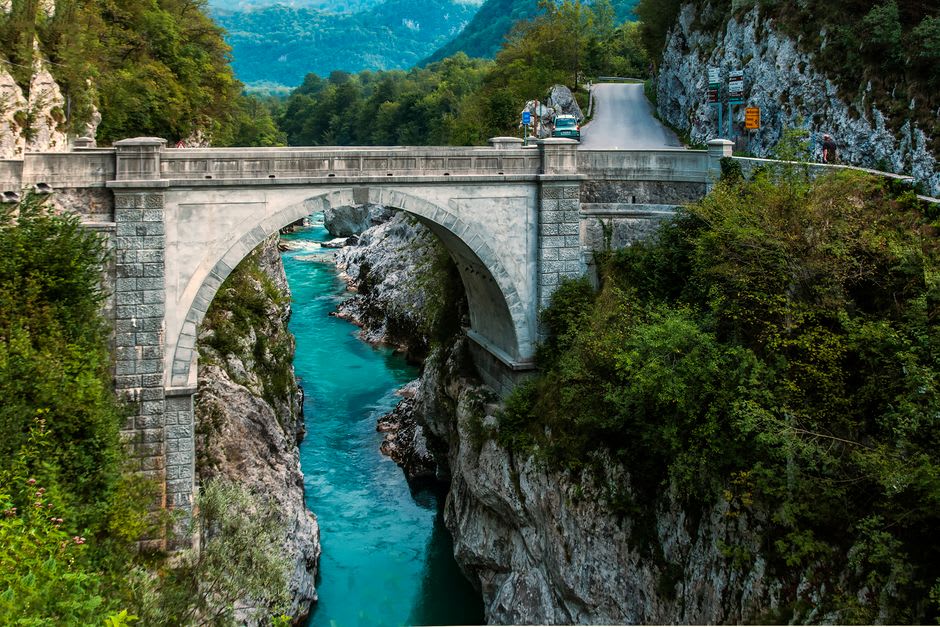
Rebuilt After Being Blown Apart
What makes the bridge’s survival even more remarkable is that it didn’t, technically, survive intact — it was destroyed during the fighting of the First World War along this same Isonzo Front that scarred Kobarid and Tolmin, and again suffered damage in the Second World War. Each time it was rebuilt using the original design and largely the original stone, salvaged and reassembled, a small act of civic stubbornness that treated the bridge as something worth restoring exactly rather than replacing with something more modern and practical.
The View From the River Below
We scrambled down to the riverbank on the Solkan side, where a narrow gravel beach lets you sit almost directly beneath the arch and watch the Soča’s turquoise water pass beneath a century of stonework. A few local teenagers were jumping from a lower rock into a calm pool nearby, entirely unbothered by the historical weight of what was over their heads, which felt like exactly the right way to treat a monument this old — as scenery, not sanctity.
When to go: Year-round, since it’s a quick roadside stop rather than a full excursion. Late afternoon light works best for photographing the arch against the river.