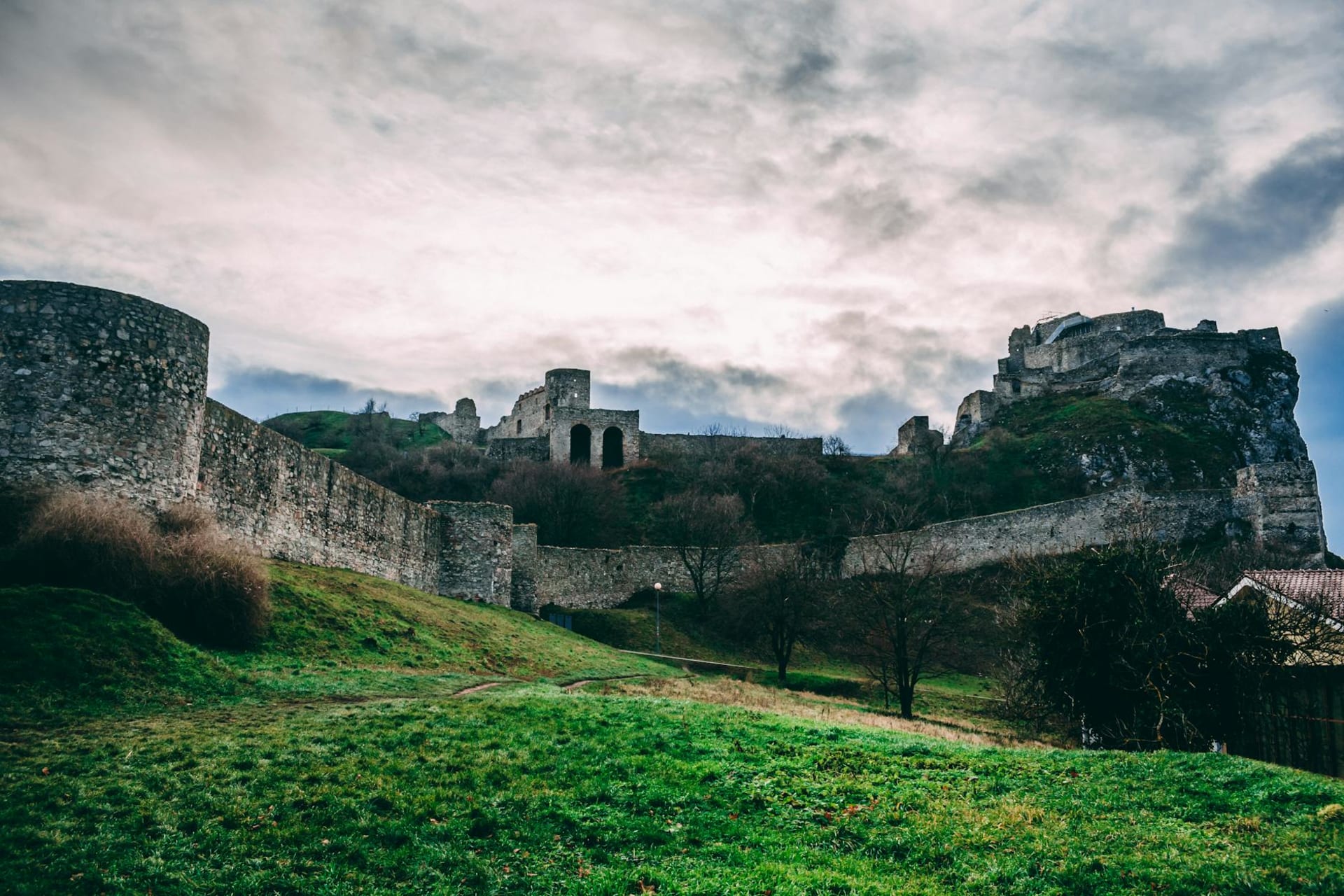
Devin Castle Bratislava
"Two rivers meet beneath the ruin. Both continue toward the sea."
A ruined castle above the confluence of the Danube and Morava rivers where Slovak nationalists gathered before independence.
We took the number 29 bus from the old town, out through the flat western suburbs of Bratislava, and I remember the moment the road bent and the ruin appeared above the treeline — a single broken tower against the grey of the January sky, not dramatic but insistent, the kind of silhouette that keeps asking to be looked at.
The Confluence
Standing on the rampart at the castle’s western edge, the thing that stops you is not the ruin itself but what it watches over. The Danube moves with the slow authority of a river that knows it has a thousand kilometers still to go. The Morava arrives from the north in a mood of total submission, lighter in color, thinner, folding itself into the larger current without ceremony. For centuries this junction was a border — the edge of the Roman Empire, the boundary of the Iron Curtain, a strip of no man’s land where the communist regime planted mines in the reeds. Lia pointed to the Austrian bank, visible and green and fifteen minutes away by ferry. It felt much further for a long time, she said, reading from the information board. I believed it standing there.
What the Nationalists Came For
In the 1820s and 1830s, Slovak intellectuals made pilgrimages up this limestone bluff to recite poetry and argue about language and the possibility of a Slovak nation. The castle was already a ruin then. They chose it deliberately — the broken walls as a symbol that something had existed here, something worth rebuilding. I found a small plaque near the inner gate that marked one of these gatherings, the names weathered but legible. There is something quiet and serious about a place where people came not to be entertained but to be reminded of something they were afraid of forgetting.
The Unexpected Detail
What I did not expect was the wine. Inside the small museum at the base of the tower, a volunteer explained that the slopes below the castle have been producing wine since Roman times, the same thin chalky soil that runs through the Morava valley. He handed me a glass of local Welschriesling without asking. It was cold and slightly sharp and tasted of the mineral ground underfoot. I bought a bottle from a stand near the parking area on the way out. We drank it that evening in the apartment looking at the photographs we had taken of the two rivers, trying to see where one ended and the other began.
When to go: Late spring through early autumn gives the clearest light and the best views down to the confluence; May is ideal when the hillside vegetation is still spare enough to see the full sweep of both rivers from the ramparts without the summer crowds.