
Kampong Glam
"Haji Lane was barely wide enough for two people and every door led somewhere unexpected."
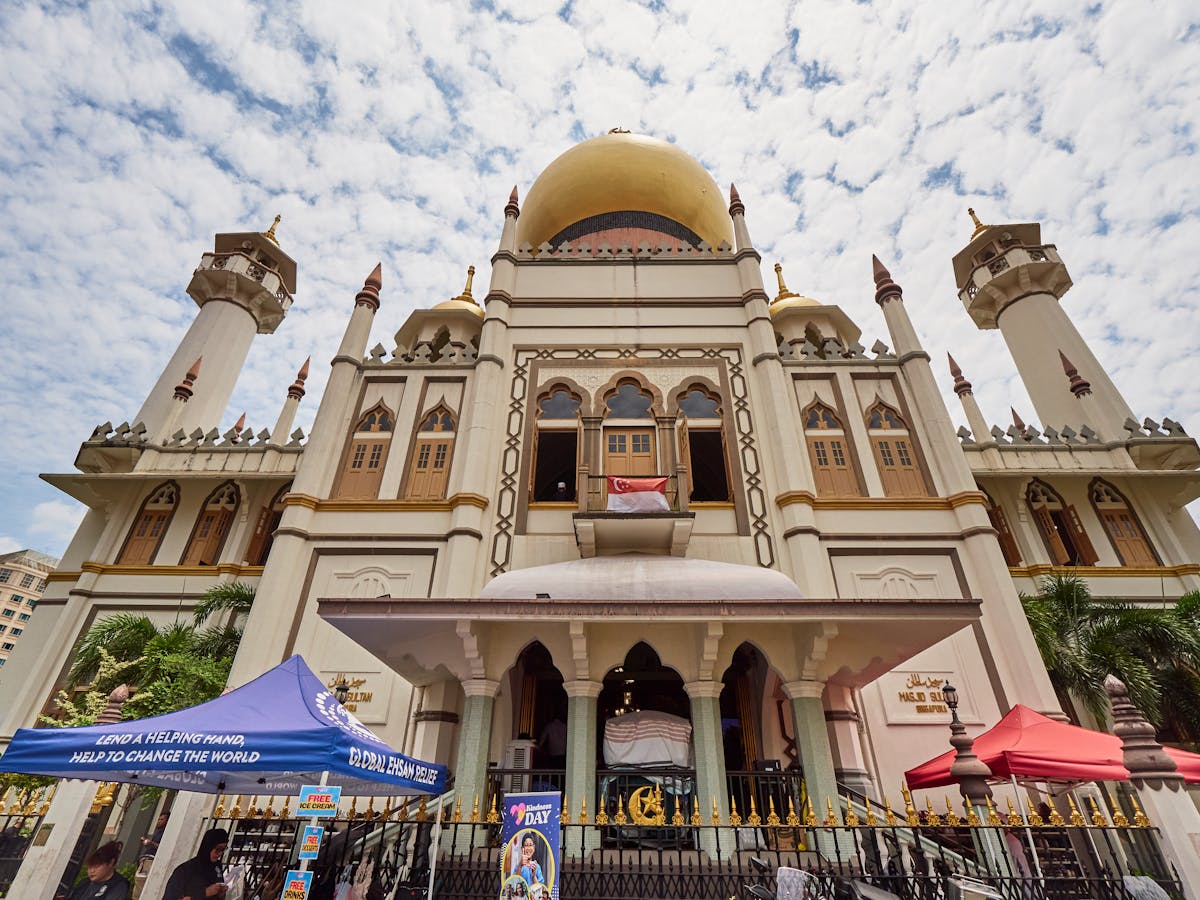
Kampong Glam is where Singapore’s Malay and Arab heritage lives, and it has become one of the city’s most vibrant creative districts without losing its cultural roots. The Sultan Mosque, with its golden dome and prayer hall that holds 5,000 worshippers, anchors the neighbourhood in both geography and spirit. I stood in the courtyard during the call to prayer and the sound filled the streets in every direction, drifting over the shophouses and the cafes and the vintage shops, and for a moment the entire neighbourhood felt unified by something larger than commerce or tourism.
Arab Street is lined with textile shops, perfumeries, and carpet sellers that transport you to a Middle Eastern souk — or at least to the memory of one, filtered through a century and a half of Singaporean adaptation. The perfume shops are extraordinary. We spent forty-five minutes in one, the owner blending custom attars from essential oils with the concentration of a chemist and the showmanship of a performer. I left with a small bottle of oud and rose that still, months later, smells like that afternoon.
But turn onto Haji Lane and the mood shifts entirely. This narrow alley — barely wide enough for two people to walk abreast — is ground zero for Singapore’s independent scene. The shophouses have been converted into vintage boutiques, record shops, street-art canvases, and bars that open their shutters to the pavement at dusk. The murals change regularly, the inventory in the vintage stores rotates with the kind of curation that suggests someone with very specific taste, and the energy in the evening is young and international and creative in a way that feels genuine rather than manufactured.
We drank Turkish coffee at a cafe where the cups were handmade and the owner talked to us about the neighbourhood’s history — how it was the seat of the Malay sultans, how the textile trade brought Arab merchants, how the street art arrived decades later and the two worlds learned to coexist. Then we ate murtabak at a stall on North Bridge Road that has been flipping the stuffed pancakes for decades — the dough stretched thin and filled with spiced mutton and egg, folded and fried on a flat griddle, served with curry sauce that had the kind of depth that only comes from a recipe refined over a lifetime. Five dollars for a meal that made me rethink the entire concept of fast food.
The Malay Heritage Centre, housed in the former Istana Kampong Glam — the palace of the Malay sultans — contextualizes everything you see on the streets. The exhibitions trace the community’s history from pre-colonial trade networks to contemporary identity, and the building itself, with its colonnaded verandas and garden, is one of the most beautiful in the district. Kampong Glam proves that heritage and hipster are not opposites — they are neighbours, sharing a wall, borrowing each other’s spices.
When to go: Year-round. Ramadan transforms the neighbourhood with bazaars and food stalls that operate after sunset — a special and atmospheric time to visit. Friday afternoons around the mosque are particularly beautiful. Haji Lane comes alive after 5pm, when the bars open their shutters and the street fills with people who look like they know something you do not.