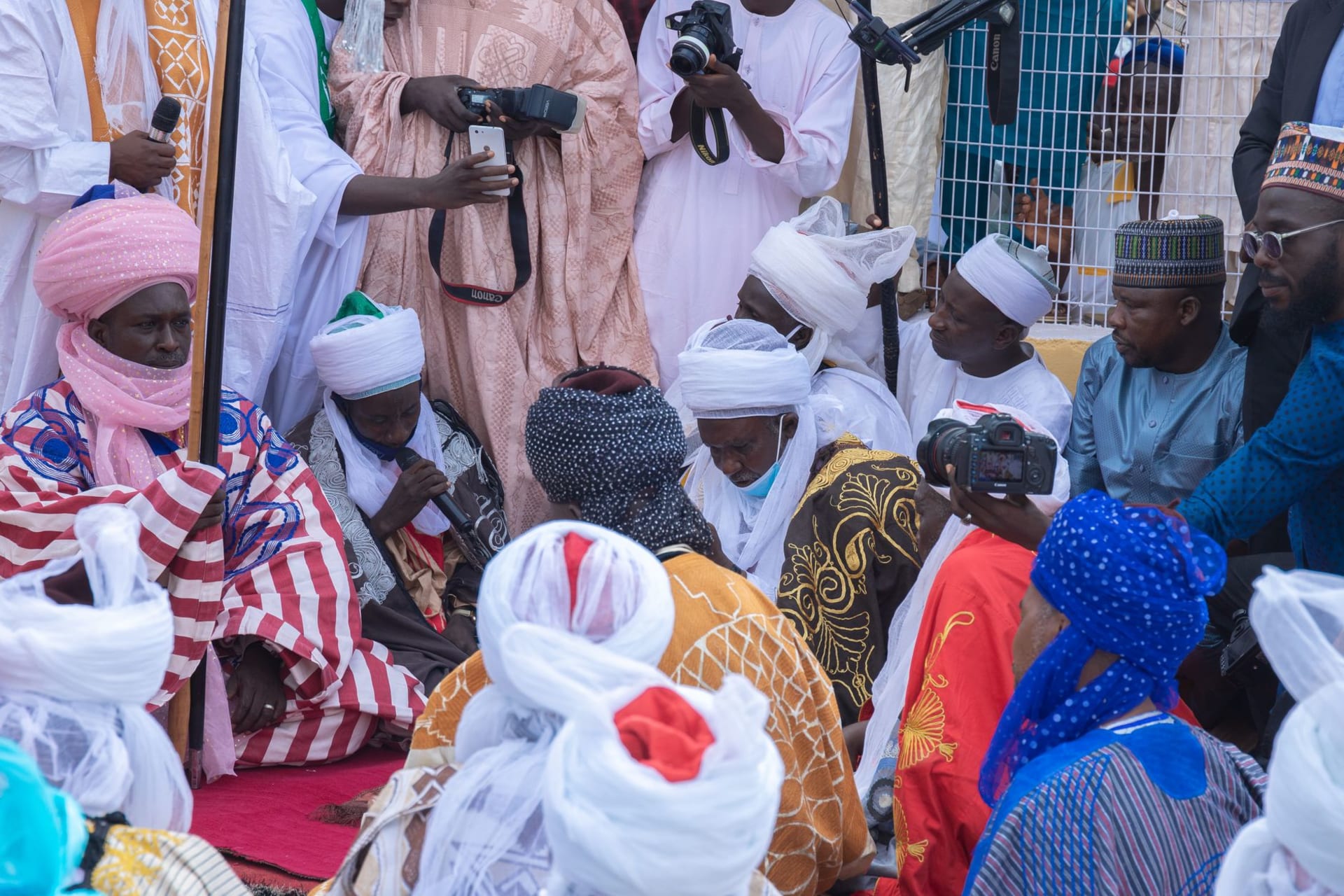
I’d been in Senegal two weeks before I understood that Touba isn’t just a city on a map — it’s a direction. In taxi parks across the country, the apprentis who call out destinations do something different when they say Touba. There’s a pause after, a slight shift in register, as if the name requires a moment of its own. The Mouride brotherhood is one of the largest Sufi orders in West Africa, and Touba is its capital, founded around the tomb of Cheikh Amadou Bamba, who established the order in the late nineteenth century while under the pressure of French colonial detention. The city he is buried in is now approaching one million residents and growing every year.
The Grand Mosque
The mosque at the center of Touba is one of the largest in Africa. Five minarets, the tallest rising over 85 meters. The main courtyard can hold hundreds of thousands of worshippers during the Grand Magal pilgrimage. I arrived on a Thursday afternoon — a Thursday, Touba’s day — when the city was busy with local devotion but not the scale of the pilgrimages.
Non-Muslims don’t enter the mosque. I walked the perimeter with a guide named Bassirou who had been born in the city and knew the building’s biography better than most people know their own neighborhoods. He told me which minaret was constructed by which Caliph, what each addition cost, who donated the Italian marble, what the current building phase is aiming at. The relationship between the Mouride Brotherhood and money is open and systematic in a way I found clarifying rather than uncomfortable. Devotion has produced infrastructure; infrastructure has produced more devotion. It compounds.
The City’s Own Rules
Touba operates under a different authority than the Senegalese state. No alcohol within city limits — not a law, exactly, but a fact enforced by collective agreement and the weight of the brotherhood’s moral authority, which in this city is absolute. Dress is conservative. Public behavior is measured. I expected a policed atmosphere and found instead something more interesting: a city that has chosen its constraints and has no ambiguity about them.
The Mouride economy spans peanut agriculture, trade networks across West Africa and the diaspora, real estate, and commerce. Dakar’s markets and street vendors include a significant proportion of Mouride merchants connected to Touba’s structures. The remittances flow back in. New construction was going up on every street I walked — hotels, housing blocks, a ring road under expansion. The city has tripled in size since the 1980s.
What I Didn’t Understand
I was visibly out of place in Touba, and people were uniformly and genuinely courteous about it. One man, near the mosque perimeter, asked me what I thought of the building. I said it was impressive. He said that wasn’t quite the right word — the right word was blessed. We stood with that difference between us for a moment. He smiled and went on his way.
I thought about that exchange for the rest of the trip. Not because I had an answer to it, but because I didn’t, and because Touba was one of the few places I visited where my tools for making sense of things were simply insufficient, and I knew it in real time.
When to go: Any time outside the Grand Magal, which draws three to four million pilgrims annually and becomes logistically impossible for independent travelers (it follows the Islamic lunar calendar — check dates each year). November through February for comfortable temperatures. Dress conservatively throughout: covered shoulders, long trousers or skirts for everyone. Alcohol is absent from the city entirely — plan accordingly.