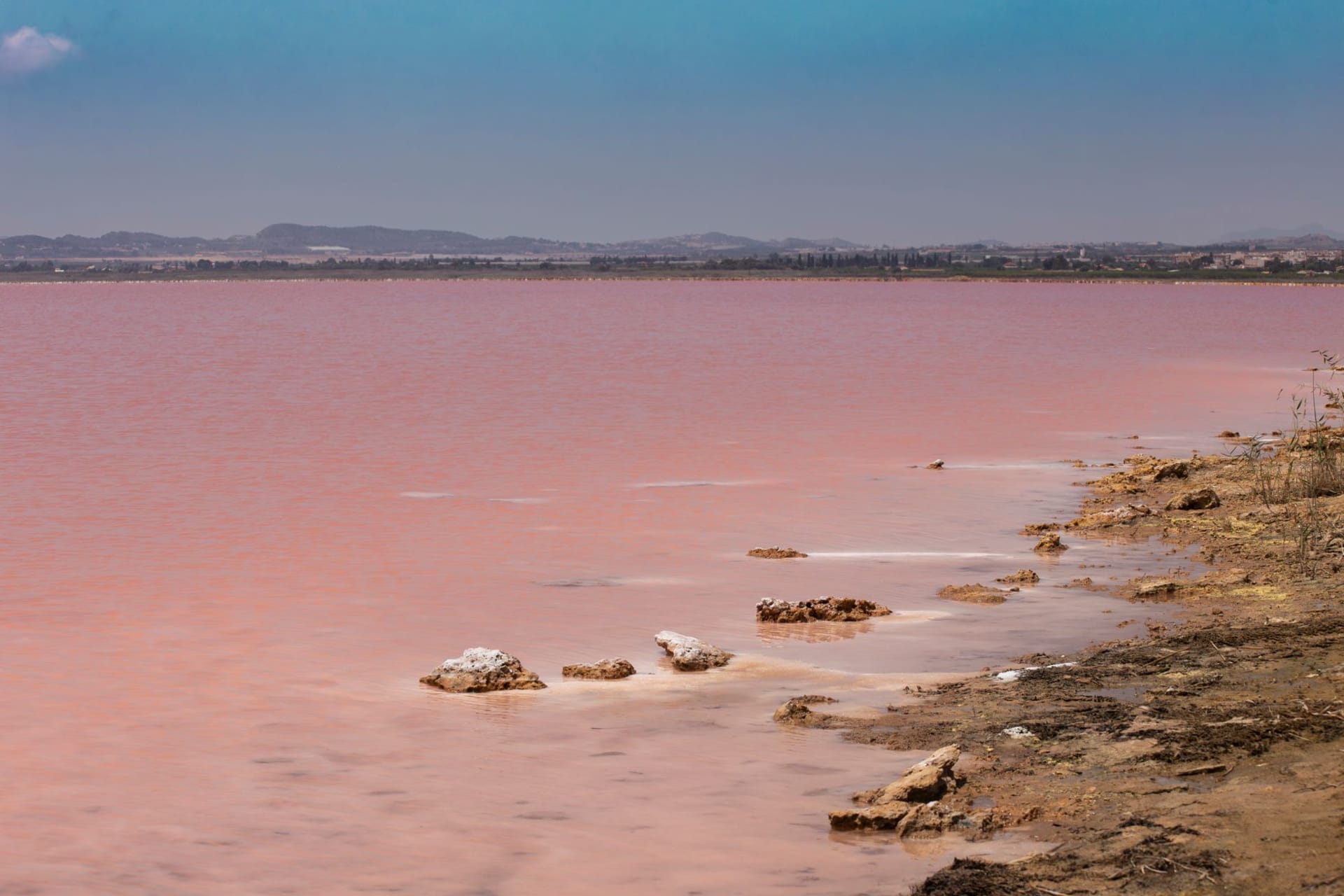
Lac Rose
"I've seen pink lakes in photos and dismissed them. I should have trusted the photos."
The pirogue driver told me the lake isn’t always pink. That was his opening line, delivered while we pushed off from the sandy bank — a kind of preemptive management of expectations. Color depends on the time of day, the angle of light, the concentration of algae, the season. I arrived at eleven in the morning in January, and by the time we’d crossed to the salt harvesters’ side, Lac Retba had opened what I can only describe as its full argument.
The Salt Men
The men who work the lake wade in water so saline it would blind you if it hit your eyes wrong. Before they enter, they coat themselves head to toe in shea butter — not ceremony, not performance for visitors, but necessity. Without the fat layer, the salt would work through their skin by midday. Their arms are glazed and muscular. They use short-handled shovels to scrape crystallized salt from the lake floor, load it into wooden pirogues, and pole it back to shore. A woman I spoke to at the sorting area said her husband had been doing this for eleven years. She weighed and bagged the salt in fifty-kilogram sacks while we talked, never stopping her hands.
The work is brutal and matter-of-fact. The men are out there from early morning. Watching them, I felt the usual discomfort of the tourist observing labor — then noticed that nobody was watching me back. They were working. I was just a man in a pirogue who happened to be there.
The Pink Logic
The color comes from Dunaliella salga, an algae that produces beta-carotene to protect itself against extreme salinity. In the dry season, evaporation concentrates the salt until the lake approaches the Dead Sea in density — some areas you can almost float. The algae blooms in those conditions. The light hits the beta-carotene and reflects back something the camera registers as pink but that the eye perceives as something more spatial than that: not just the surface of the water but the quality of the air above it.
I took too many photographs. None of them captured it. There’s a texture to being inside that color — the pink is ambient, not flat, the way light inside a cathedral is different from light on the street.
The Dune Edge and the Village
The lake sits in a basin between the Cap-Vert peninsula and a ridge of pale sand dunes that separate it from the open Atlantic. You can hear the ocean if the wind is coming from the right direction. The salt workers’ village clusters along the eastern bank — a few hundred families, guesthouses that have opened in the last decade to catch the tourist traffic from Dakar. Basic, clean, positioned for sunrise, which I can only assume is extraordinary.
I didn’t stay. I went back to Dakar in the afternoon and regretted it by evening. Some places tell you immediately that you’ve made the wrong logistical decision, and this was one of them.
When to go: December through April for the most reliable pink — the algae bloom peaks when dry season evaporation is at its height. November works but the color is less intense. Aim for midday on a weekday. The lake gets overwhelmed on weekends with Dakar excursion groups; the crowd disrupts the stillness that makes the whole experience.