Timbuktu
"Timbuktu earns its legend not by being extraordinary but by being exactly what you feared it might no longer be."
Everyone who goes to Timbuktu arrives carrying a version of it assembled from books, from the phrase “from here to Timbuktu,” from centuries of rumor about a city of gold at the edge of the known world. The gap between that version and the actual place is something you have to negotiate for yourself, and I am still not sure I managed it cleanly. The city is smaller than you expect. The streets are sand. The mud-brick walls are lower than the photos suggest. And yet something persists — a quality of remoteness so genuine it has a physical texture, a dusty dryness in the air that makes everything feel provisional, as though the city is holding its position at the edge of the Sahara through pure stubbornness.

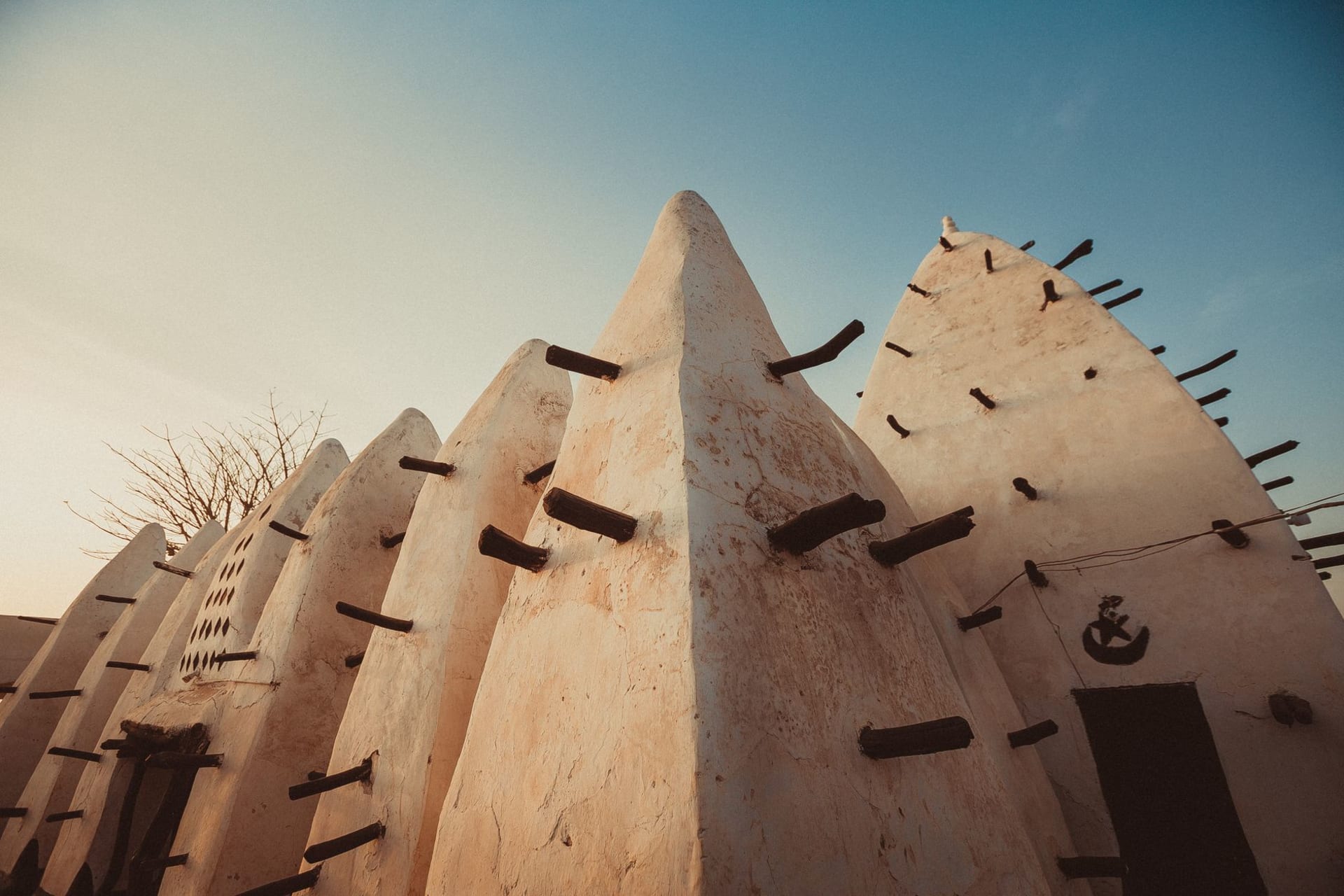
The three great mosques — Djinguereber, Sankore, and Sidi Yahia — are what the city built with its medieval wealth, and they are still the reason to come. Djinguereber dates from 1327, commissioned by Mansa Musa on his return from the pilgrimage to Mecca that had deposited so much Mali gold in Cairo that it destabilized the Egyptian economy for a decade. The mosque is built in the Sudano-Sahelian style — earthen walls, toron scaffolding poles protruding at intervals, flat roof with small conical turrets — and it sits at the southern end of the city looking like it grew there rather than was built. Inside, where non-Muslims may not enter, the scholars’ tradition stretches back to the 14th and 15th centuries when Timbuktu’s madrasas attracted students from across the Islamic world. Outside, you walk around the perimeter on sand streets and a man offers to show you the door that the 16th-century explorer Leo Africanus used. Maybe he did. The city was real enough to attract real people.
The manuscripts are what most disturb the simple narrative of decline. In private family collections throughout the city, and in the Ahmed Baba Institute, there are somewhere between 100,000 and 700,000 handwritten texts — estimates vary wildly — covering theology, astronomy, mathematics, history, and medicine, written in Arabic and in the Bambara, Songhai, and Tuareg languages. When jihadist forces occupied the city in 2012, librarians quietly moved hundreds of thousands of manuscripts south to Bamako to save them. The courage of that act, and the fact that the manuscripts exist at all, complicates every lazy narrative about the Sahel having no intellectual history.

Salt slabs from Taoudenni, 700 kilometres to the north in the open desert, still arrive by camel caravan and are still sold in the market. The caravans are smaller than they were — trucks have taken most of the trade — but the salt still comes, still the same size and shape it has always been, carried by animals along routes that have not changed because the desert has not changed. In the evenings I sat outside a small restaurant eating rice and sauce and watching the light flatten out across the sand, the Sankore mosque becoming a silhouette, the absolute silence of the desert pressing in from the north. Timbuktu at dusk is the most specific version of itself: a city on the edge of erasure that has been on the edge of erasure for so long it has made a kind of peace with the condition.
When to go: November through February is the only realistic window. December and January are slightly cooler and the light is exceptional — clear, low, golden for most of the day. The security situation in northern Mali has been unstable for years and requires serious research before travel; check current advisories carefully. Timbuktu is best reached by river from Mopti (by pinasse, the flat-bottomed riverboats), a journey of several days that is itself one of the finest river experiences in West Africa.