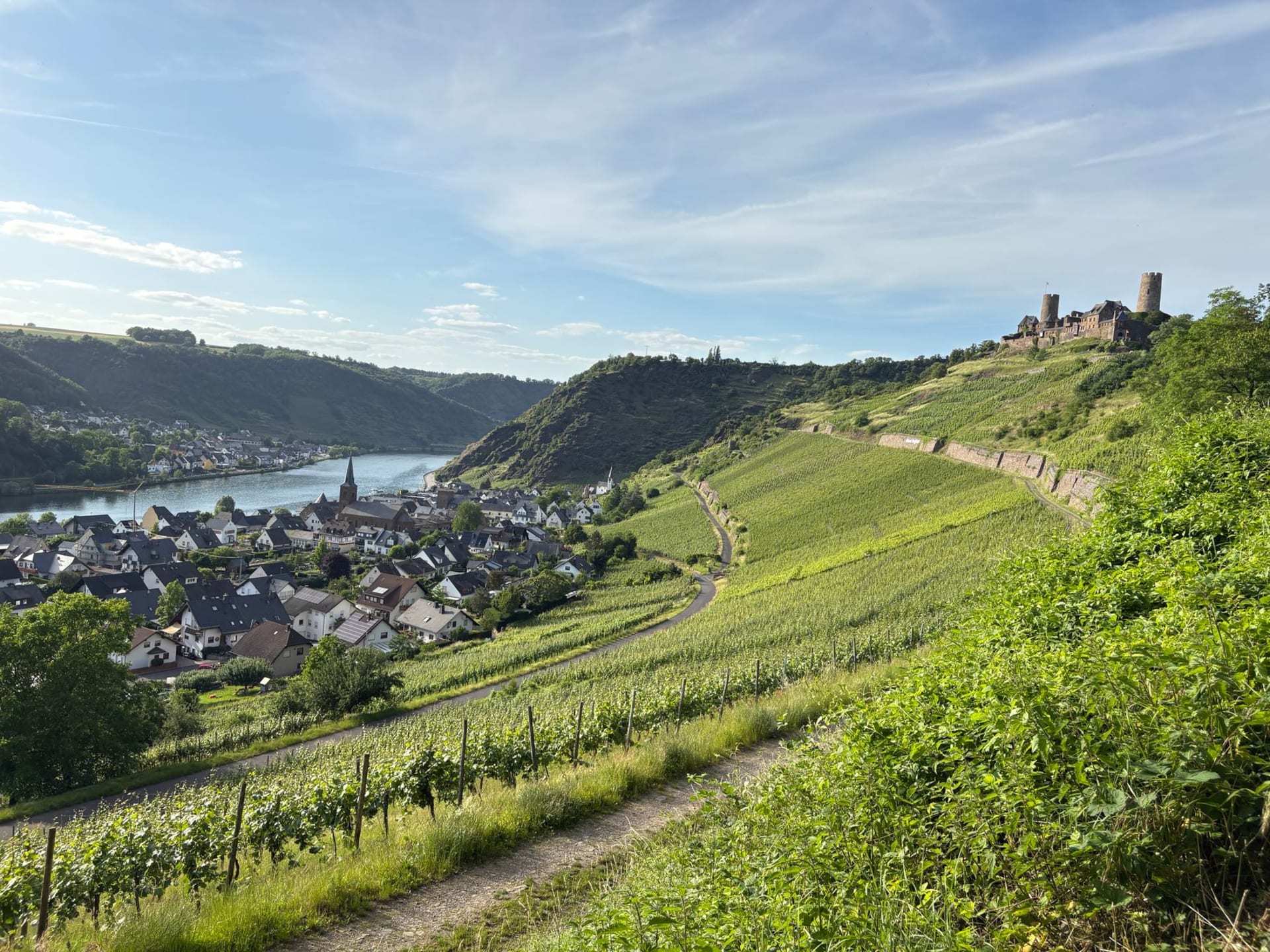
Braubach
"Every other castle on this river is a romantic ruin. This one would still kill you."
The Rhine is lousy with castles — you cruise past a dozen crumbling silhouettes in an afternoon, each one more picturesquely ruined than the last. After a while they blur together into a single mood of romantic decay. And then you reach Braubach, and the castle on the hill above it, the Marksburg, and you realize you’ve been looking at the wrong thing all day. The Marksburg is the only hilltop castle on the entire Rhine that was never destroyed. It is the real article — a genuine medieval fortress, intact, intimidating, and still very much capable of ruining your day if you arrived in armor.
The climb to the real thing
Braubach itself is a small, pretty half-timbered town on the river’s right bank, the kind of place a Rhine cruise blows through without stopping. Lia and I made a point of getting off, because I’d read that the Marksburg was the genuine survivor, and I am constitutionally unable to resist a castle that actually means it. The walk up from the town is steep, through woods, on a cobbled path that the defenders clearly designed to make attackers miserable. By the time we reached the gate I was wheezing and full of respect for medieval siege logistics.
You can only see the interior on a guided tour, which I usually resent and this time did not. Because the Marksburg isn’t a museum of polished romance — it’s a working machine of war, preserved as it actually was. Our guide led us through a battery of cannons, a kitchen with a vast open hearth, a chillingly practical torture chamber, and the cramped, smoky, genuinely uncomfortable living quarters of people who chose defensibility over every other consideration.

Why it survived
The reason the Marksburg still stands while every other Rhine castle is a postcard ruin is almost mundane: it was never strategically important enough to be worth the trouble of besieging and blowing up, and it sat on a stretch of river where the wars of the 17th century did their worst. It dodged the French armies that flattened its neighbors. In the 19th century, when wealthy Prussians were busy fake-medievalizing ruins into the romantic fantasies you see today, the Marksburg simply went on being what it had always been. That authenticity is its whole power. There is no fairytale veneer here — just thick walls, low doorways, and the cold logic of survival.
The herb garden on the rampart, planted with the medicinal and poisonous plants a medieval household actually used, was Lia’s favorite corner. She lingered over the labels — this one for fevers, this one for getting rid of a rival — while I leaned on the battlements and looked down at the Rhine sliding past, barges and all, exactly as it has for a thousand years.

Going, practically
Braubach is an easy stop on the right-bank rail line or by car between Koblenz and the gorge. The Marksburg is open daily and seen only by guided tour, in German with English text sheets provided; tours run frequently. Wear shoes you can climb in — the path up and the castle’s own stairs are steep and uneven. Give yourself two hours for the climb and the tour, and have lunch down in Braubach’s little square afterward, where the half-timbered houses lean in companionably over the cobbles.