Boppard
"From the Sesselbahn, Boppard looks like someone folded the Rhine around the town just to make it more interesting."
The chairlift arrives at the Gedeonseck viewpoint at a pace that allows careful contemplation — a four-person gondola of the old alpine variety, moving slowly enough to watch the vineyards shift beneath you. At the top, it deposits you above the treeline into a silence that surprises after the cable mechanism’s hum. Below, Boppard curves along the Rhine in a near-complete horseshoe, the river wrapping around three sides of the town like a moat that outgrew its intentions. The viewpoint is in every Rhine guide, and I arrived expecting the particular deflation of the over-publicized view. Instead I stood with my hands in my jacket pockets for twenty minutes, rotating slowly, because no photograph does the geometry justice.

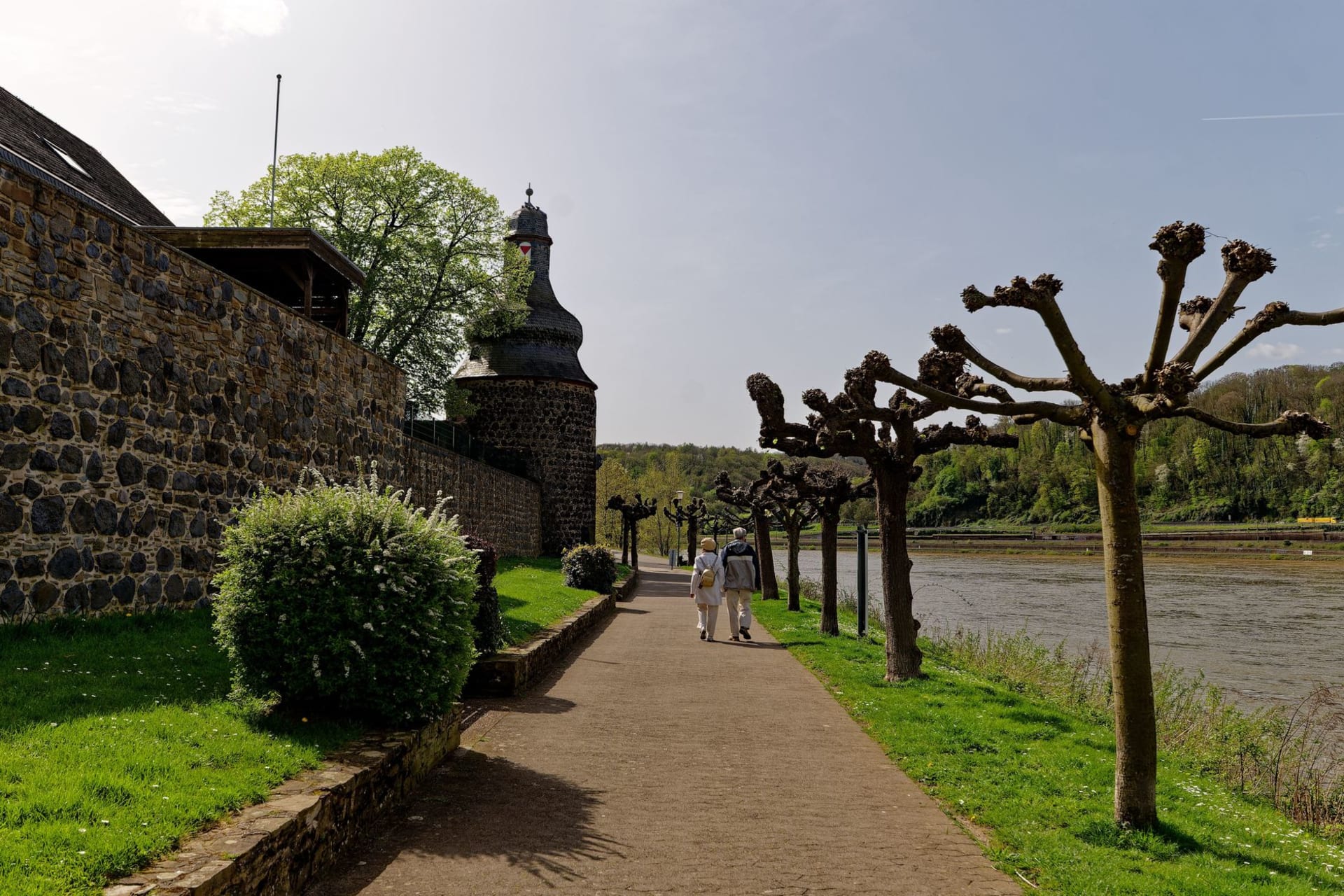
Boppard has the unusual distinction of being a real town — a place where people buy groceries and argue about parking — that also happens to occupy one of the most scenically significant positions in the valley. The pedestrianized Rheinallee runs along the waterfront, lined with Rhine-facing restaurant terraces and a promenade planted with plane trees that have been there long enough to produce serious shade. I sat on a bench at nine in the morning eating a bread roll I had bought from a baker on the corner, drinking coffee from a paper cup, watching a pair of elderly men in identical caps walking at identical speeds in opposite directions along the promenade. One of them nodded at me. That was sufficient morning.
Below the streets, Roman Boppard — known as Bodobrica in the fourth century — has left substantial traces. The town museum occupies the former Electoral Palace and contains mosaic floors, relief carvings, and a Roman wall section you can view through a glass floor panel in the courtyard. The medieval St. Severus church stands above all this layered history with its distinctive octagonal towers, which I kept noticing from different angles throughout the day, the way a good piece of architecture insists on its presence without being showy about it.

The Bopparder Hamm — the vineyard peninsula created by the horseshoe bend — produces what many Mittelrhein experts consider the region’s finest Rieslings. The blue slate soils and the river’s reflected heat create growing conditions that are genuinely unusual, a microclimate produced by the river’s own geometry. At a wine bar near the waterfront, I worked through a flight of three local producers: dry wines so precise in their minerality they made the river outside the window seem like a deliberate thematic element rather than a coincidence. The barman explained the geology the way a person explains something they find genuinely interesting, which is the only convincing way to explain anything.
When to go: May and early June, when the vineyards are freshly leafed and the Bopparder Hamm glows acid green from the Gedeonseck. October for harvest color and the best Federweisser. The chairlift to the viewpoint typically runs April through October — check schedules before visiting in shoulder season.