Jaisalmer
"By the time the fort turns that deep amber at sunset, you stop wondering why anyone built a city in the middle of a desert."
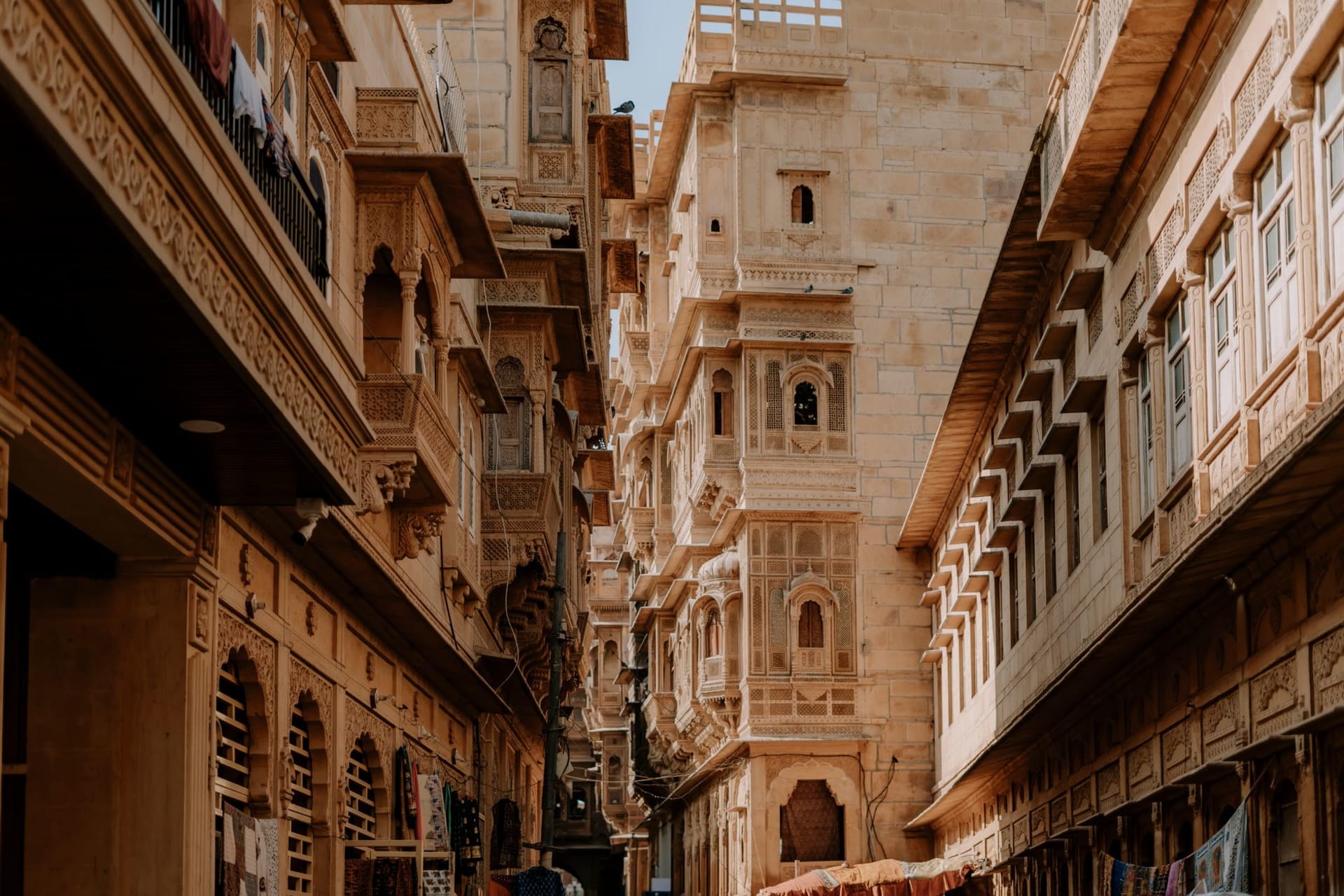
The fort is still a living city — that’s the thing they don’t quite prepare you for. I walked through the main gate expecting a museum and found instead a working neighbourhood, a place with its own grocery shops and tailors and children chasing each other through alleys so narrow my shoulders brushed both walls. The sandstone is the colour of old honey and in the late afternoon it deepens to something closer to fire. I’d arrived the night before on a sleeper train, stepping out at 4 a.m. onto a platform that smelled of coal smoke and desert cold, and by breakfast I was already sitting on a rooftop inside the fort eating poha and watching the light change across the battlements.

The Jain temples inside the fort — there are seven of them, built between the 12th and 16th centuries — stopped me in my tracks in a way I hadn’t anticipated. The marble work inside is unlike anything else I encountered in Rajasthan: pillars carved in spiralling patterns so intricate they seem impossible, as though whoever designed them was testing the absolute limits of what stone permits. The temples are still active places of worship, and you remove your shoes at the entrance and walk in silence through chambers where the floors are cold and smooth and the air carries a particular quality of stillness that is very hard to locate anywhere else. Outside the fort walls, the merchant havelis are something else entirely — the Patwon Ki Haveli, five adjacent mansions belonging to a single trading family, has a facade so covered in carved detail that I stood in front of it for twenty minutes and still couldn’t take it in whole.
The desert outside the city is where Jaisalmer’s full scale becomes apparent. I went out to the Sam dunes one evening, arriving just before sunset, and the landscape shifted colour in waves — first gold, then orange, then a deep burnished red before the light died entirely. Camels moved along the ridge in silhouette. It is, I’ll admit, a very photogenic situation, and plenty of tourists are there to confirm it. But what no photograph prepares you for is the silence once the jeeps and the vendors and the other visitors disperse — a silence so complete it has texture, almost like cloth pressing gently against your ears.

The food in Jaisalmer runs on ghee and flour and a certain desert practicality. I ate ker sangri — a curry made from dried desert beans and desert berries cooked together with spices — that tasted like nothing I could quite compare to anything else I’ve had in India. It’s a dish that has evolved specifically to make use of what grows in hostile soil, and there’s an austerity in its flavour that becomes, after a few bites, something close to beautiful.
When to go: November through February is the clear window — days are bright and manageable, nights cold enough to need a proper jacket. The Desert Festival in February brings folk music and turban-tying competitions to the dunes. Avoid May and June entirely; the Thar in summer is not poetic, it is punishing.