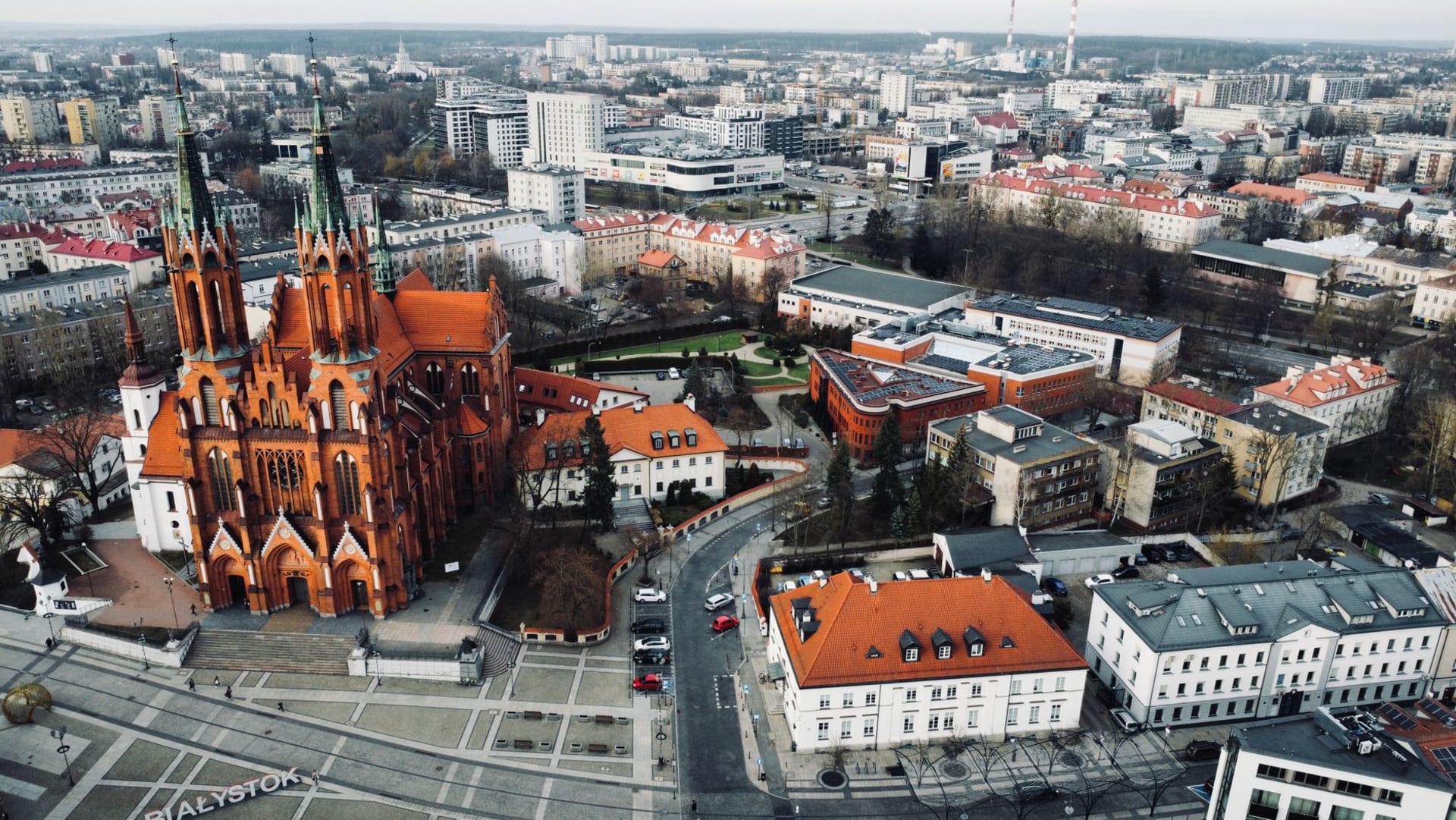
Bialystok
"Bialystok stands at the edge of the oldest forest in Europe and has absorbed some of its stillness."
The gateway to the Białowieża primeval forest is also a city of architectural eclecticism, a Branicki Palace called the 'Versailles of Poland,' and true Eastern frontier spirit.
We arrived on an overcast afternoon when the light was the color of old linen, and I remember thinking the city felt like a place that had given up competing with Warsaw and found its own footing because of it. Białystok is the largest city in northeastern Poland, the capital of Podlaskie province, and it carries that frontier quality — the sense of being close to something wilder than city life permits.
The Palace at the Heart of Things
Branicki Palace is the reason most travelers slow down here, and it earns the detour. The complex was built in the eighteenth century for Jan Klemens Branicki, a Polish hetman who wanted something Versailles-like on the flatlands of Podlaskie. What remains — after wartime destruction and careful postwar reconstruction — is formal French gardens with symmetrical parterres, stone sphinxes flanking gravel paths, and a baroque palace facade that feels genuinely incongruous in this part of the world. Lia spotted the peacocks before I did, loose among the hedgerows, treating the grounds as their own. Nobody warned us about the peacocks.
City Layers and the Ulica Lipowa Light
Ulica Lipowa, the main promenade, is lined with linden trees that must be magnificent in June when they bloom. We walked it in late September and the air still carried a faint sweetness. The city’s architecture is genuinely eclectic — Orthodox domes beside neoclassical facades, Art Nouveau apartment buildings next to Soviet-era concrete — a visible record of the hands that governed this region over centuries. The old market square around Rynek Kościuszki anchors the center with a town hall and the particular kind of provincial dignity that comes from a city that has survived a great deal.
The food surprised me. I expected standard Polish fare and found it, but better and stranger: at a small restaurant near the Branicki gardens I had chłodnik — cold beet soup with hard-boiled egg and dill — so deeply purple it looked like something ceremonial. The kulebiak, a stuffed pastry with mushrooms and buckwheat, tasted like the forest already.
The Forest at the Edge
Białystok matters partly for what lies beyond it. The Białowieża primeval forest is ninety kilometers to the west, and the city functions as the practical base — the last reliable train connection, the last well-stocked supermarket. Standing in the palace gardens at dusk, watching the light fail over the flat eastern horizon, I could feel the forest’s proximity as a kind of atmospheric pressure. The city had that stillness in it, something absorbed from centuries of proximity to old trees.
When to go: Late spring through early autumn, May to October, gives the most comfortable conditions. September is ideal — the gardens at Branicki Palace hold their shape, the lindens are still green, and the forests around the city begin their turn toward amber.