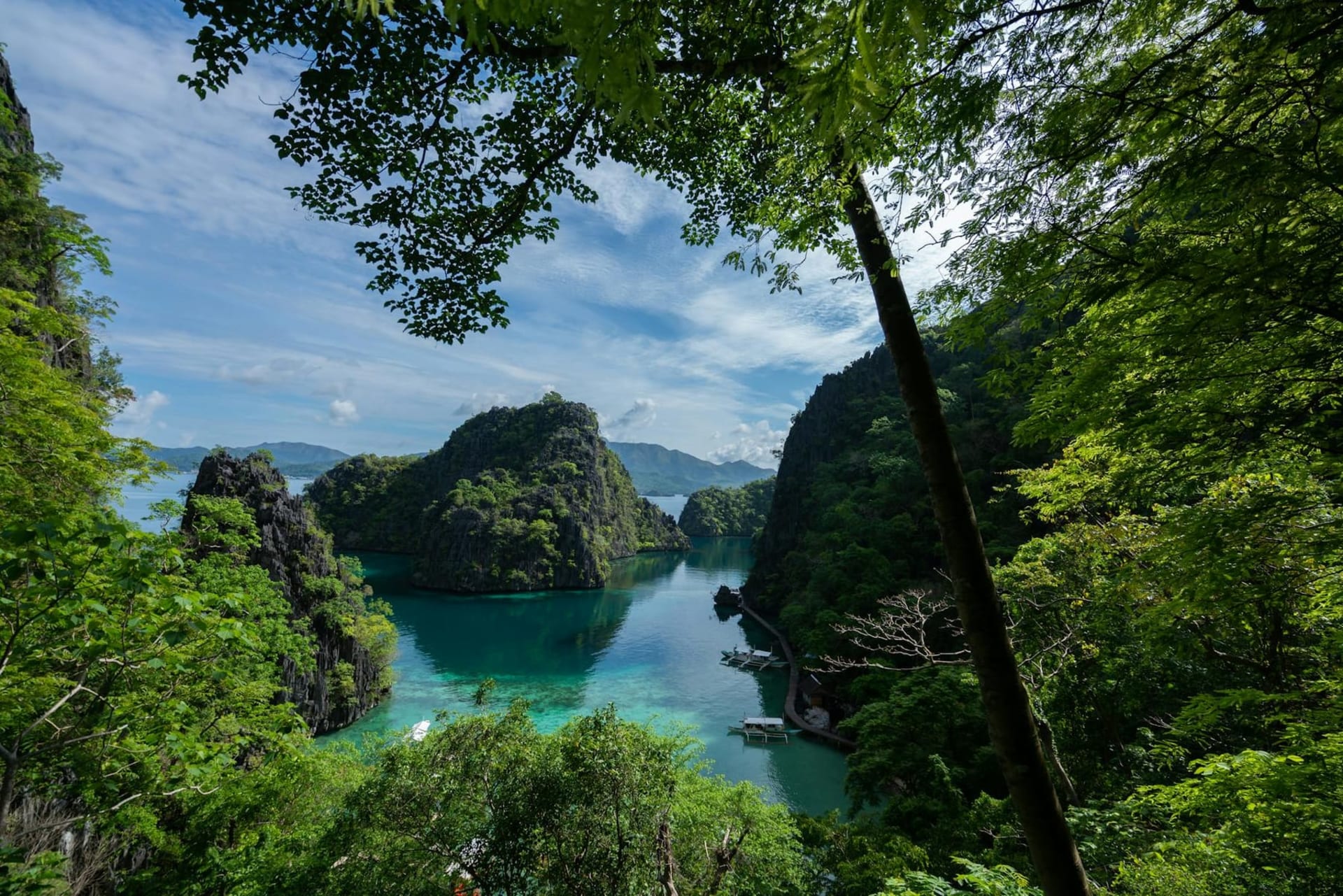
The cleanest lake in Asia inside a karst lagoon on Coron Island, accessible through a fissure in the limestone cliff.
The banca drops anchor off a spit of white sand at the base of Coron Island’s western face. From the water the cliff is just rock — pocked and grey, smelling of brine and something older, mineral, like the inside of a cave. There is no obvious lake. You have to climb to find it.
The Climb, the Crack
The path up from the beach is carved wooden steps, maybe two hundred of them, steep enough that Lia pauses twice and I pretend not to. At the top, the viewpoint over Coron Bay opens south toward Busuanga, the water below going from green to deep blue in bands you could chart on paper. But the reason people climb isn’t the view out. It’s the view down — and through. A narrow fissure splits the limestone at the col, barely shoulder-width in places, and on the other side of it the light changes entirely. The sky turns smaller and the walls lean in, tall and overhanging, layered with fig roots and maidenhair fern. Then you descend again, and Kayangan Lake is there, inside the mountain, as if the cliff simply swallowed it.
Ten Metres of Two Worlds
The water is the detail that stops you. It is genuinely, disconcertingly clear — not the modest clarity of a clean alpine lake but something that makes distance hard to read, that makes the bottom seem closer than it is until you are already in and sinking through the fresh layer, past it, into the halocline, and then into cold salt beneath. The thermocline sits at roughly ten metres. I found it on a single breath dive and came back up telling Lia about it in a rush. She looked skeptical. She went down herself and came back up saying nothing for a moment, just readjusting her goggles. Then: “It feels like two different planets stacked.” That is the surprise no photograph prepares you for — not the visual beauty but the sensation of passing through an invisible membrane between two bodies of water that have coexisted inside this lagoon for longer than any of the boats anchored outside.
Submerged rock formations line the edges of the lake, some of them visible from the surface as dark shapes in the pale water. Occasional fish move through the halocline without apparent concern. The walls above are silent except for wind and, on busy mornings, the distant sound of other bancas unloading.
Getting There
Kayangan is included on almost every Coron island-hopping tour leaving from the town pier on Coron town’s main waterfront. Private hire is straightforward and worth the cost if you want to arrive before the mid-morning rush from the big liveaboards. The lake is protected — no sunscreen, no fins — and the rules are enforced by the bangkeros who accompany every boat.
When to go: November through May, when the Palawan corridor stays dry and the water visibility in Kayangan reaches its peak. June through October brings swells that make the open crossing from Coron town uncomfortable and occasionally impassable.