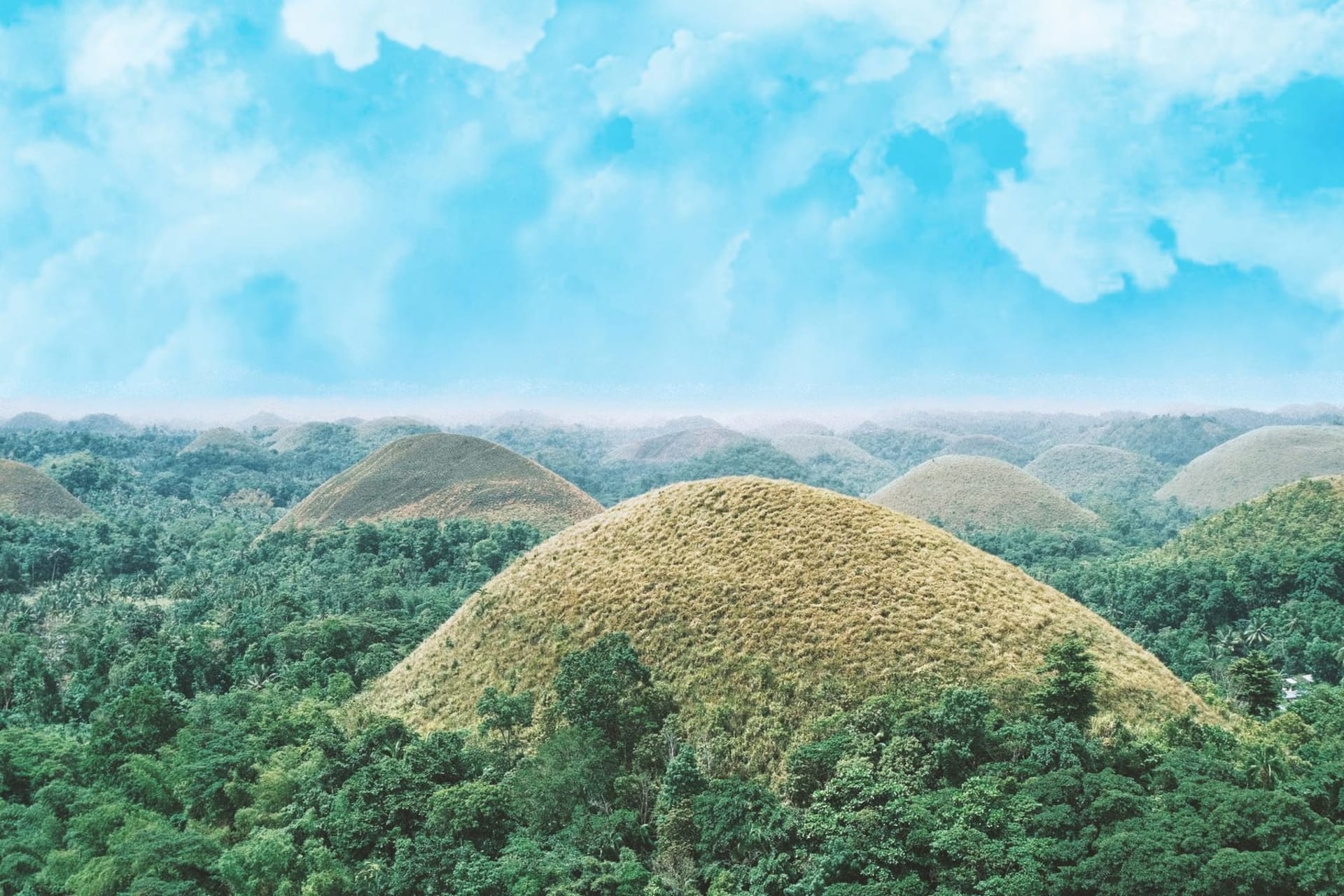
Chocolate Hills
"The Chocolate Hills are so geometrically improbable that seeing them in person makes geology feel like comedy."
Over a thousand perfectly conical grass mounds that turn brown in summer and give Bohol its signature view.
No photograph prepares you for the sheer repetition of them. I had seen the pictures — everyone has — but standing on the viewing deck of the Carmen observation tower at eight in the morning, the humidity already thick enough to taste, I found myself laughing out loud. The hills went on and on, cone after identical cone, as if some enormous pastry chef had piped them into existence and then wandered off. Lia grabbed my arm and said nothing, which is what she does when something exceeds language.
The Geometry of the Absurd
The Chocolate Hills are not one or two peculiar formations you walk around and photograph. There are 1,268 of them — geologists will tell you they are ancient coral limestone karst formations, worn by millennia of rain into these uncanny domes — and they cover more than 50 square kilometers of the Bohol interior between the towns of Carmen, Batuan, and Sagbayan. The hills range from 30 to 120 meters tall, each one grass-covered and almost perfectly conical, as though the landscape had been designed by someone with a very literal mind and an inexhaustible budget.
In the dry season, roughly January through May, the grass browns and the hills turn the color of milk chocolate, which is where the name comes from. I arrived in late April and caught them at peak oxidation — a thousand rust-and-copper mounds baking under a sky the color of old linen. The air smelled of dry grass and distant charcoal, with faint diesel from the habal-habal motorcycles ferrying tourists up from the Carmen highway below.
What I Did Not Expect to Feel
I expected spectacle. What I did not expect was the silence. Once the tourist tricycles cut their engines, the hills absorbed sound in a way that felt almost deliberate. I walked a short trail below the main viewpoint, off the concrete steps and into the grass itself, and for twenty minutes I heard nothing but wind moving over the rounded crests. The hills have that quality of very old things — they are indifferent in a way that is not unfriendly.
On the road back toward Tagbilaran, we stopped at a roadside stall outside Batuan for a lunch of puso — rice wrapped in woven coconut leaves, served alongside grilled liempo that had been charred dark over coco-husk coals. The woman running the stall pointed back toward the hills and said simply, “God was bored.” I wrote it down.
When to go: April and May give you the full chocolate-brown effect that earned the hills their name. Arriving before nine in the morning avoids the midday tour buses and gives the landscape the quiet it deserves.