Camiguin
"Camiguin packs more volcanoes per square kilometre than any island on Earth, and somehow stays charming."
Tiny island of four volcanoes, a sunken cemetery offshore, and sweet lanzones fruit in every market.
We crossed from Balingoan on a slow ferry that smelled of salt and engine grease, standing at the bow as Camiguin assembled itself out of the haze — four volcanic cones, none of them polite about their height, draped in forest so dense it looked almost wet from a distance. The island is small enough to circumnavigate by habal-habal in a morning. That smallness is the whole point.
The Sunken Cemetery and Other Oddities
The first thing that surprised me had nothing to do with the volcanoes. On a snorkelling trip out of Bonbon Beach, the boatman cut the engine and pointed straight down. Below the hull: a rusted cross standing in open water, marking the old cemetery of Catarman, swallowed by the sea when Mount Vulcan erupted in 1871. I floated above it for a long time, watching the cross sway faintly in the current, fish threading through the coral that had colonised the old graves. It was one of those moments where history becomes something you feel in your chest rather than read in a book.
Lia found the whole thing equal parts beautiful and deeply unsettling, which seems like the correct response.
Hot Springs and Lanzones at the Market
Every morning we passed through Mambajao — the island’s main town — and stopped at the public market on Bonifacio Street before the heat peaked. The stalls were stacked with lanzones, the small sweet fruit that Camiguin grows better than almost anywhere in the Philippines, with a thin translucent skin and a flavour somewhere between grape and mild citrus. We ate them by the handful. A kilo cost almost nothing.
In the afternoon we drove up to the Ardent Hot Springs near the base of Mount Hibok-Hibok, where steaming sulfurous water pours into concrete pools tucked under banana trees. The smell is distinct — mineral, faintly rotten, insistently geological — and after twenty minutes soaking in it while rain started falling through the canopy above, I felt like a different person than the one who’d arrived. The volcano exhaled somewhere above us, invisible in cloud. It has been active within living memory. You feel that.
White Island at Low Tide
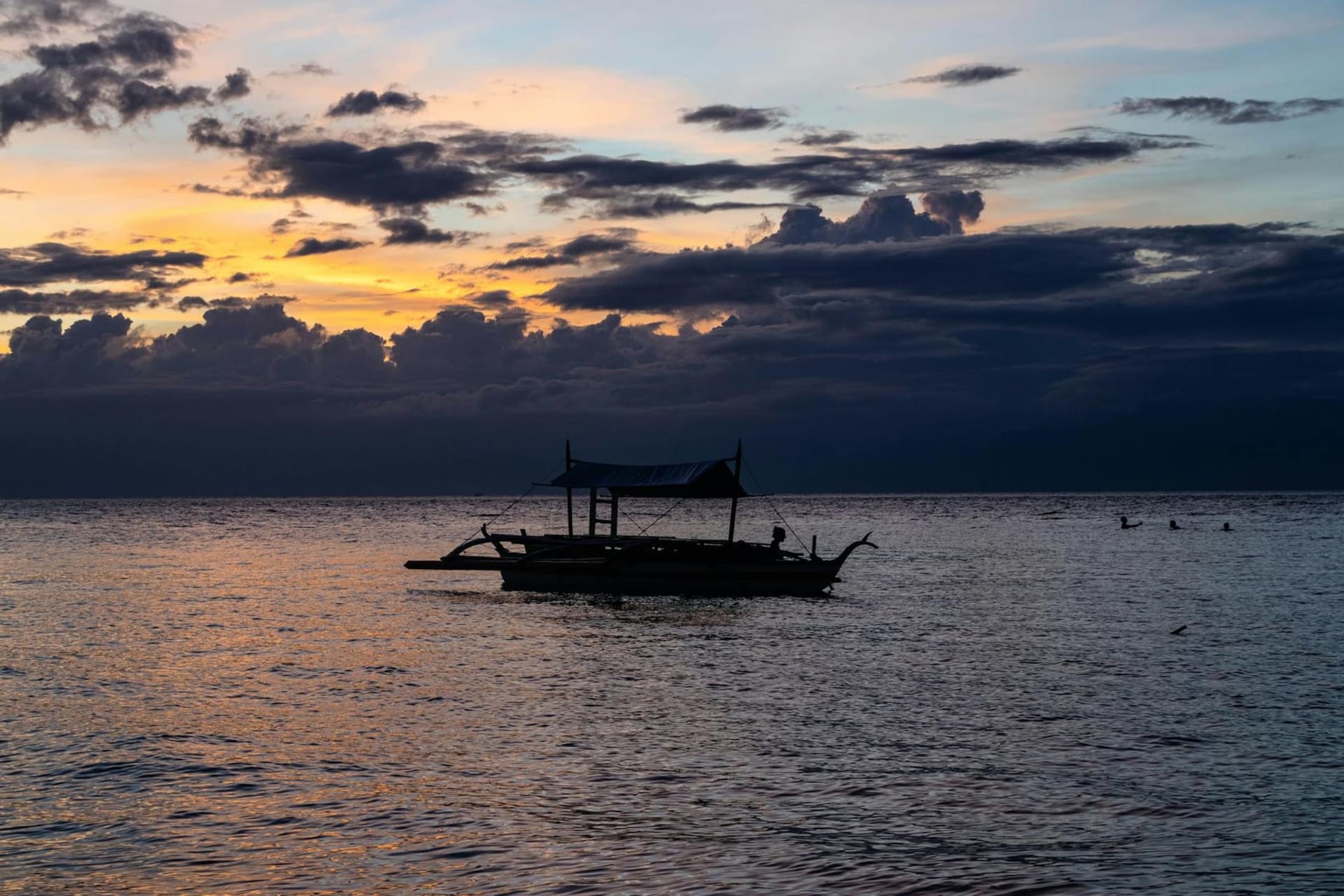
A sandbar called White Island appears offshore at low tide, a temporary sliver of white sand with no shade and no structures. We took a bangka out at dawn. The light came in sideways across the water, the volcanoes turning purple then green behind us as the sun climbed. We were alone on the sandbar for almost an hour. Nothing to do but stand in the warm shallows and look back at an island that somehow contains multitudes in fewer than two hundred and forty square kilometres.
When to go: November through May, before the wet season thickens. The Lanzones Festival in October draws crowds but the fruit is at its peak — worth the company.