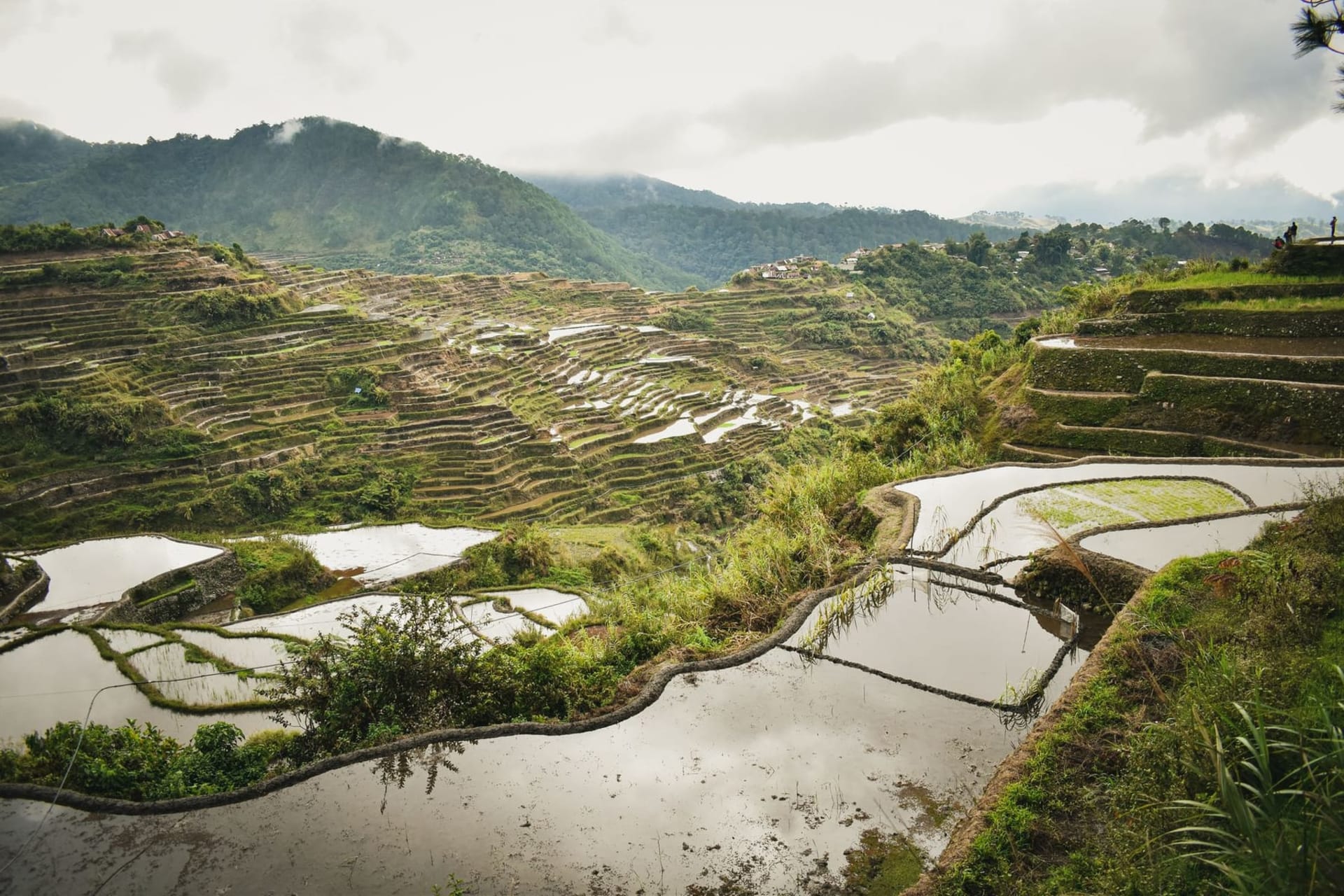
An amphitheater of 2,000-year-old Ifugao rice terraces accessible only on foot from Banaue, with a village of no roads.
There is a moment on the trail from the saddle — maybe twenty minutes into the descent — when the forest opens and Batad appears below you all at once. Not gradually, not in pieces. All at once. A full amphitheater of rice terraces, carved in stacked curves that follow the mountain’s logic rather than any human grid, dropping from the ridge line down to a village so small you cannot quite believe it sustains itself. I stopped walking and Lia walked into my back. Neither of us spoke for a few seconds. That is the appropriate response to Batad. Silence, and then the slow understanding that something took two thousand years to look like this.
The Walk In
The jump-off point is the Batad Saddle, reached by a forty-five-minute jeepney ride from Banaue along a road that grows increasingly optimistic about the meaning of “paved.” From the saddle, the trail descends through humid pine forest, past a scattering of Ifugao fale — the traditional thatch-roofed houses that look like upturned boats — and across stone pathways worn glossy by generations of bare feet. The path is clear enough but steep, and the soil is red clay that turns ceramic-smooth when wet. I was wearing the wrong shoes. I noted this about a hundred meters in, when my right foot slid wide on a muddy corner and I grabbed a fern for balance and the fern pulled out of the ground entirely, root-ball and all, as if to demonstrate that this place would not be gripped.
The descent takes roughly forty minutes at a careful pace. When the terraces finally come into full view — the impossibly green walls of the amphitheater, tier after tier, reflecting sky in the flooded paddies — you stop thinking about your shoes.
Inside the Village
Batad village sits at the base of the bowl with the confidence of a place that has never needed a road. There is one main lane through it, paved in flat stones, and then narrower paths that thread between houses and garden plots of chili and kangkong. The Ifugao Artifact Museum at the edge of the village is a single dark room full of hand tools — the kodong adze, ancient rice wine jars, carved wooden figures — and a woman of perhaps seventy who watched us move through it with the expression of someone who has seen many foreigners try to understand her world in ten minutes.
We had lunch at a small guesthouse near the trailhead for Tappiya Falls — pinikpikan chicken, the Ifugao ritual dish that I had read about but not tasted before, served with inasaw greens and rice cooked in bamboo that tasted of smoke. It was the kind of meal that has a specific gravity, that sits not just in your stomach but in your memory. The owner brought it out without ceremony and went back to watching a soap opera on a phone propped against a jar of vinegar.
What I Did Not Expect
The thing that surprised me — genuinely surprised me, not the pleasant surprise of something beautiful but the stranger surprise of encountering something I had no framework for — was the silence. Not the absence of sound. Batad is full of sound: frogs in the paddies, water moving through the stone channels that irrigate each terrace, a rooster announcing something urgent from three houses away. But underneath all of that, a structural quiet. No engine noise. No hum of traffic or generators. The terraces absorb sound the way forests do, and after three days of moving through cities, I had forgotten what it felt like to hear only things that were alive.
I sat on a stone wall at the edge of one of the upper terraces for longer than I planned. A farmer was working a lower tier, bent at the waist, moving through ankle-deep water with the unhurried efficiency of someone who has been doing this since childhood. The reflection of clouds moved across the flooded paddy below him. A pair of egrets picked their way along the bund wall. I had my notebook but I did not write anything. Some things resist the sentence.
The trail to Tappiya Falls — roughly thirty minutes from the village, mostly down and then steeply down — ends at a twenty-meter curtain of water falling into a cold green pool ringed by boulders. Lia swam. I sat on a rock and ate the last of the rice we had bought at the guesthouse, still warm in its banana-leaf wrapping.
When to go: March to May, when the terraces are at their greenest before the June harvest and the June–September rains. February is also beautiful but cooler. Avoid July and August unless you enjoy hiking through a warm waterfall.