The westernmost tip of Oman's Dhofar coast, near the Yemen border, where the khareef arrives first and the crowds never arrive at all.
Dhalkut is about as far west as you can drive in Oman before the road effectively stops mattering — a small fishing town perched near the Yemeni border, roughly two and a half hours from Salalah along a coastal route that gets progressively wilder and greener the further you go. We went mostly out of curiosity about what “the edge of Dhofar” actually looked like, and came back having seen some of the most dramatic, least-visited coastline of the entire trip.
The Mountains Get Greener the Further West You Go
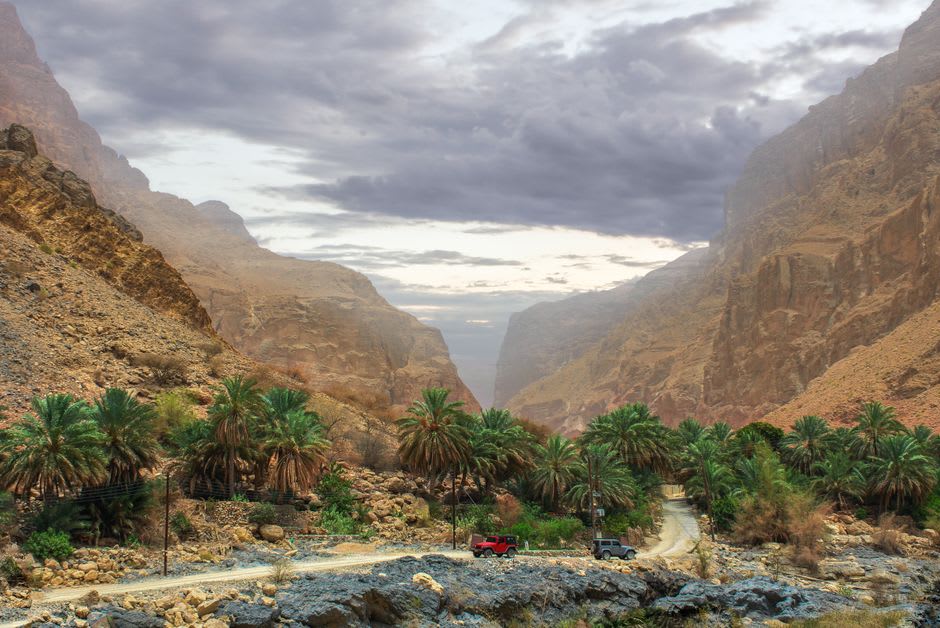
Something counterintuitive happens on the drive out here during khareef season: the vegetation gets thicker, not thinner, as you approach Yemen. The Jabal Qamar range that frames this stretch of coast catches even more monsoon moisture than the hills around Salalah, and by the time we reached the outskirts of Dhalkut the slopes were a genuinely startling shade of green, terraced in places with small plots where locals grow coconut and banana. We stopped at an overlook where the road hugs a cliff edge, mist rolling up from the sea below in slow waves, and didn’t see another car for almost twenty minutes.
A Town That Feels Genuinely Untouched by Tourism
Dhalkut itself is small and unpolished in the best sense — a fishing harbor with brightly painted boats, a modest fish market, and streets where we were clearly the only foreign visitors anyone had seen in a while, judging by the openly curious looks from kids playing near the mosque. We found a tiny restaurant serving grilled kingfish and rice that had no menu and no English, ordered by pointing, and ate the best fish of the entire Oman trip while the owner’s son practiced English phrases on us between courses with visible delight at getting to use them.
Lia kept saying the whole drive back that Dhalkut felt like what Salalah must have been decades before tourism found it — not undeveloped exactly, just unbothered, still organized entirely around fishing and farming rather than khareef season visitors. I don’t know if that will last. But for now, it’s about as far as you can get from anything resembling a tour bus in this part of Oman, and that distance is worth the drive on its own.
When to go: July through September for the most intense khareef greenery, though the road can be affected by heavy rain and mist reduces visibility on the cliff sections. Check border-area travel advisories before heading out, as conditions near Yemen can shift.