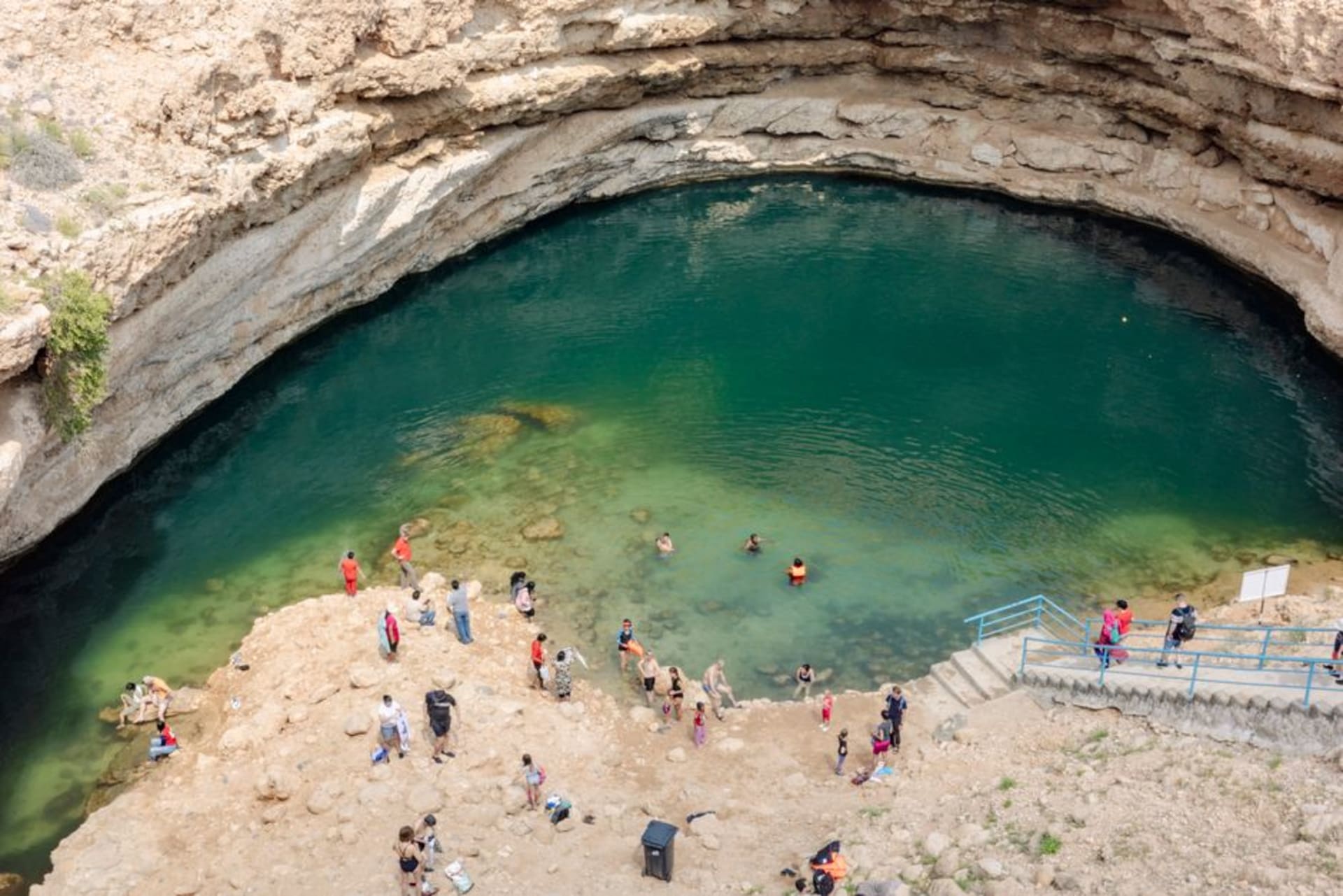
A collapsed limestone crater filled with impossibly blue-green water, right off the coastal highway between Muscat and Sur.
We almost drove past it. That’s the strange thing about the Bimmah Sinkhole — it sits maybe two hundred metres off the coastal highway, inside a small municipal park with a car park and a snack stand, and gives absolutely no exterior sign of what’s inside. Then you walk up a short flight of steps, look down, and there’s a crater of water so blue-green it looks color-corrected.
Hawiyat Najm Park, as it’s officially called, protects a sinkhole formed when the limestone bedrock beneath collapsed, either from erosion or — depending on which local you ask — a meteorite, a story nobody can substantiate but everyone repeats anyway because it’s a better story. The pool itself is maybe forty metres across and connects to the sea through underground channels, which is why the water shifts color through the day and occasionally clouds with a faint sulfur smell that the local kids treat as a non-issue and I treated, initially, as a reason to reconsider swimming.
Getting In
Stone steps lead down one side to a rocky ledge where most people jump from a modest height, though there’s a gentler entry via a ladder if jumping isn’t your idea of a good afternoon. Lia went in immediately. I stood at the top doing the mental math on rock depth for embarrassingly long before following her.
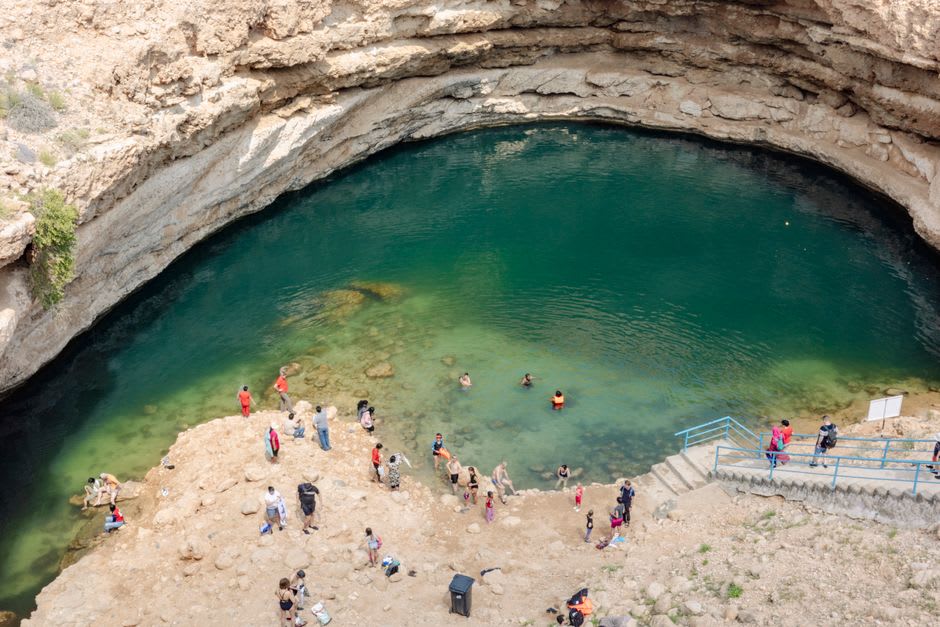
The water is noticeably warmer near the surface and colder in pockets below, a thermocline you feel change against your legs mid-swim. Small fish nibble at your feet if you stay still, which everyone warns you about and which still startles every single visitor equally.
The Coastal Stop That Isn’t Just a Stop
Because it’s directly on the road between Muscat and Sur, Bimmah tends to get treated as a twenty-minute photo break, and that undersells it. Go at midday when the light drops straight down into the crater and the color is at its most saturated, or early morning when it’s nearly empty and you have the whole pool to yourselves.
There’s a small mosque and shaded seating area above the crater, and a decent, unpretentious café at the entrance that does a passable shawarma if you want lunch before continuing on toward Wadi Shab or Tiwi, both a short drive further along the coast.
When to go: Year-round, though October to April keeps the midday heat manageable for the walk back up the steps. Aim for late morning for the best light on the water.
Keep exploring
More from Oman
 oman
oman Birkat Al Mouz
A crumbling mud-brick ghost village and its living falaj-fed oasis, at the foot of the road up to Jebel Akhdar.
Explore oman
oman Bukha Fort
A squat coastal fortress guarding the road between the UAE and Khasab, and the fishing village that grew up in its shadow.
Explore oman
oman Daymaniyat Islands
Nine uninhabited islets off Muscat where turtles nest, reef sharks patrol, and Oman's best snorkeling happens without another boat in sight.
Explore oman
oman Dhalkut
The westernmost tip of Oman's Dhofar coast, near the Yemen border, where the khareef arrives first and the crowds never arrive at all.
Explore oman
oman Dibba
The gateway port where Musandam's mountains meet the Gulf of Oman, split awkwardly across three jurisdictions and unbothered by the fact.
Explore oman
oman Duqm
A boomtown port on the empty central coast where new cranes rise over an old fishing harbour, and whale sharks pass close offshore.
Explore