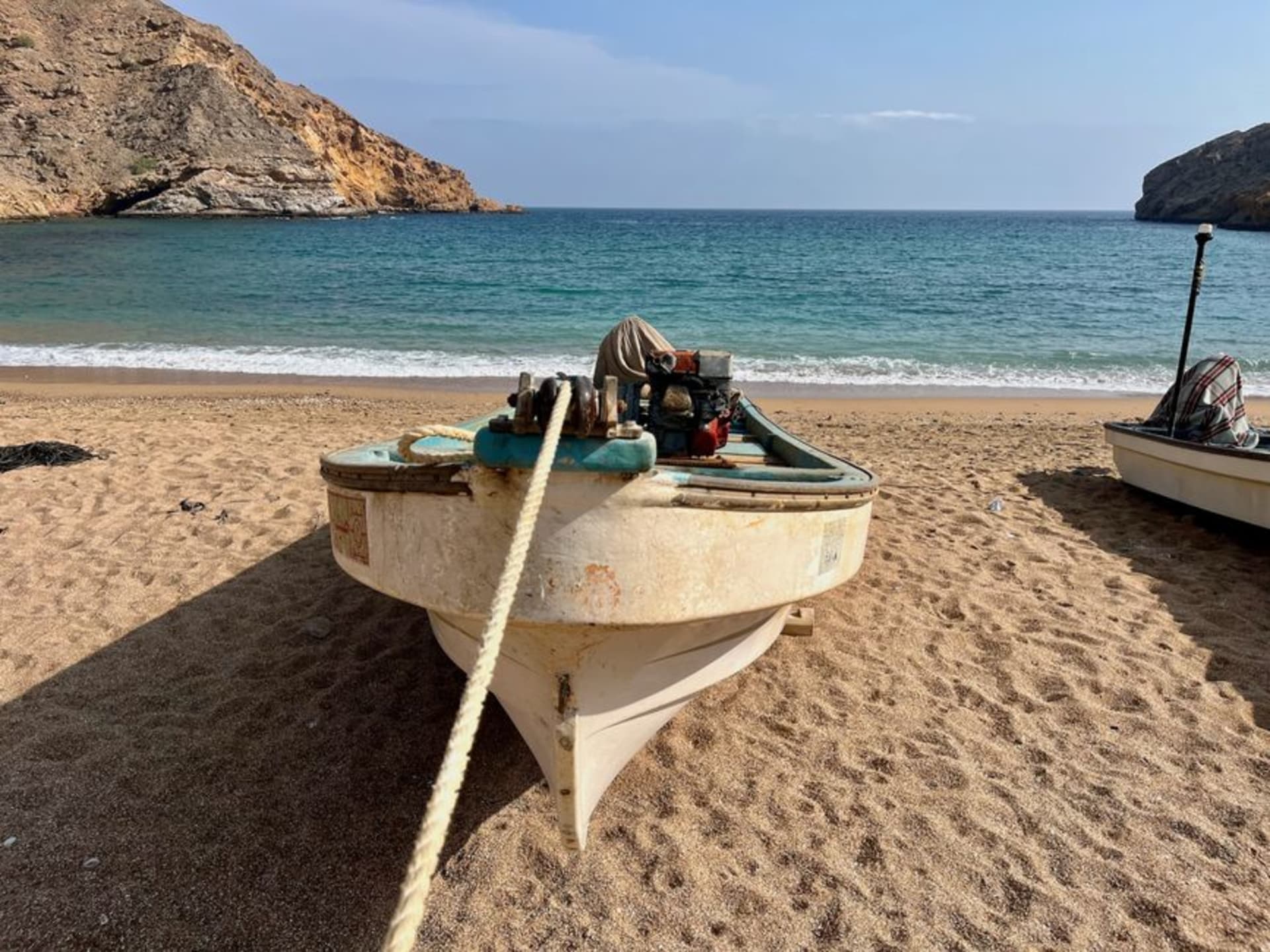
Al Mudayrib
"Every caravan between the interior and the coast used to answer to this town first."
A fortified caravan town on the old route to the interior, its watchtowers and mud-brick core still standing guard over a settlement most travelers drive straight past.
Al Mudayrib doesn’t appear on a single one of the tourist maps handed out at the Muscat airport, which is exactly why I ended up there — a friend of Lia’s family, originally from the Sharqiyah region, told us over dinner one night that we couldn’t claim to understand old Oman without seeing it. She was, predictably, right.
A Town Built to Be Defended
The town sits at what used to be a critical junction of caravan routes linking the interior to the coast, and its layout still reads like a defensive plan rather than a settlement. Watchtowers stand on the rocky outcrops surrounding the old core, positioned so that no approach could go unnoticed, and the town itself was once entirely walled, with gates that closed at night. Walking the perimeter with the afternoon sun low over the hills, I could trace the old wall line easily enough even where it had crumbled to knee height — a continuous ridge of packed earth circling the mud-brick houses like a memory the landscape refused to give up.
Inside the walls, the old quarter is quieter and less restored than Ibra’s, which somehow made it feel more honest. Houses here have simply been left, doors hanging at angles, palm-frond roofing collapsed into interior courtyards choked with weeds. I found one house with a partially intact majlis — the formal reception room every well-off Omani household built for receiving guests — its plaster still showing faint traces of the geometric painted borders that would have run along the ceiling.
The Falaj Nobody Photographs
What surprised me most wasn’t the fortifications but the falaj system still running quietly beneath the town, a channeled irrigation network diverting groundwater to a scatter of small date gardens on the settlement’s edge. An older farmer tending one of the plots waved us over without a word of English between us and simply handed Lia a date off the tree, gesturing for her to try it — sun-warm, barely dried, nothing like the packaged dates sold in Muscat’s supermarkets.
We left without ever finding an official entrance, ticket booth, or sign explaining what we’d seen — which felt, in hindsight, entirely appropriate for a town nobody had bothered to turn into an attraction.
When to go: October through March, in the cooler hours of morning or late afternoon. There’s no infrastructure for visitors here — no shade, no café, no marked trail — so bring water and expect to navigate the old quarter on instinct rather than signage.