
Preikestolen
"You get to the edge of Preikestolen and look down 600 metres and your body sends one message and your eyes send another."
The hike to Preikestolen takes between two and three hours depending on your fitness and how often you stop to look at things. I stopped frequently. The trail climbs through birch forest and over open moorland and then across a series of glacier-smoothed rock slabs where the route is marked by cairns rather than a path, because the rock itself is the path. In August the heather was in bloom and the smell of it was specific and northern — something like thyme without the sharpness, dusty and warm. I reached the final ridge in early morning, before the crowds, and had the summit to myself for twenty minutes.
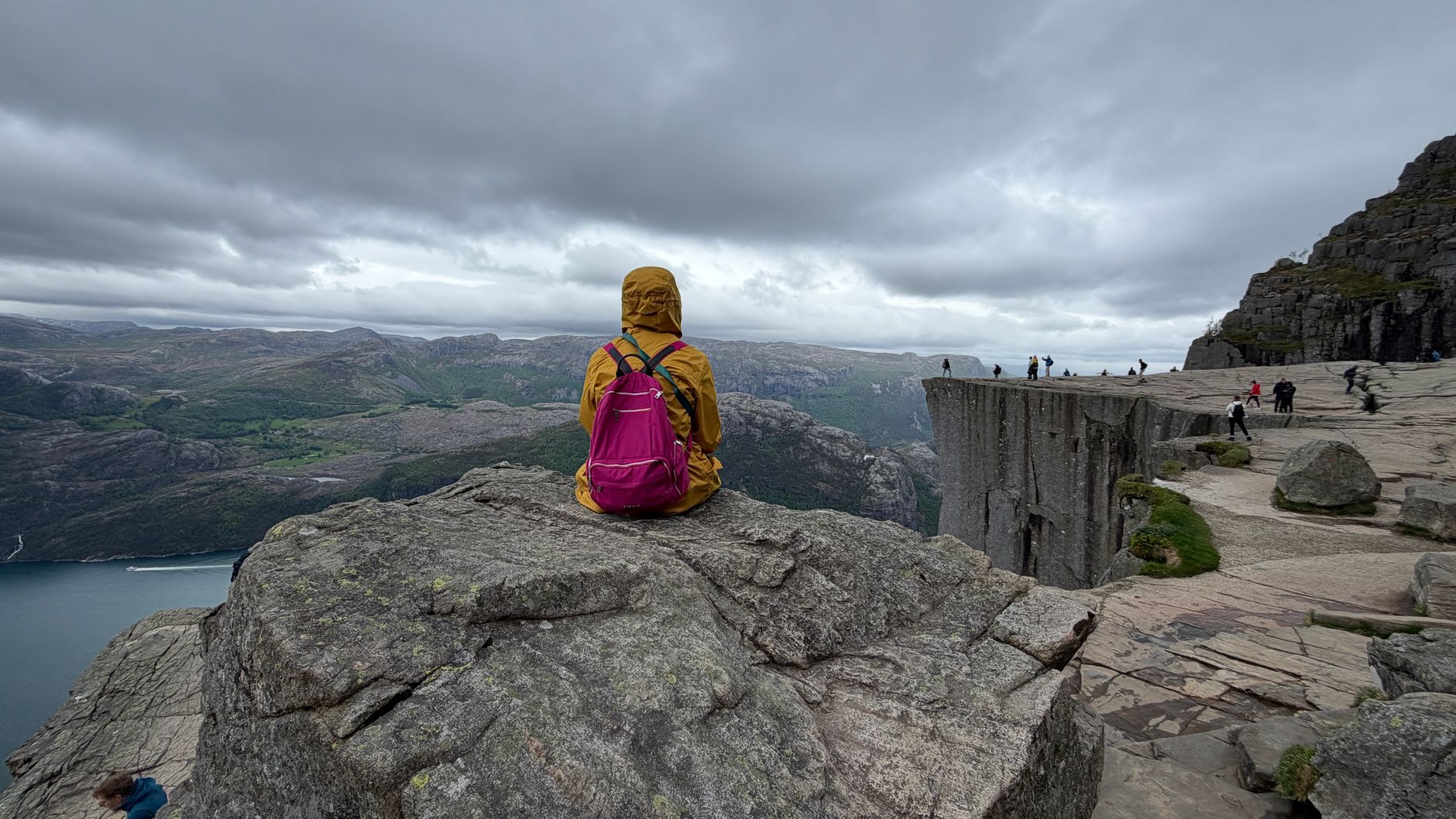
Preikestolen — Pulpit Rock — is a slab of granite roughly 25 by 25 metres, flat on top, jutting horizontally over the Lysefjord six hundred metres below. It was formed when meltwater from the last ice age froze inside existing cracks in the rock and shattered off a clean vertical face. The geology is legible and precise. The fact that you are standing on it is not entirely legible. I walked to the edge and looked down and my body sent an immediate and unambiguous message to step back. I compromised and sat down and moved forward on my hands, which felt more controllable even though it was physically identical.
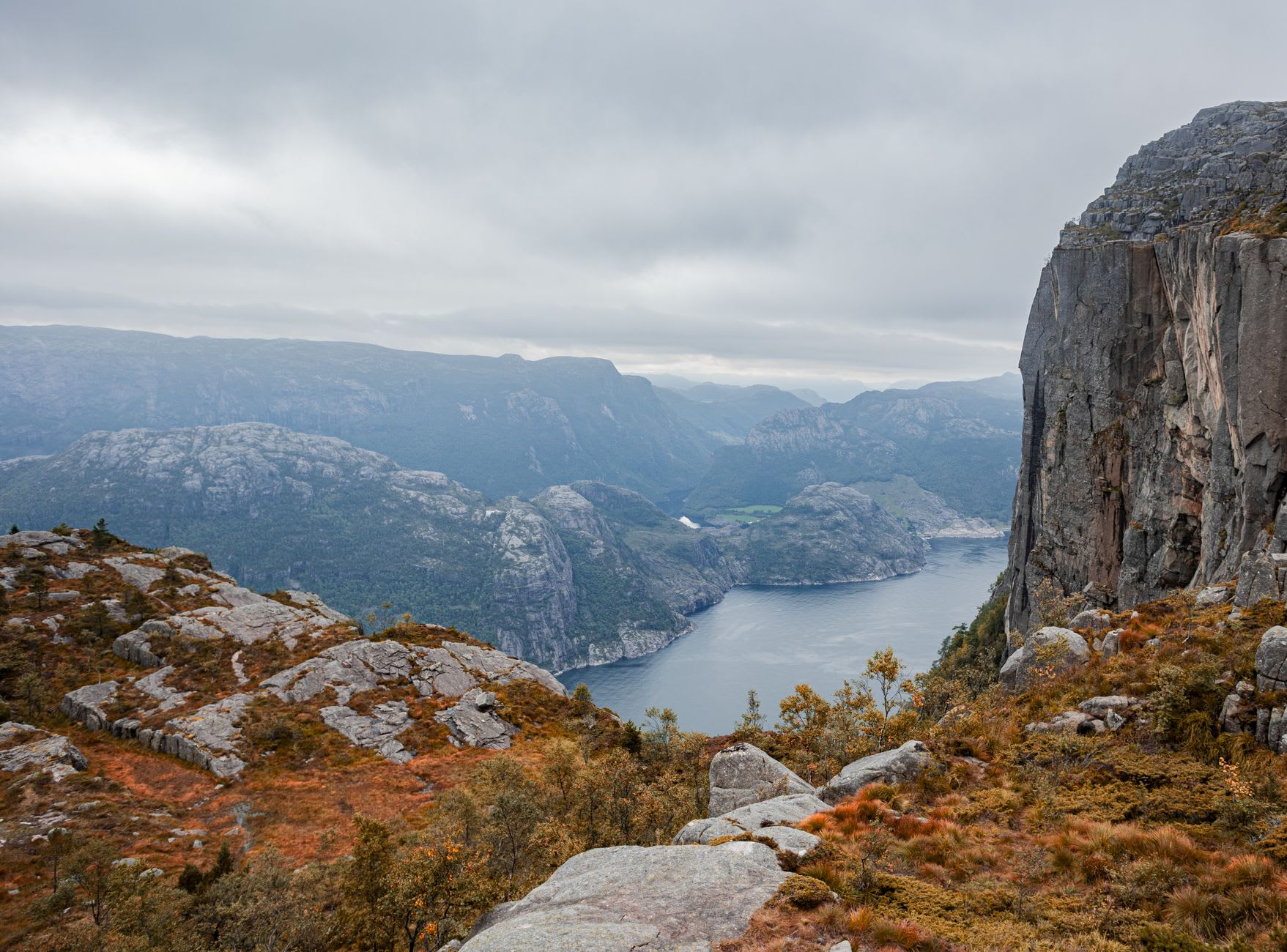
The Lysefjord below is long and straight, and from this height it looks like a model — the water a flat dark blue, the cruise boats leaving tiny white trails, the walls on the far side streaked in horizontal bands of grey and ochre. Two kayakers were working their way along the base of the cliff directly below me, barely visible, a reminder that scale is always relative. A raven landed on the rock two metres from where I was sitting, considered me, and left. No drama. Just a raven doing what ravens do on cliffs.
By ten in the morning the first larger groups had arrived and the rock was busy. People from everywhere — I heard Norwegian, German, Spanish, what sounded like Cantonese — all making the same face, the face people make when the world has exceeded the model they had built of it. A woman took off her shoes and sat barefoot on the warm rock and closed her eyes. A father explained something to a young child who was not interested in the explanation and was instead crawling toward the edge while the father tried to intercept him with escalating alarm.
The descent takes its own time. Your knees register the complaint the ascent kept quiet. I stopped at one of the lakes on the moorland and swam briefly — the water was cold enough to hurt and clear enough that I could see the bottom at five metres — and then dried in the sun on a flat rock and watched clouds move across the sky and thought about how small I had felt at the edge and how that had not been an unpleasant feeling. It had been clarifying.
When to go: Late June through August for the most reliable weather and the longest light — sunrise hikes in late June mean reaching the top before seven in the morning in full light, with the fjord below still in shade. September is excellent, with mist sometimes filling the fjord below and rising around the cliff in the mornings. Avoid the wettest periods in May and late October; the rock slabs on the trail become genuinely dangerous when wet.