Lũng Cú
"Standing at Lũng Cú felt less like a boundary and more like a threshold — though I couldn't have said to what."
The road north from Đồng Văn to Lũng Cú passes through twenty-three kilometres of karst plateau that gets progressively more austere as it nears the border. The villages become smaller. The flat ground, never abundant up here, disappears almost entirely. The terraced fields on the slopes are planted in maize and buckwheat rather than rice — too high, too cold for rice — and the colours in October run to amber and dusty pink. The road surface is good, which feels incongruous with the remoteness, and occasional road signs appear in Vietnamese and Hmong script that I couldn’t read but found moving for reasons I couldn’t immediately explain.
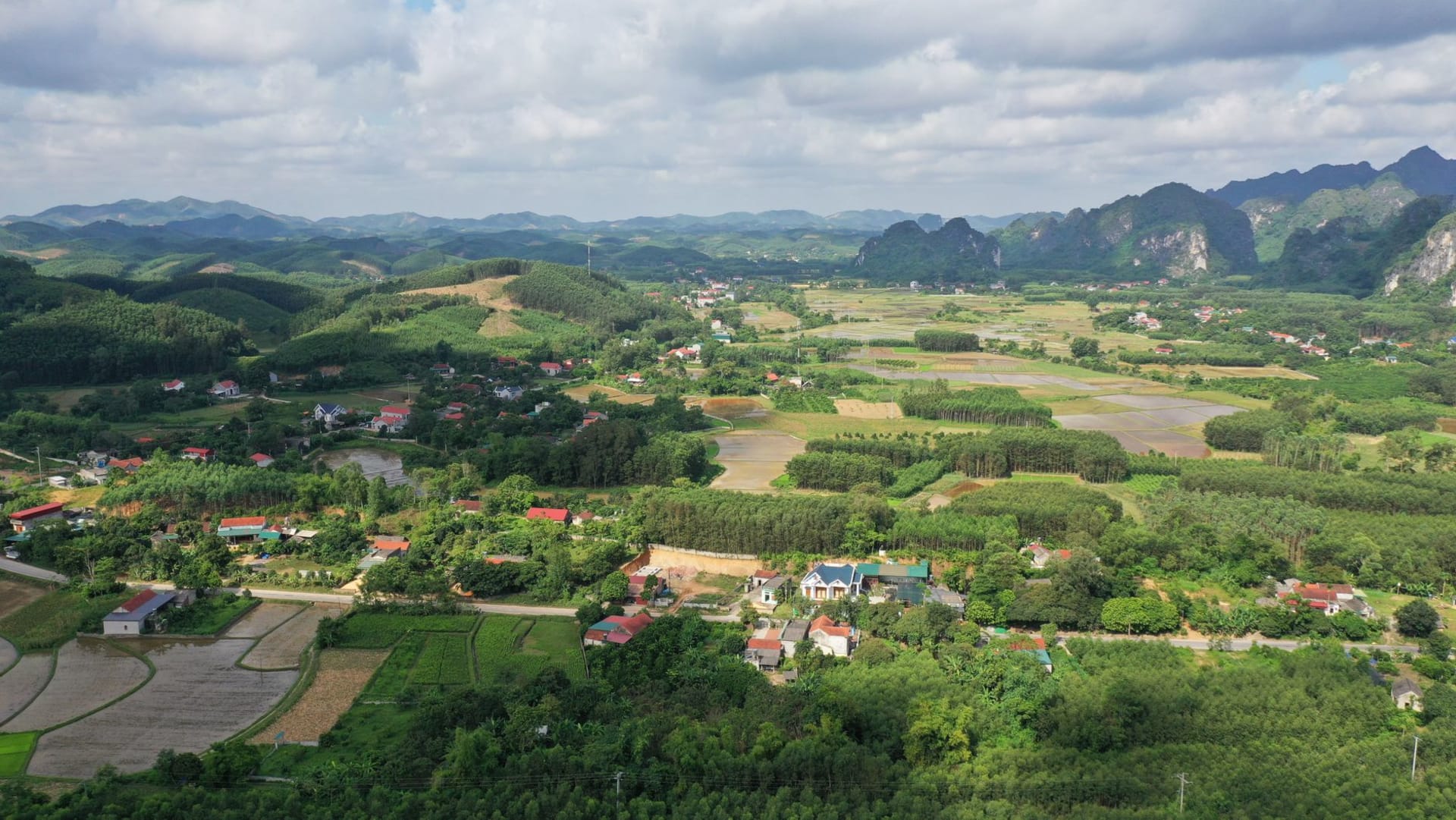
Lũng Cú itself is a village, and then it is a Dragon Mountain, and at the summit of Dragon Mountain is a flag tower that has been there in various forms since the Lý dynasty, though the current concrete version dates from 2010 and is not pretending to be ancient. You park at the base, climb 389 steps, and arrive at a flagpole from which a Vietnamese flag of substantial dimensions flies with an authority that the altitude and the context make completely appropriate. The view from the tower’s base, before you climb it, is already the view — the border ridge with China runs along the north horizon, close enough to see the road on the other side, and the plateau falls away in all directions in that vertiginous way that the Ha Giang karst has made normal for you by this point.

From the top of the tower, on a clear day, the view extends far into Yunnan province of China to the north and far south into the Ha Giang plateau. The Ha Giang loop makes a shape in the landscape below you that you can trace — that road, that valley, the village you stopped for water in yesterday. It is the kind of view that reorganises the journey you’ve been on into a geography you can now see whole, which is satisfying in a way that I hadn’t anticipated. I stayed up there for forty minutes, longer than the steps warranted, because the wind kept shifting and each direction offered something different and I was unwilling to choose which to look at.
The Lô Lô village at the base of Dragon Mountain has a few families who have set up small guesthouses and sell embroidery from their doorsteps with a low-key hospitality that doesn’t involve following you or price negotiation — they sit, the work is displayed, you stop or you don’t. The Lô Lô are one of the smallest ethnic minority groups in Vietnam and their embroidery tradition is distinct from the Hmong work you see throughout the region — smaller motifs, more geometric, a palette that runs to deep red and black with white accents. I bought a small piece from a woman who had made it herself and seemed mildly pleased that I could tell, though I couldn’t have explained in Vietnamese how.

The drive back to Đồng Văn in the late afternoon has a quality particular to roads taken twice — you see things in opposite light, from the other direction, and they reveal aspects you missed. A valley that was in shadow on the way north is lit from the west on the return. A village that was quiet at eight in the morning has smoke rising and children outside at four in the afternoon. The flag on the tower is visible for longer than you’d expect from how small the summit looks — you keep seeing it in the rearview until the karst closes around the last bend.
When to go: October is ideal — the buckwheat flowers that cover the plateau around Lũng Cú and Đồng Văn are in bloom, turning the high fields a dusty rose-pink that is one of the region’s most particular and most fleeting pleasures. March for clearer air and fewer other motorbikes on the road. Clear days at any time of year give the best flag tower views, so check conditions in Đồng Văn before setting out — cloud can close in fast and erase the panorama entirely.