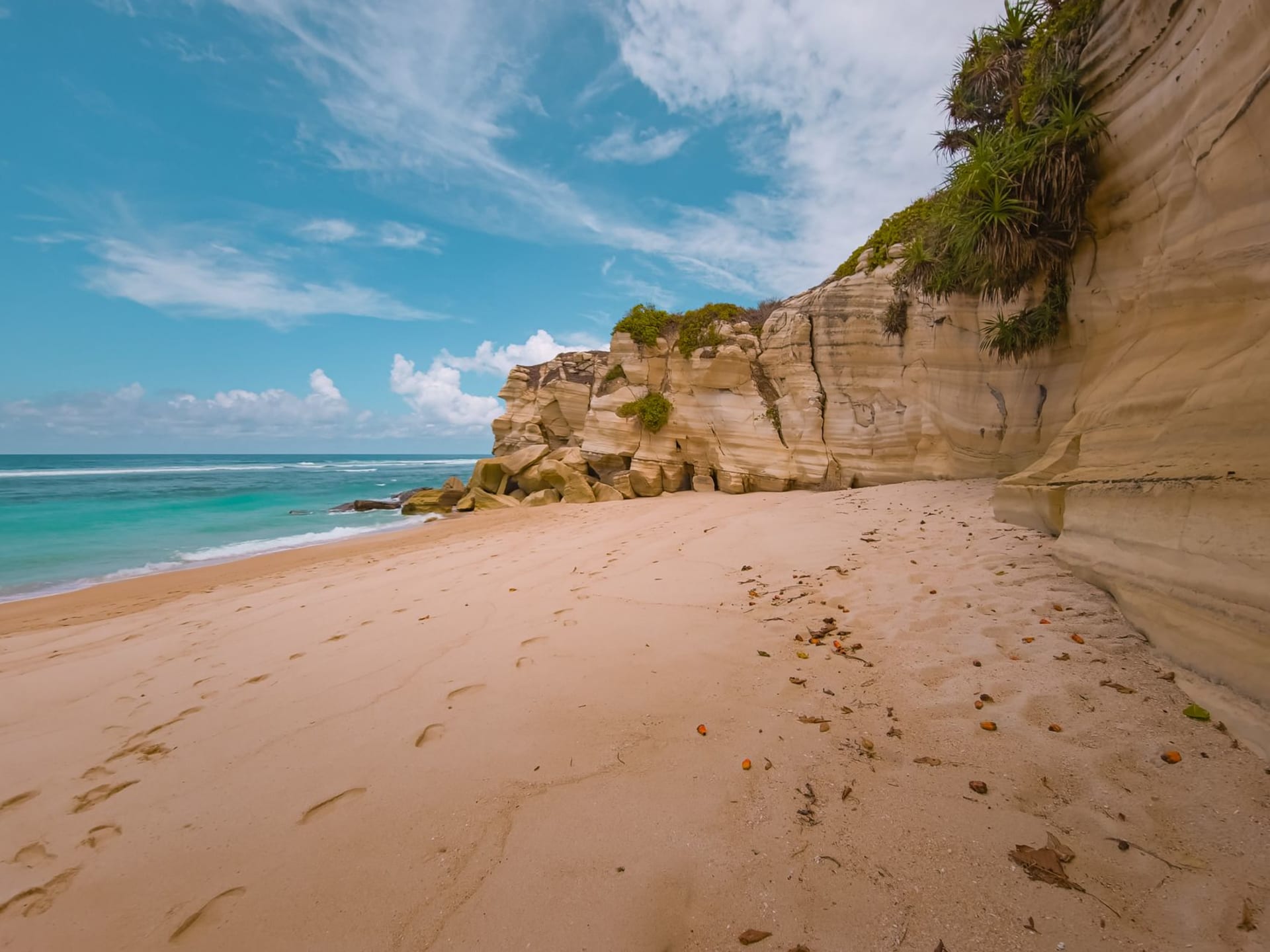
Hio Beach
"Hio takes effort to reach and then refuses to explain itself to you — which is exactly right."
The track to Hio Beach starts from a turnoff north of the Hikutavake area and goes through coastal scrub for about forty minutes, dropping eventually through a narrow fissure in the limestone to a small, boulder-strewn cove sheltered by rock walls on three sides. It is not easy to find the first time, the signage being somewhere between minimal and deliberate misdirection, and by the time I arrived I’d second-guessed the track twice and doubled back once. And then there it was: a cove perhaps thirty metres wide, large dark boulders arranged by ancient wave action into something that looked almost deliberate, water the colour of blue-green glass between them, and absolute silence except for the slight sigh of a calm ocean.
Hio is not a beach in the conventional sense — there’s no sand, just smooth coral rock and boulders and the clear water between them. But it has a pool on the left side of the cove, where a natural rock shelf creates a protected area deep enough to swim in even when the swell is moderate, and it’s this pool that makes the walk worth it. I slid into it and floated on my back looking up at the cliff edge above, where a few pandanus trees leaned over the drop. The water was cooler than the pools on the west coast, fed by some deeper current, and so clear that I could count the barnacles on the boulder three metres below me.

I had the cove entirely to myself. This is not unusual on Niue — most places, most of the time, are empty in a way that would be inexplicable anywhere with better tourist infrastructure — but Hio’s remoteness adds an additional layer. Getting there requires real walking, not just the short hop from a carpark that most of the island’s highlights allow. The people who make it to Hio are people who wanted to make it to Hio. There’s something about that kind of self-selection that makes a place feel earned.
The north coast of Niue sees a different light than the west, where most visitors concentrate. In the morning, before the sun gets fully overhead, the east-facing walls of the cove catch the angled light and the water inside turns almost luminescent. I stayed longer than I planned — this is a pattern on Niue generally, but Hio particularly — and arrived back at the road in the early afternoon with salt drying on my skin and the pleasant tiredness of having done something slightly difficult.

There’s no infrastructure at Hio: no steps, no roped path down to the cove, no shade at the cliff edge. You descend through the fissure carefully, one hand on the rock. What the place offers in exchange for this modest effort is precisely the absence of everything that infrastructure usually brings: no signs, no people, no managed experience. Just the water and the boulders and the sound of the Pacific doing what it has been doing here for fifty thousand years.
When to go: Hio is most accessible from June through September when the northern swell is generally smaller. The walk out is exposed and hot — start early, bring far more water than you think you need, and wear reef shoes for the boulder entry. Low tide makes the pool more swimmable and the natural ledges more accessible. Do not attempt the descent in choppy conditions; the rock at the base is wet and sharp.