Agadez
"That minaret appears on the horizon before the city does, and you spend the last hour of driving wondering if it's real."
The road north from Niamey to Agadez is long in a way that reconfigures how you think about distance. For hours there is scrub, red laterite earth, the occasional acacia holding itself together against the wind. Then — gradually, then all at once — the land empties of green entirely, the soil lightens to ochre, and somewhere around the seventh hour the mud-brick minaret of the Grand Mosque appears on the horizon like a finger raised above the flat line of everything. It stands 27 meters tall and has stood roughly in that shape since the 16th century. I pulled over when I first saw it and just looked. Some things earn the approach they demand.
Agadez is not a ruin and it is not a museum. The old city — the medina that predates the colonial-era grid by centuries — still functions as a living thing. The lanes are too narrow for cars, paved in packed sand that holds the heat until well after dark. I walked them for two days without a map, which was the right decision. The souks are small and unglamorous by global standards, but the silversmiths working Tuareg crosses and the saddle-makers stitching camel leather were not performing for me. They were working their trade the way their fathers did, indifferent to tourism in a way that felt like the highest possible compliment to the place.

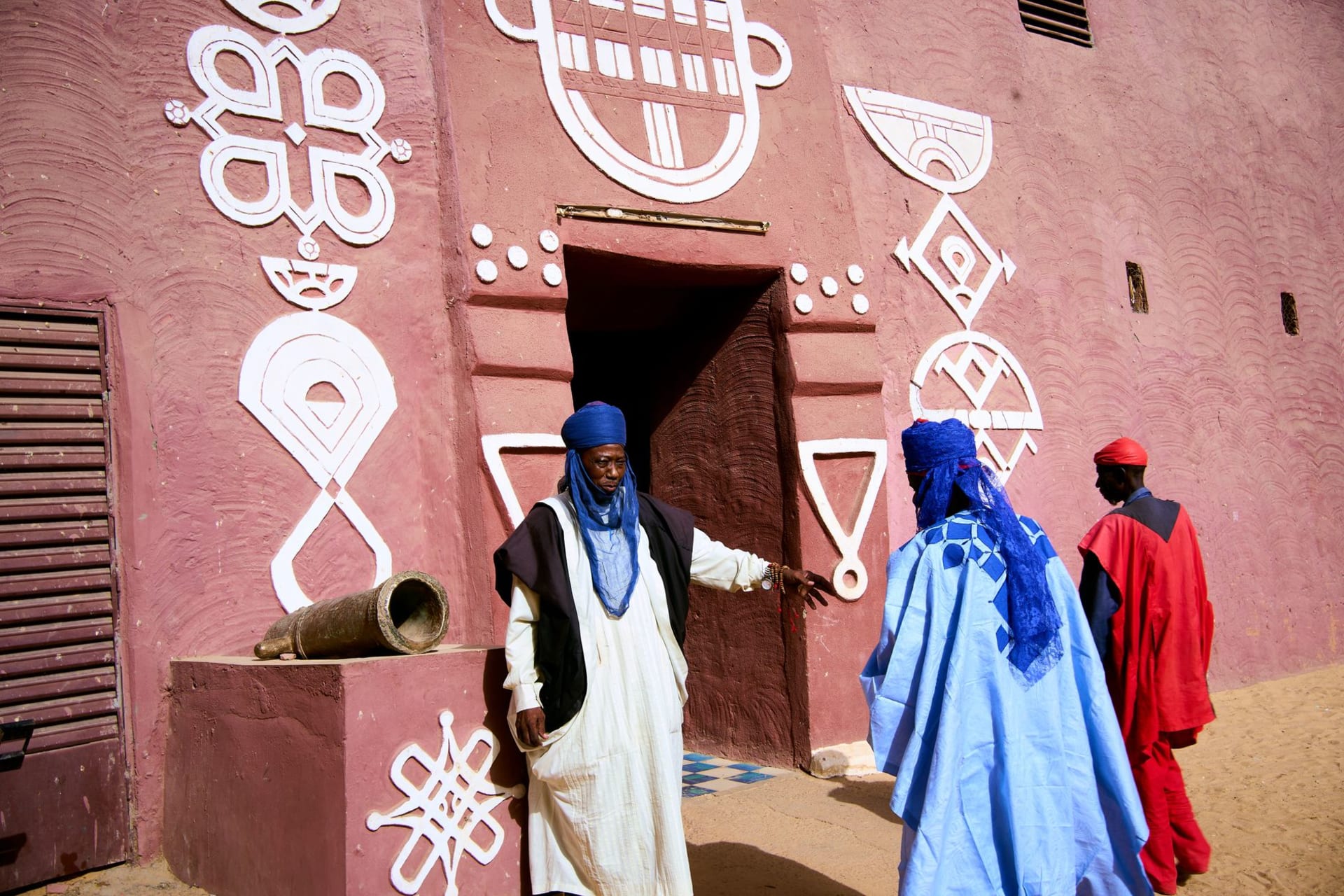
I ate brochettes of camel meat from a street stall near the Sultan’s Palace — the fat rendering out in the heat of the charcoal, served with a rough chili sauce that arrived without my asking. The sultan himself still holds court in that palace; the Sultanate of Agadez has been continuous since 1449, and the title carries genuine social weight in the Tuareg community. On a Friday afternoon I watched the sultan’s horsemen parade out in robes that had been pressed within an inch of their lives, and the crowd that gathered was not a tourist crowd — it was a local event, something that had been happening for longer than anyone there could trace.
The city sits at the edge of the Aïr Mountains and serves as the departure point for deeper desert. Every morning before dawn, men gather near the old caravanserai with camels loaded for journeys I couldn’t verify on any map. The trans-Saharan trade in salt and goods from Bilma — sodium chlorate hauled by camel across hundreds of kilometers of nothing — is still real. Not romantic or reenacted. Real. I watched one caravan prepare in the dark, the camels groaning and folding their legs, the men working by headlamp, and thought: this is the oldest logistics network in the world and it is still operating.

Evenings in Agadez belong to the rooftops. The guesthouses here are small and personal — usually a family operation, a courtyard, a squatting toilet, a cold bucket shower — and the rooftops open at dusk when the temperature drops twenty degrees in an hour. You sit up there with whoever else happens to be traveling, the minaret visible from almost every angle, and watch the stars emerge with a completeness that city-dwellers forget is possible.
When to go: October through March is the window. November and December are ideal — warm days, cold nights, the Saharan light at its most angled and beautiful. Avoid April onwards as temperatures climb past 45°C before the harmattan makes travel miserable. Check current security advisories for the region before traveling north of Niamey.