Patan
"Patan's Durbar Square is what happens when a civilization decides its temples are worth more than its wars."
The finest Newari architecture in the Kathmandu Valley, a medieval city of bronze windows and courtyards.
I crossed the Bagmati River on a rusted footbridge and entered Lalitpur — the City of Beauty — without any ceremony. A dog slept on a warm stone slab outside the Mangal Bazaar gate. Pigeons argued in a crevice above a centuries-old doorway. Nobody was performing antiquity for me. That was the first thing I understood about Patan: it does not present itself. It simply continues.
The Square That Earns Its Name
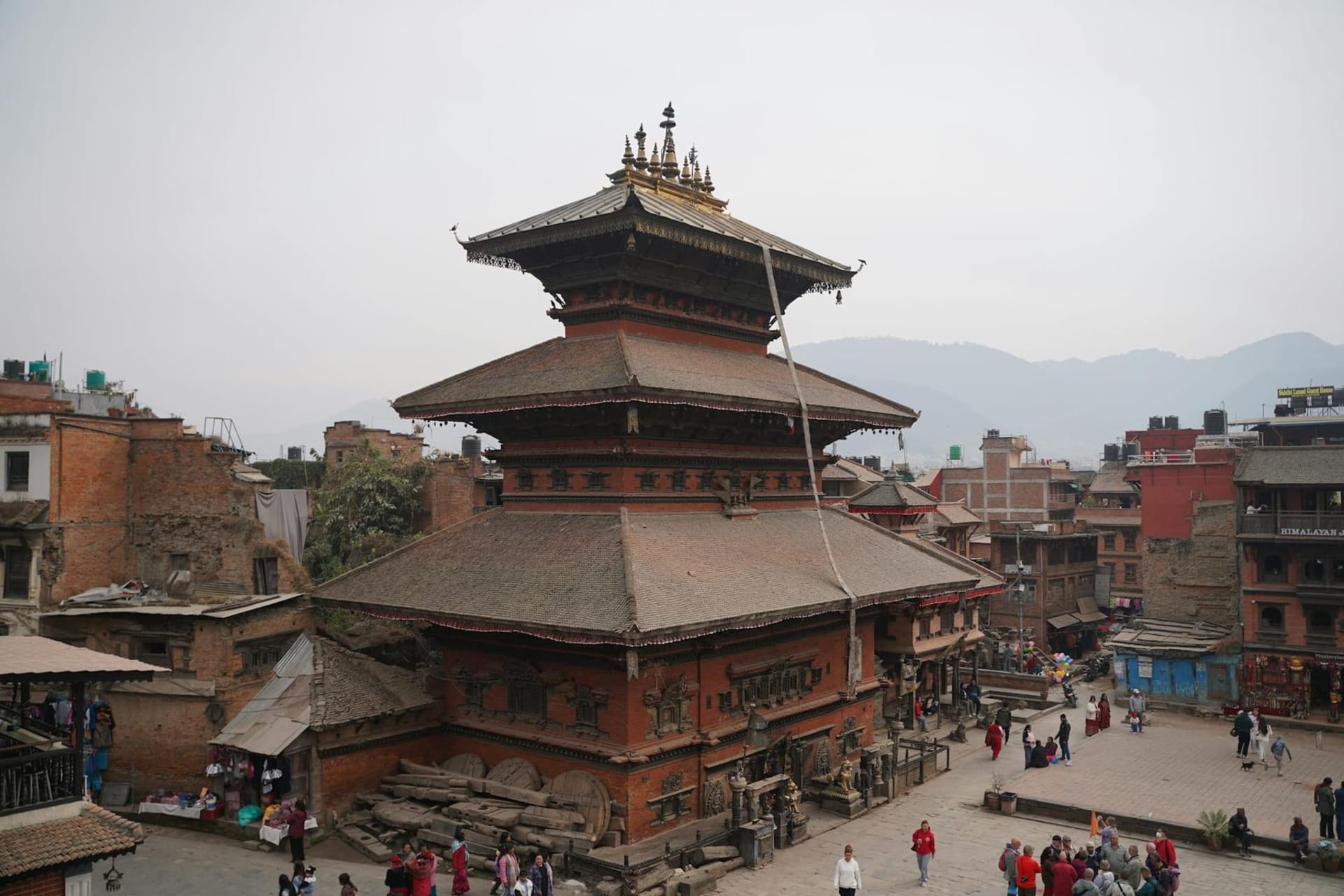
Durbar Square in Patan is smaller than Kathmandu’s, which is precisely why it works. Everything is proportioned for human beings rather than monuments. I stood at the center surrounded by the Krishna Mandir — its three-tiered grey stone rising in a style borrowed from India and made entirely Newari — and the gilded rooftop of the Taleju Bell, and the great brass statue of King Yoganarendra Malla seated on a tall pillar, a cobra hood raised above his head. Lia pointed out that the cobra was facing the Taleju temple, as if the king had simply never stopped watching over it. I had to sit down on the steps and look for a while.
The carved wooden struts on the Vishwanath temple each show erotic scenes — a common apotropaic feature in Newari sacred architecture, believed to ward off the thunder goddess Vajradevi, who was thought to be a modest virgin. I had read this before arriving. What I had not expected was how small and tender the figures were, worn by rain and centuries of fingers.
Into the Courtyard Neighborhoods
Behind the square, Patan becomes a labyrinth of interconnected courtyards called chowks. I turned off Mangal Bazaar Lane and followed the smell of incense and damp stone into Kumbheshwar, a five-tiered temple complex with a sacred pond at its center. Old women circumambulated the water, spinning prayer wheels. A boy ran past us chasing a red ball. The courtyard had the atmosphere of a neighborhood square, because that is exactly what it was.
The real discovery came later, by accident. Looking for a shortcut toward Hiranya Varna Mahavihar — the Golden Temple — I pushed through a low doorway and found a coppersmith at work in a half-dark room, hammering a vessel against a wooden form. The sound rang through the stone. Patan has been a center of bronze and copper craft for over a thousand years, and in that moment the millennium felt concrete, present, tactile.
We ate sel roti at a small stall near the Rato Machhendranath temple — the fried rice-flour rings slightly sweet, slightly chewy — and drank black tea while the afternoon light turned the brick facades the color of old terracotta.
When to go: October through December is ideal — the monsoon has cleared, skies are sharp, and temperatures stay mild enough to walk the chowks for hours. March and April work almost as well, before the heat settles in.