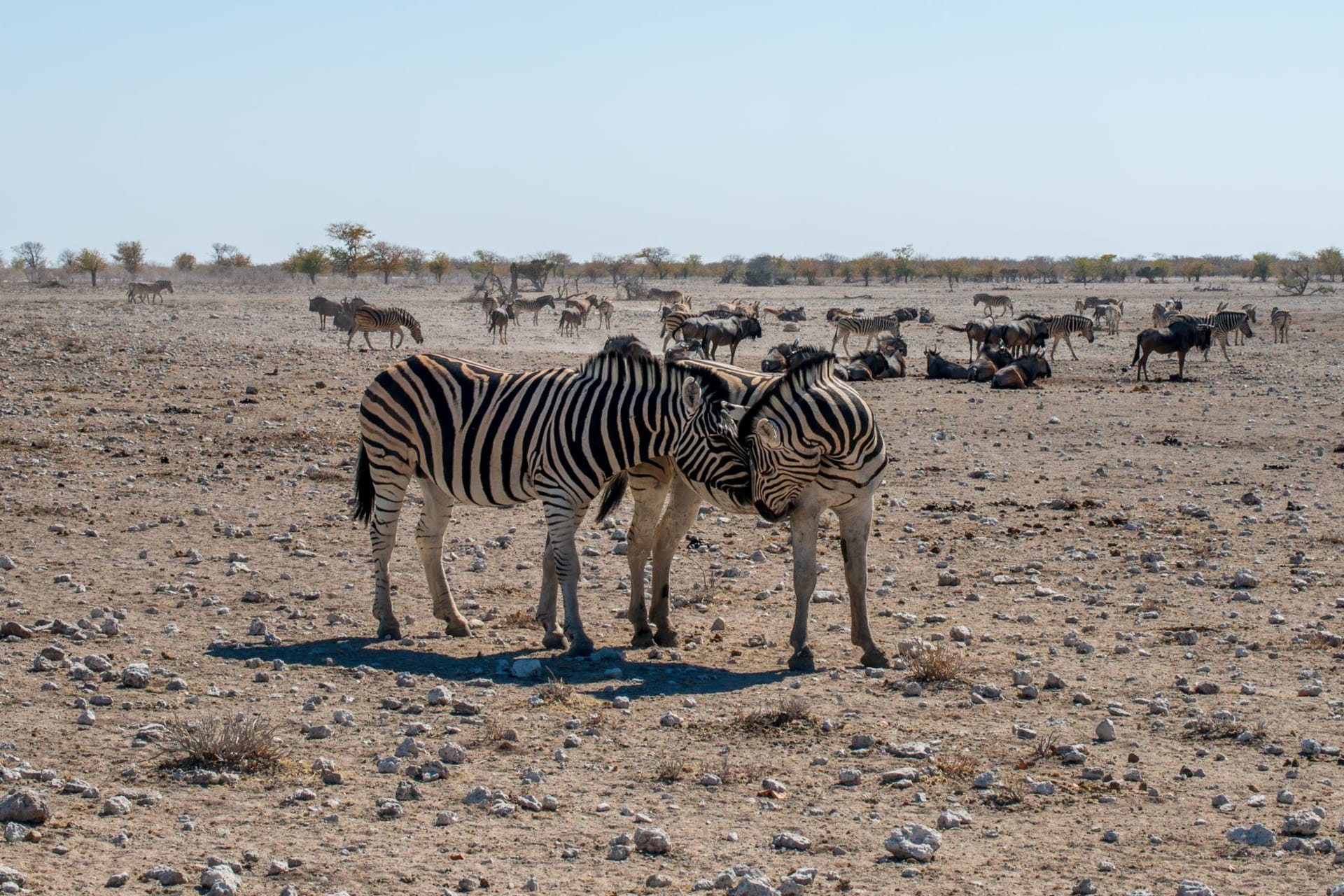
A colossal salt pan visible from space, ringed by waterholes where predators and prey drink side by side.
There is a light in Etosha that does not exist anywhere else I have been. It bounces off five thousand square kilometres of white salt crust and turns the air itself into something luminous and disorienting — a flat, bleached glare that erases shadows and makes distances impossible to read. Lia put on her sunglasses before we had even left the tar road at Andersson Gate and said nothing for a long time. That silence said everything.
The Pan at the Edge of Everything
The salt pan is not beautiful in any conventional sense. It is alien. The surface is cracked into polygons, ghostly white, smelling faintly of mineral brine even from a kilometre away. Nothing grows on it. Nothing moves across it. In the dry season, mirages pool and ripple along its far edge, creating phantom lakes that retreat as you approach. The Owambo people called it the place of dry water. Standing at the rim with the Okerfontein road behind me, I understood why.
What surprised me — genuinely stopped me mid-sentence — was the bone yard. Along the southern edge of the pan, scattered across the crust in no pattern I could identify, lay the bleached remains of animals: a zebra skull here, a rib cage half-submerged there. The pan preserves what falls onto it. Some of those bones are decades old. It is a museum no one curated.
The Waterholes and the Truce
The magic of Etosha is not the pan itself but its perimeter. The park maintains a chain of floodlit waterholes — Okaukuejo, Halali, Namutoni — where the logic of predator and prey suspends itself, briefly, every evening. At Okaukuejo waterhole I watched a male lion drink three metres from a nervous gemsbok. Neither moved toward the other. The gemsbok’s flanks trembled; the lion’s tail swept slowly. They drank, and then they left in opposite directions.
I have read that this happens because the animals understand the waterhole as neutral ground, a biological ceasefire enforced by thirst. Watching it in person, I could not make it feel scientific. It felt like a negotiation. It felt like manners.
Driving the Loop Roads
The C38 and the roads branching north toward Fischer’s Pan reward patience above speed. We drove slowly, windows down, scanning the mopane scrub where the pale trunks dissolve into the same colour as elephant hide. We saw black rhino at dusk near Rietfontein, a shape so still it looked painted onto the grass until it wasn’t. The dust in the evening light turns amber and settles on everything — the dashboard, the back of your hands, the taste at the back of your throat.
When to go: The dry season between May and October concentrates wildlife around the waterholes; late July through September offers the most dramatic sightings. Avoid the rainy months of January and February when the pan floods and roads can close.