
Tangier has always been a city of arrivals and departures, a place perched on the lip of Africa where the Mediterranean narrows to a strait you could almost swim across. Fourteen kilometers of water separate it from Spain, and on a clear day you can see the hills of Tarifa from the terraces of the medina — Europe shimmering like a rumor on the horizon. This proximity to two worlds has shaped Tangier’s character more than any sultan or colonial power. It is a city that belongs fully to neither continent, and that ambiguity has made it irresistible to those who thrive in the spaces between things.
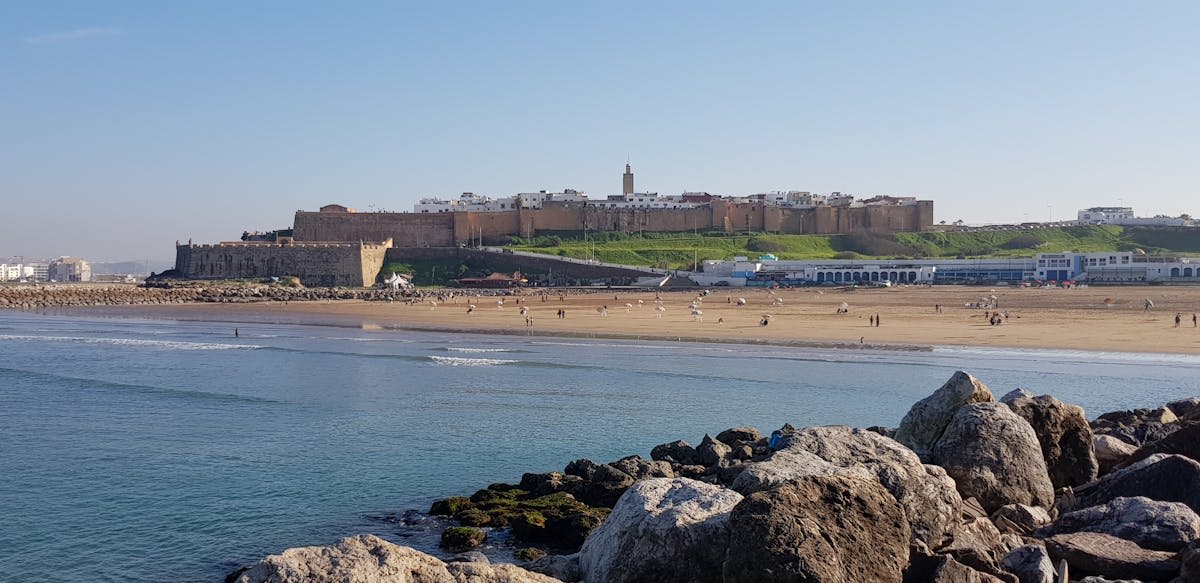
The Kasbah crowns the old city, a fortified quarter of whitewashed walls and heavy cedar doors that opens onto a terrace with one of the most storied views in the Mediterranean. From here you look down over the medina’s cascade of flat roofs to the port below, ferries sliding in and out like shuttles on a loom, and beyond them the strait itself — that narrow band of cobalt where currents collide and civilizations have met, clashed, and traded for three thousand years. The Kasbah Museum, housed in the former sultan’s palace of Dar el Makhzen, holds Roman mosaics, Berber textiles, and illuminated manuscripts, but the building itself — its courtyard garden of jasmine and orange trees, its painted wooden ceilings — is the real exhibit. The surrounding streets are narrow and steep, their walls brushed in blue and white, their corners fragrant with cedar shavings from the carpenter workshops that have operated here for generations.
Tangier’s literary mythology is inseparable from its identity. Paul Bowles arrived in 1947 and never really left, spending over half a century in a small apartment on the Itesa building, translating Moroccan storytellers and receiving pilgrims from the literary world. William Burroughs wrote much of Naked Lunch in a room at the Hotel El Muniria, fueled by substances the International Zone’s relaxed laws made easy to procure. Tennessee Williams, Truman Capote, Jack Kerouac — they all passed through, drawn by the cheap living, the anonymity, and the feeling that Tangier existed outside the normal rules. The city was an International Zone from 1923 to 1956, governed by a committee of foreign powers, and that statelessness attracted smugglers, diplomats, exiles, and artists in roughly equal measure. You can still feel that outlaw energy in the medina’s winding alleys, though today it is more likely to manifest as a gallery opening than a clandestine transaction.
Cafe Hafa is where this history crystallizes into a single experience. Perched on a cliff above the strait, this terraced tea house has been serving mint tea and little else since 1921. The Rolling Stones drank here. Bowles was a regular. The Beatles visited. But the cafe does not trade on its celebrity — there are no photographs on the walls, no signed menus under glass. You sit on a reed mat at a low table, order your tea, and watch the light change over the water. Container ships slide past. The Spanish coast appears and disappears in the haze. Time, that most precious commodity, becomes temporarily abundant.
The new Tangier is as compelling as the old. The waterfront has been transformed by a sweeping promenade and the Grand Theatre de Rabat’s architectural cousin — a performing arts center that signals the city’s cultural ambitions. The Ville Nouvelle is dotted with restaurants and bars that draw a young, cosmopolitan crowd. The port area, once seedy and chaotic, is being reimagined as a cultural district. Yet the renaissance has not erased Tangier’s rougher edges. The Grand Socco still roars with traffic and vendors. The medina still requires navigation by instinct rather than map. The city still keeps its secrets close, revealing them only to those who stay long enough to earn its trust.
Drive west from the city and you reach Cap Spartel, the northwestern tip of Africa, where a lighthouse marks the exact point at which the Mediterranean and the Atlantic collide. Below the cape, the so-called Caves of Hercules open a window in the rock shaped, with startling precision, like the outline of Africa itself. Whether the resemblance is natural or carved by centuries of stone quarrying depends on whom you ask. Tangier has always preferred its mysteries unresolved.
When to go: May to June or September to October for warm, luminous days without the August crowds. Winter brings rain and dramatic Atlantic storms that batter Cap Spartel — beautiful if you like your cities brooding. Spring sees the hillsides above the city carpeted in wildflowers.