
The road to the desert is long, and that is part of the design. From Marrakech, the route climbs over the Atlas Mountains through the Tizi n’Tichka pass, where the air thins and Berber villages cling to slopes terraced with almond and walnut trees. Then the descent begins — into the Draa Valley, where a ribbon of date palms follows a riverbed that may or may not contain water, depending on the year and the mood of the sky. Mud-brick kasbahs appear at intervals, glowing amber in the afternoon light, their crenellated towers casting long shadows across the valley floor. The landscape dries and flattens. The colors simplify from green to ochre to gold. By the time you reach Merzouga, a one-street town that exists solely as a threshold, the world has been reduced to its essential elements: earth, sky, heat, and the promise of sand.
Erg Chebbi delivers on that promise with a generosity that borders on the absurd. The dunes rise to 150 meters — taller than most buildings you have ever entered — and they stretch in undulating waves toward the Algerian border. Their color shifts with the hour: pink at dawn, gold at noon, copper at sunset, silver under a full moon. The crests are razor-edged, sculpted by winds that rearrange the topography nightly, so that the desert you walk into each morning is not quite the desert you left the evening before. There is something humbling about terrain that refuses to hold still.
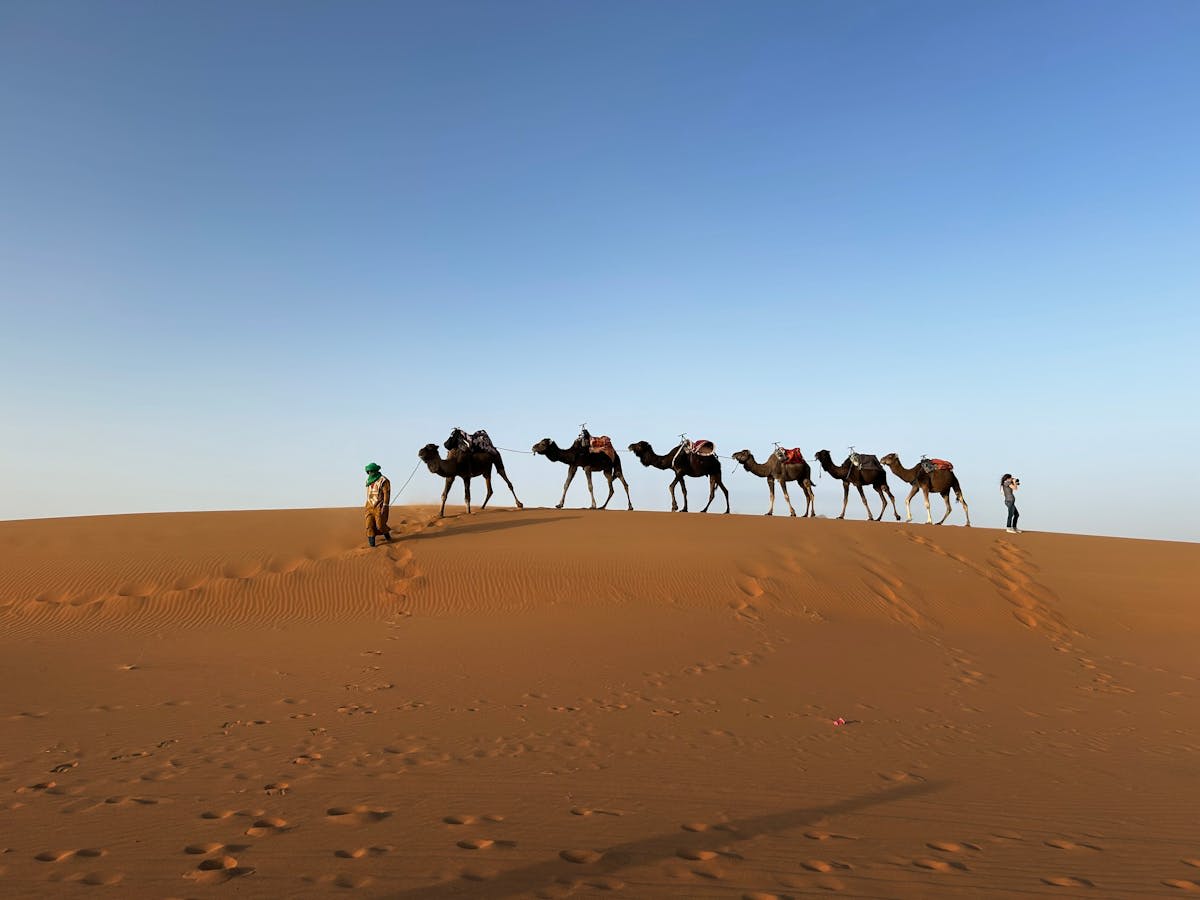
The camel trek into the dunes is the classic approach, and it remains the right one. The dromedaries move at a pace that forces patience — a slow, rocking gait that gives you time to watch your shadow lengthen across the sand, to notice the way the wind lifts grains from the crest of a dune and sends them streaming like smoke, to hear the remarkable silence that falls once the last engine sound fades behind you. The Berber guides who lead these treks grew up in the desert and navigate it the way you navigate your kitchen — by feel, by memory, by a relationship with the landscape so intimate it resembles conversation. They will point out scarab beetle tracks, the burrow of a fennec fox, the place where a sidewinder crossed the dune face during the night.
The desert camps range from simple bivouacs to elaborate tented affairs with carpets and cushions, but even the most luxurious cannot compete with what surrounds them. Dinner is tagine cooked over coals buried in the sand, its lid sealed with dough, the lamb inside falling from the bone after hours of slow heat. Bread is baked in the same buried coals. Mint tea arrives in the inevitable glasses, poured from height with a showmanship that transcends setting. After dinner, the Berber hosts bring out drums — the bendir and the taarija — and begin to play. The rhythms are ancient, rooted in a musical tradition that predates the Arab conquest, and the singing that accompanies them is a call-and-response that invites participation. You will clap along. You will feel slightly foolish. You will not care.
Then the music stops, and the stars arrive. This is the moment the desert has been preparing you for. Without light pollution, without haze, without the visual noise of civilization, the night sky over the Sahara is not a backdrop — it is a presence. The Milky Way arcs overhead in a dense, luminous band that casts actual shadows on the sand. Shooting stars are not events but regular occurrences, streaking across the darkness every few minutes. You lie on your back on a dune and stare upward, and the sheer density of visible light makes the sky feel close, almost low, as though you could reach into it. People describe this experience as spiritual, and for once the word is not an exaggeration.
Sunrise demands an early alarm — four-thirty, five o’clock — and a climb up the nearest high dune in the dark. The sand is cold beneath your bare feet. The ascent is harder than it looks, each step sliding back half its length. But the reward is absolute: the eastern horizon shifts from black to violet to rose to gold, and the dunes emerge from darkness in waves of shadow and light that change by the second. For perhaps ten minutes, the entire landscape is in motion — not the sand itself, but the light upon it, reshaping the desert into something new with every passing moment. Photographers despair. Cameras cannot hold what the eye sees. You stand on the crest of a dune with the cold morning air on your face and the warm sand beginning to glow beneath you, and you understand, with a clarity that does not require thought, why people have always gone to the desert to find something they had lost.
When to go: October to April for bearable daytime temperatures and cold, crystalline desert nights ideal for stargazing. Avoid summer entirely — sand temperatures can exceed 70 degrees Celsius, and the beauty becomes inaccessible behind the wall of heat.