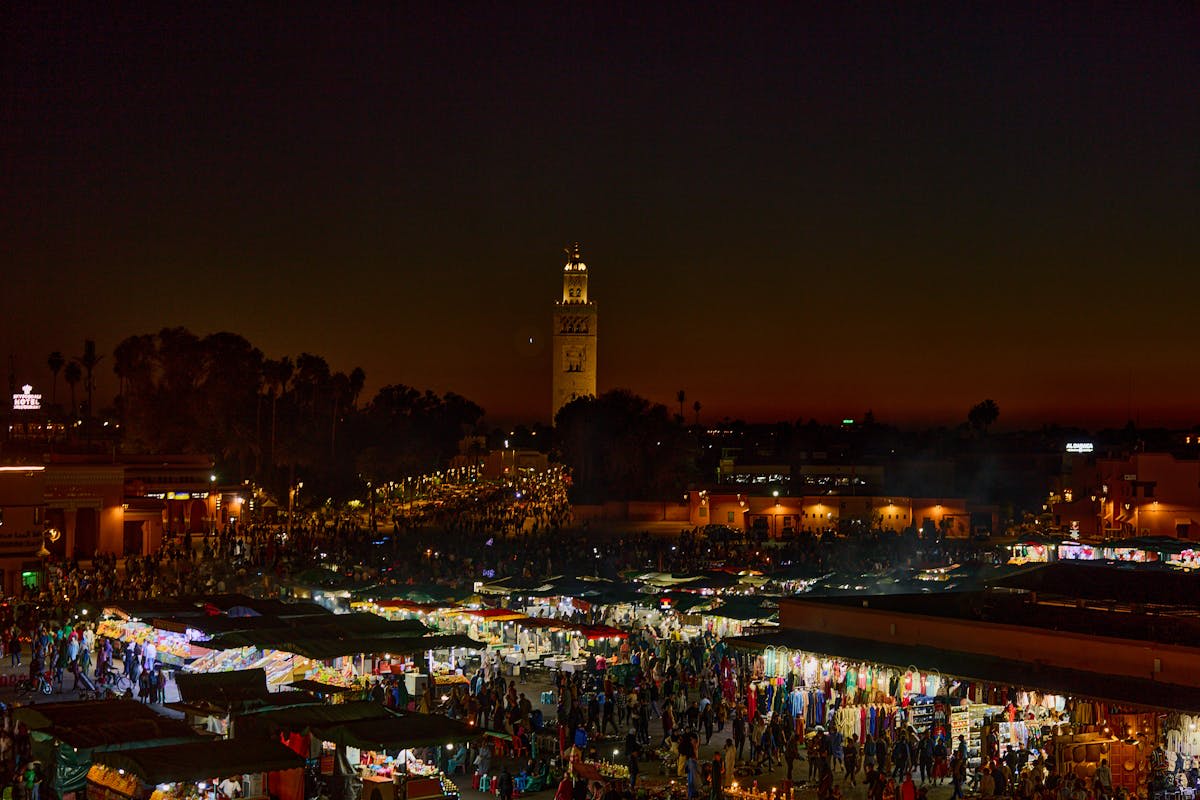
There is a moment each evening, roughly an hour before the sun drops behind the Koutoubia minaret, when Jemaa el-Fna begins its nightly metamorphosis. The daytime hustlers and orange juice vendors yield ground to something older and stranger. Smoke rises from a hundred charcoal grills. Circles form around storytellers whose audiences understand every gesture even when the Darija escapes them. Gnawa musicians strike up their metallic clatter. A man with a Barbary macaque on his shoulder crosses paths with a woman balancing a tray of msemen flatbreads on her head, and neither breaks stride. The square is not a place you visit; it is a place that happens to you, wave after wave, until the lantern light and the smell of grilled lamb and the press of strangers become a single overwhelming thing you will spend years trying to describe and never quite succeed.
Step off the square in any direction and the souks swallow you whole. There is no map that helps here, only instinct and the willingness to be lost. The spice souk hits first — pyramids of turmeric, cumin, ras el hanout, and dried rosebuds stacked with architectural precision, the air so thick with scent it becomes almost tactile. Beyond it, the leather workers hammer and stitch in workshops no wider than a doorway. The metalwork souk rings with the steady percussion of brass being shaped into lanterns, teapots, and trays whose geometric patterns obey mathematical rules the artisans could not name but have inherited through centuries of muscle memory. Somewhere deeper still, the carpet sellers wait with mint tea already poured, knowing that the transaction is also a performance, and that both parties enjoy the theatre.
The Bahia Palace offers a different kind of extravagance — the quiet, calculated kind. Its name means “brilliance,” and every surface justifies it: carved cedar ceilings so intricate they seem to breathe, zellige tilework in patterns that reward long staring, and courtyards planted with jasmine and banana palms that filter the light into something liquid and green. It was built for a grand vizier’s concubines, and it still carries that air of private, scented indulgence.
The Jardin Majorelle is louder in its beauty. The cobalt blue that French painter Jacques Majorelle chose for his studio walls in the 1930s — a blue so vivid it seems to vibrate — has become inseparable from Marrakech itself. Yves Saint Laurent and Pierre Berge saved the garden from developers, and now it thrives as a dense, curated jungle of cacti, bougainvillea, and bamboo groves where the light plays tricks all afternoon. It is one of the few places in the city where silence and color exist in equal measure.
But Marrakech’s deepest pleasure may be its riads — those hidden courtyard houses whose blank exterior walls betray nothing of the tiled fountains, orange trees, and carved plasterwork within. To sleep in a riad is to understand the Moroccan genius for privacy, for the idea that beauty is not something you display to the street but something you guard behind heavy wooden doors. Evenings end on the rooftop terrace, where dinner arrives as a procession of salads, tagine, and pastilla beneath a sky that fades from rose to indigo. Below, the medina murmurs and clanks and calls to prayer. Above, the stars appear one by one over the Atlas. And somewhere between the saffron-scented steam of the tagine and the distant rhythm of drums from Jemaa el-Fna, you understand that Marrakech does not simply occupy your senses — it colonizes them.
A morning in the hammam completes the circuit. The ritual is ancient: steam, black soap, a scrubbing so vigorous it borders on violence, then the sudden relief of warm water poured over clean skin. You emerge feeling not just clean but somehow simplified, as though the city had scrubbed away everything unnecessary and left only the essential you.
When to go: March to May for warm days, blooming gardens, and jasmine-scented evenings. October to November for golden light, thinner crowds in the medina, and cool enough nights to sleep with the riad windows open.