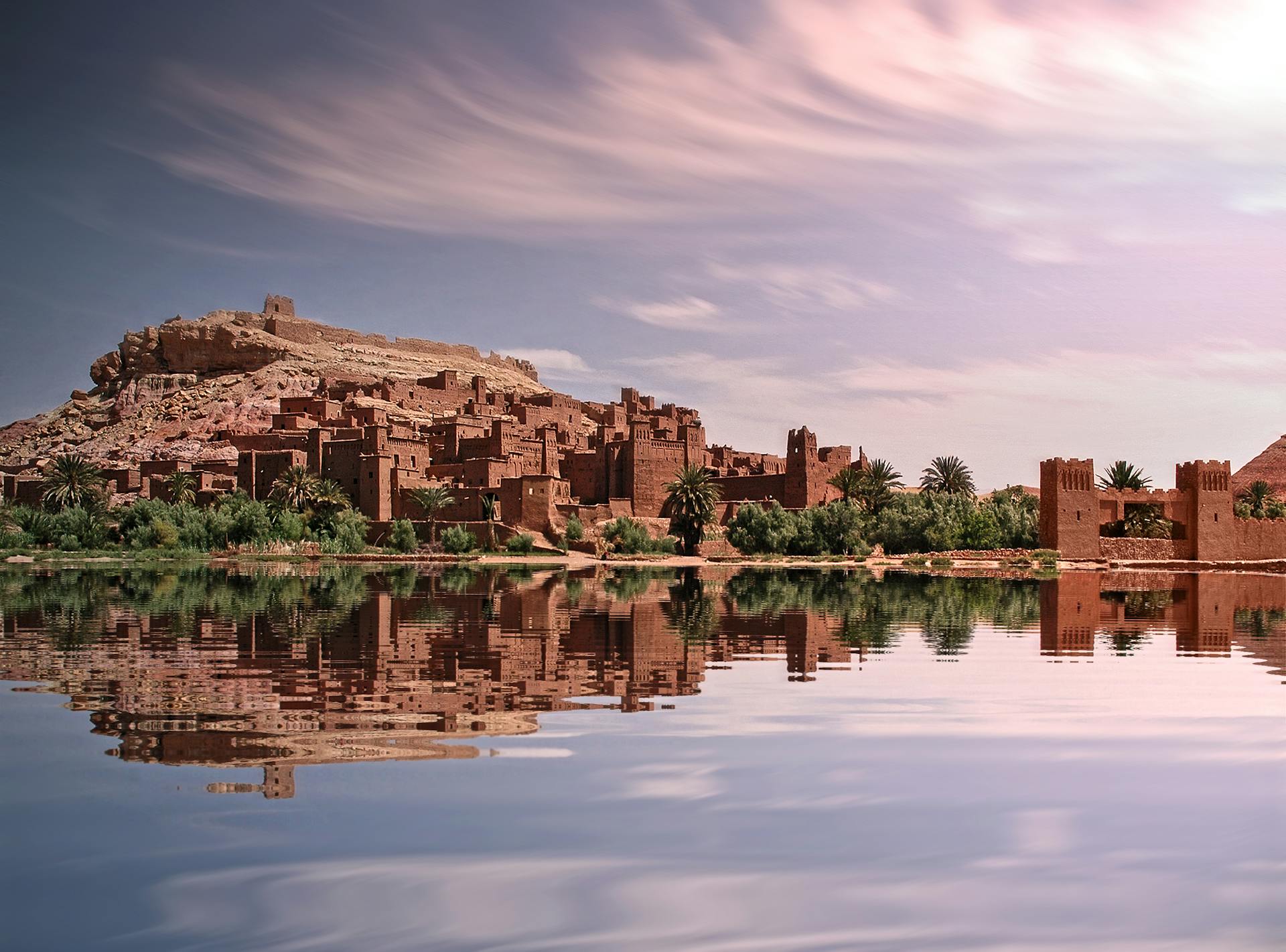
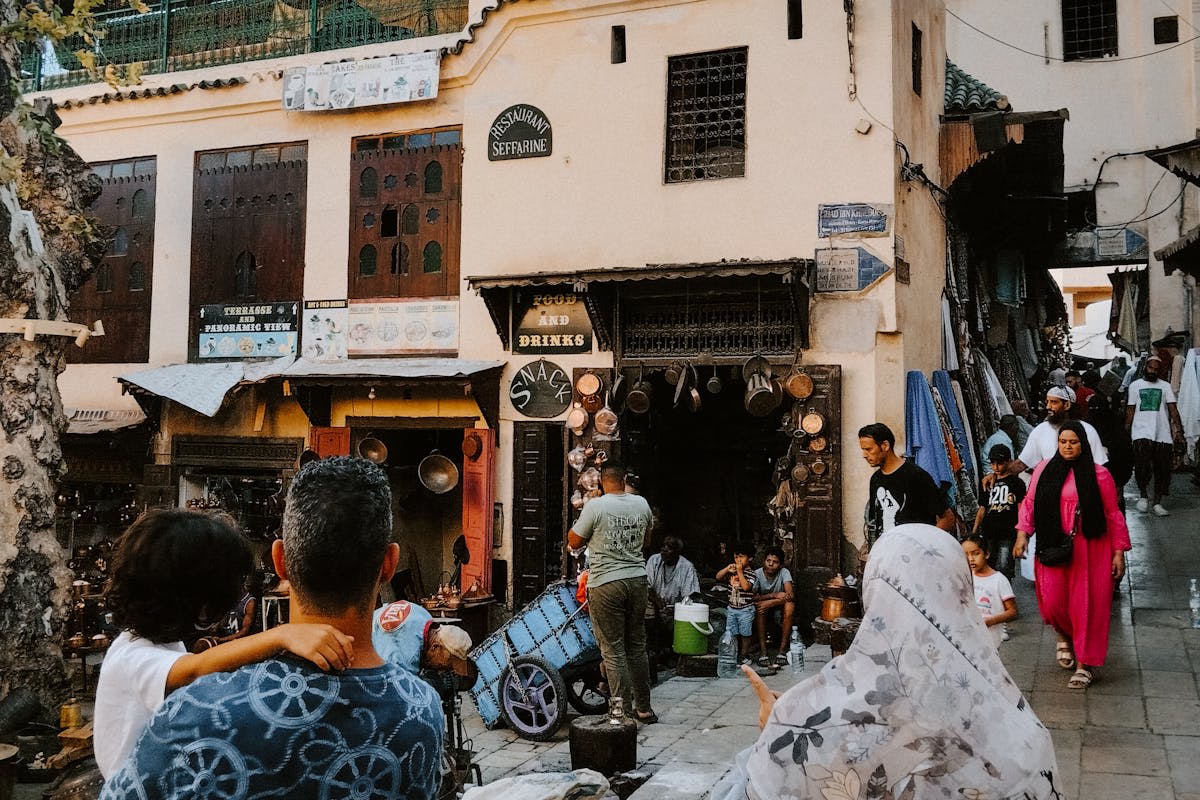
Fes el-Bali is the largest car-free urban zone on earth, and that fact alone changes everything about how you move through it. There are no engines here, no horns, no exhaust — only the sound of footsteps, donkey hooves on stone, the rhythmic clang of a coppersmith’s hammer, and the muezzin’s call threading above it all like smoke. Nine thousand alleys wind through a medina that has been continuously inhabited since the ninth century, and to enter it is to accept, immediately and without negotiation, that you will be lost. The alleys narrow until your shoulders nearly brush both walls. They dead-end without warning. They open, suddenly and implausibly, onto hidden squares with fountains and mosques whose doors you are not permitted to enter. Getting lost is not a failure of navigation. It is the entire point.
The Chouara tannery is the image that defines Fes for the outside world, and it earns its fame. From the terraces of the surrounding leather shops — where a sprig of mint is pressed into your hand to hold beneath your nose — you look down on a honeycomb of stone vats filled with liquid color: white from pigeon droppings used to soften the hides, crimson from poppy, gold from saffron, deep blue from indigo. Men stand waist-deep in the vats, working skins with their hands and feet in a process that has not changed in a thousand years. The smell is magnificent and terrible. The sight is one you will not forget. And the leather goods that emerge from this medieval alchemy — bags, jackets, slippers, belts — are sold in the shops above at prices that seem absurd for the labor involved.
But the tanneries are only one room in a city-sized workshop. Walk deeper and you find the brass-workers’ quarter, where artisans engrave enormous trays with geometric patterns using nothing but a chisel and an inherited sense of symmetry. The weavers sit at wooden looms threading silk and wool into fabrics whose patterns encode Berber symbols older than Islam. The woodworkers carve cedar into screens, doors, and furniture so densely patterned that the wood seems to have been laced rather than cut. Every craft in Fes is a living tradition, not a museum exhibit, and the difference is palpable.
The Bou Inania Madrasa stands as perhaps the finest piece of architecture in all of North Africa. Built in the fourteenth century by a Marinid sultan who reportedly threw the accounting ledgers into a river, declaring that beauty has no price, the building justifies his extravagance completely. The carved stucco reaches a level of intricacy that seems to defy the limits of human hands. The zellige tilework — thousands of hand-cut ceramic pieces assembled into patterns of staggering mathematical precision — covers every lower wall in a mosaic that rewards hours of close looking. The cedar lattice screens filter light into soft geometric pools on the marble floor. It is a building that makes you understand why medieval scholars traveled months to study here.
Fes is also, quietly, one of the great food cities of Morocco. The street food alone — bowls of bissara (split pea soup) for breakfast, grilled kefta wrapped in bread at lunch, honey-drenched chebakia pastries from a shop no wider than a cupboard — could sustain a week of exploration. But the private kitchens are where the city’s culinary genius truly lives: slow-cooked lamb with prunes and almonds, pigeon pastilla dusted with cinnamon and sugar, preserved lemons that taste like concentrated sunlight. To eat in Fes is to understand that Moroccan cuisine was never simple — it was always, from the beginning, an architecture of flavor as intricate as any madrasa wall.
At dusk, climb to the Merenid Tombs on the hill above the medina. The ruins themselves are modest, but the view is one of the great urban panoramas on earth: the entire old city spread below in a dense carpet of white and green, punctuated by minarets and the occasional satellite dish, bounded by olive groves and the Middle Atlas foothills beyond. As the light fades, the call to prayer rises from dozens of mosques simultaneously, each voice slightly different in pitch and timing, creating an accidental polyphony that fills the valley. In that moment, standing among crumbling stone with the ancient city murmuring below, the century you inhabit becomes genuinely and beautifully unclear.
When to go: April to May for mild days and the scent of orange blossom in the medina. September to October for golden light and comfortable temperatures. Avoid midsummer — the airless alleys trap heat like an oven.